Other grades of this product :
| D(+)-Xylose Basic information |
| D(+)-Xylose Chemical Properties |
| Melting point | 154-158 °C(lit.) | | alpha | 20 º (c=10, H2O) | | Boiling point | 191.65°C (rough estimate) | | density | 1.525 | | refractive index | 20 ° (C=10, H2O) | | FEMA | 3606 | D-XYLOSE | | Fp | > 100°(212°F) | | storage temp. | Sealed in dry,Room Temperature | | solubility | H2O: 1 M at 20 °C, clear, colorless | | form | Fine Crystalline Powder | | pka | pKa (18°): 12.14 | | Specific Gravity | 1.535 | | color | White | | PH | 4.0-6.0 (25℃, 1M in H2O) | | Odor | Odorless | | PH Range | 4.5 - 6.0 | | optical activity | [α]20/D +20.0±1°, 10 hr, c = 10% in H2O | | Water Solubility | soluble | | Sensitive | Hygroscopic | | λmax | λ: 260 nm Amax: 0.05λ: 280 nm Amax: 0.05 | | Merck | 14,10087 | | BRN | 1562108 | | Stability: | Stable. Incompatible with strong oxidizing agents. | | CAS DataBase Reference | 58-86-6(CAS DataBase Reference) | | NIST Chemistry Reference | D-Xylose(58-86-6) | | EPA Substance Registry System | D-Xylose (58-86-6) |
| D(+)-Xylose Usage And Synthesis |
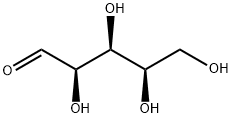
| Chemical Properties | white crystals or powder | | Chemical Properties | D-Xylose is nearly odorless and has a smoky flavor. | | Uses | D-Xylose is used in diagnostic malabsorption tests as well as in the production of Furfural. | | Uses | sweetener, pharmaceutical intermediate | | Uses | An aldopentose monosaccharide. | | Uses | In tanning, dyeing, and as a diabetic food. | | Definition | A SUGAR that has five
carbon atoms in its molecules. | | Definition | pentose: A sugar that has five carbonatoms per molecule. | | Definition | ChEBI: The pyranose form of D-xylose. | | Brand name | Xylo-Pfan (Savage). | | General Description | Xylose is a five-carbon sugar that contributes to lignocellulose in plants. Xylose is predominantly found in hardwoods and agricultural residues. | | Biochem/physiol Actions | Estimation of xylose in the urine after oral administration, is useful in diagnosing absorption of carbohydrates and malabsorption of non-pancreatic molecules. Xylose plays a significant role in the biologically conversion of plant biomass to fuels and chemicals. | | Purification Methods | -D(+)-Xylose forms needles or prisms (which have a very sweet taste) by slow crystallisation from aqueous 80% EtOH or absolute EtOH, which are then dried at 60o in vacuo over P2O5. Store it in a vacuum desiccator over CaSO4. 1Gram dissolves in 0.8mL H2O. [Bragg & Hough J Chem Soc 4347 1957, Hudson & Yanovsky J Am Chem Soc 39 1029 1917, Monroe J Am Chem Soc 41 1002 1919, Beilstein 1 IV 4223.] In D2O at 31o, 1H NMR showed the following ratios: -pyranose (36.5), -pyranose (63), -furanose + -furanose (~1) [Angyal Adv Carbohydr Chem 42 15 1984, Angyal & Pickles Aust J Chem 25 1711 1972]. |
| D(+)-Xylose Preparation Products And Raw materials |
|


 日本语
日本语 한국어
한국어 Français
 Deutsch
 España
 Türkiye