Other grades of this product :
| Phenylacetaldehyde Chemical Properties |
| Melting point | −10 °C(lit.) | | Boiling point | 195 °C | | density | 1.079 g/mL at 20 °C | | vapor pressure | 2.09hPa at 20℃ | | FEMA | 2874 | PHENYLACETALDEHYDE | | refractive index | n20/D 1.535(lit.) | | Fp | 188 °F | | storage temp. | 2-8°C | | solubility | 2.21g/l slightly soluble | | form | Liquid | | Specific Gravity | 1.075 (20/4℃) | | color | Clear colorless to pale yellow | | Water Solubility | 2.210 g/L (25 ºC) | | Sensitive | Air Sensitive | | Merck | 14,7265 | | JECFA Number | 1002 | | BRN | 385791 | | Stability: | Stable. Combustible. Incompatible with strong oxidizing agents, strong bases. | | LogP | 1.44 at 25℃ | | CAS DataBase Reference | 122-78-1(CAS DataBase Reference) | | NIST Chemistry Reference | Benzeneacetaldehyde(122-78-1) | | EPA Substance Registry System | Phenylacetaldehyde (122-78-1) |
| Hazard Codes | Xn,F | | Risk Statements | 22-36/37/38-43-11 | | Safety Statements | 26-36-37-24-16-7 | | RIDADR | UN 1170 3/PG 2 | | WGK Germany | 2 | | RTECS | CY1420000 | | TSCA | Yes | | HS Code | 29122990 | | Toxicity | LD50 orl-rat: 1550 mg/kg FCTXAV 17,377,79 |
| Phenylacetaldehyde Usage And Synthesis |
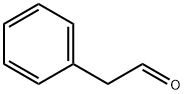
| Description | Phenylacetaldehyde is an organic compound which can be naturally found in buckwheat, flowers, and communication pheromones from various insect orders. It is commonly used for the preparation of fragrance as well as flavors, and applied in flavored cigarettes and beverages because of its honey-like sweet character. It is also applied in the synthesis of polymers, such as polyesters, as a rate controlling additive in polymerization reactions and used in the preparation of more complex chemicals like resmethrin, where it acts as a building block. Besides, the naturally sweet odor of phenylacetaldehyde makes it an insect attractant, which is effective to ensnare pests in blacklight trap. Its application also involves in the field of medicine, in which it is responsible for the antibiotic activity of maggot therapy.
| | Chemical Properties | Phenylacetaldehyde has been identified in many essential oils and as a volatile constituent of foods. It is a colorless liquid with a sweet, green odor, reminiscent of hyacinth. Since it readily undergoes oxidation and polymerizes, it must be stabilized by addition of antioxidants and by dilution with, for example, diethyl phthalate before use in compositions.
| | Uses | Phenylacetaldehyde is used in perfume compositions, in particular for hyacinth and rose notes.
Phenylacetaldehyde was used in a study to analyse the role of plant derived volatile chemicals on foraging of 1st instar Helicoverpa armigera.
Phenylacetaldehyde is an insect attractant and can be used in blacklight trap for pests.
| | Preparation | Phenylacetaldehyde can be obtained in high yield by vapor-phase isomerization of styrene oxide, for example, with alkali-treated silica–alumina. Another process starts from phenylethane-l,2-diol, which can be converted into phenylacetaldehyde in high yield. The reaction is performed in the vapor phase in the presence of an acidic silica–alumina catalyst. | | References | https://en.wikipedia.org/wiki/Phenylacetaldehyde
https://www.alfa.com/zh-cn/catalog/A14263/
http://www.sigmaaldrich.com/catalog/product/aldrich/107395?lang=en®ion=US
| | Chemical Properties | Phenylacetaldehyde has a harsh, green odor reminiscent of hyacinth on dilution. It has an unpleasant, pungent, bitter
flavor, turning sweet and fruit-like at low levels. | | Occurrence | Identified among the constituents of several essential oils: neroli, Citrus sinensis leaves, other citrus species
(flowers and leaves), narcissus, magnolia, lily, rose and tea. It is reported found in over 170 natural products including apricot,
sour cherry, cooked apple, peach, fresh blackberry, crispbread, other types of bread, green tea, unprocessed rice, lemon balm, red
sage, black currant, bilberry, cranberry, other berries, grapes, raisins, melon, papaya, guava fruit, pineapple, asparagus, celery
leaves, carrot, parsley, peas, bell pepper, sweet pepper, peach, cabbage, peppermint oil, Scotch spearmint oil, mustard, vinegar,
onion, cooked potato, tomato, cinnamon bark, cassia leaf, ginger, many cheeses, milk, yogurt, boiled egg, cooked and cured
meats, beer, cognac, grape wines, cocoa, coffee, tea, roasted filbert, roasted peanut, soybean, pecans, cauliflower, broccoli, honey,
avocado, passion fruit, beans, mushrooms, trassi, mango, tamarind, rice, licorice, buckwheat, lovage root, pumpkin, sweet potato,
cassava, corn oil, malt, wort, dried bonito, loquat, pawpaw, maté, sweet grass oil, orange peel oil, grapefruit juice, endive, clam
and Chinese quince. | | Uses | In perfumery; intermediate in organic synthesis. | | Uses | Phenylacetaldehyde is used for the preparation of fragrances and polymers like polyesters, which find application as a rate controlling additive in polymerization reactions. It is an active component of fragrances and floral scent due to its honey-like sweet character and finds application in flavored cigarettes and beverages. It is an insect attractant and utilized in blacklight trap for pests. It is also used as a building block in the synthesis of more complex chemicals, such as resmethrin. Furthermore, it is used in association with acetic anhydride and allyltrimethylsilane in three-component coupling process catalyzed by LiBF4 providing homoallylic acetates. | | Definition | ChEBI: An aldehyde that consists of acetaldehyde bearing a methyl substituent; the parent member of the phenylacetaldehyde class of compounds. | | Aroma threshold values | Detection: 4 ppb. Aroma characteristics at 1.0%: sweet, floral honey, rosy and slightly powdery with a
fermented note, cocoa and tobacco with a yellow tropical fruity nuance. | | Taste threshold values | Taste characteristics at 5 ppm: floral and honey-like with a sweet floral, fruity, tobacco, with a yellow tropical
fruity waxy nuance. | | Synthesis Reference(s) | Journal of the American Chemical Society, 99, p. 4536, 1977 DOI: 10.1021/ja00455a071Tetrahedron Letters, 29, p. 1471, 1988 DOI: 10.1016/S0040-4039(00)80328-7 | | General Description | Phenylacetaldehyde is an important aroma volatile found in tomato and roses. It has also been identified in potato, roasted cocoa beans and honey. Phenylacetaldehyde is also a potent moth attractant. | | Flammability and Explosibility | Notclassified | | Biochem/physiol Actions | Phenylacetaldehyde is an insect attractant and can be used in blacklight trap for pests. It is constituent of floral scent. It is an intermediate in a variety of biochemical pathways. | | Safety Profile | Moderately toxic by
ingestion. Human skin irritant. Combustible
liquid. When heated to decomposition it
emits acrid smoke and irritating fumes. See
also ALDEHYDES. | | Synthesis | By Darzen glycidic ester synthesis from benzaldehyde; readily oxidizable to phenyl acetic acid. |
| Phenylacetaldehyde Preparation Products And Raw materials |
|


 日本语
日本语 한국어
한국어 Français
 Deutsch
 España
 Türkiye