Other grades of this product :
| 2-Hydroxyethyl acrylate Basic information |
| 2-Hydroxyethyl acrylate Chemical Properties |
| Melting point | -60 °C | | Boiling point | 90-92 °C12 mm Hg(lit.) | | density | 1.106 g/mL at 20 °C | | vapor density | >1 (vs air) | | vapor pressure | <0.1 mm Hg ( 20 °C) | | refractive index | n20/D 1.45(lit.) | | Fp | 209 °F | | storage temp. | 2-8°C | | form | Oily Liquid | | pka | 13.85±0.10(Predicted) | | color | Yellow to brown | | Water Solubility | soluble | | Sensitive | Light Sensitive | | BRN | 969853 | | Exposure limits | ACGIH: TWA 5 mg/m3NIOSH: TWA 5 mg/m3 | | InChIKey | OMIGHNLMNHATMP-UHFFFAOYSA-N | | LogP | -0.17 at 25℃ | | CAS DataBase Reference | 818-61-1(CAS DataBase Reference) | | NIST Chemistry Reference | 2-Propenoic acid, 2-hydroxyethyl ester(818-61-1) | | EPA Substance Registry System | 2-Hydroxyethyl acrylate (818-61-1) |
| 2-Hydroxyethyl acrylate Usage And Synthesis |
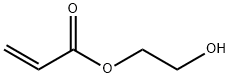
| Description | 2-Hydroxyethyl acrylate (HEA) forms homopolymers and copolymers. HEA is used mainly either as a co-monomer in the manufacture of polymers or as a chemical reactant in the manufacture of chemical intermediates. In the manufacture of polymers, HEA can be co-polymerized with acrylic acid, acrylates, methacrylates, vinyl acetate, vinyl chloride, vinylidene chloride, styrene, butadiene, and the like. Co-reactants with HEA include aromatic and aliphatic isocyanates, anhydrides, and epoxides. The polymers and chemical intermediates made with HEA find applications in automotive top coatings, architectural coatings, photocure resins, and adhesives. Globally about half of the HEA produced is used in the production of acrylic enamels for the automotive industry, where a clear topcoat is applied to a pigmented base coat to increase corrosion protection and durability. | | Chemical Properties | Hydroxyethyl acrylate is a clear colorless liquid. miscible with water, soluble in general organic solvents. The commodity generally contains 400ppm of hydroquinone methylether, a polymerization inhibitor. Hydroxyethyl acrylate is a difunctional acrylate monomer with the characteristic high reactivity. Hydroxyethyl acrylate is used in a crylics for coatings, adhesives and UV reacitve oligomers. It can be used for crosslinking with isocyantes or melamines. | | Uses | As a reactive monomer 2-Hydroxyethyl acrylate is used as a crosslinking agent for resins, plastics and rubber modifiers. Further, it is used in the synthesis of amphilic block copolymers by nitroxide mediated living radical polymerization. In addition to this, it is used to prepare tuned poly(hydroxyethyl acrylate) by atom transfer radical polymerization. | | Uses | 2-Hydroxyethyl acrylate is an acrylic monomer for use in UV inks, adhesives, lacquers, artificial nails, etc. | | Definition | ChEBI: 2-Hydroxyethyl acrylate is a functional monomer for the manufacture of thermosetting acrylic resins. | | General Description | A clear colorless liquid. Less dense than water. Vapors heavier than air. Corrosive to tissue. Flash point 120°F. May polymerize exothermically if heated or contaminated. If the polymerization takes place inside a container, the container may rupture violently. Used to make plastics. | | Air & Water Reactions | Flammable. Slightly soluble in water. | | Reactivity Profile | A functional monomer of thermosetting acrylic resins. | | Health Hazard | Inhalation causes irritation of nose and throat. Contact with liquid irritates eyes and skin. | | Fire Hazard | Behavior in Fire: Containers may explode | | Flammability and Explosibility | Nonflammable | | Potential Exposure | 2-Hydroxyethyl acrylate is contained in Lowicryl 4KM and K11M resins. It caused contact dermatitis in workers embedding media for electron microscopy. It may also be contained in ultraviolet-curable nail gel used for photobonded sculptured nails. |
| 2-Hydroxyethyl acrylate Preparation Products And Raw materials |
|


 日本语
日本语 한국어
한국어 Français
 Deutsch
 España
 Türkiye