Other grades of this product :
| Tocofersolan Basic information |
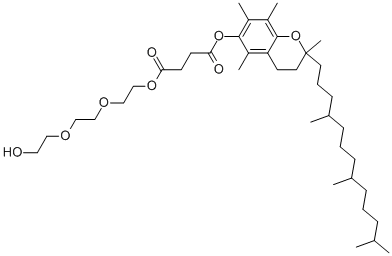
| Product Name: | Tocofersolan | | Synonyms: | DL-A-TOCOPHEROL POLYETHYLENE GLYCOL SUCCINATE;DL-ALPHA-TOCOPHEROL POLYETHYLENE GLYCOL SUCCINATE;d-alpha-tocopheryl polyethylene glycol succinate;alpha-(4-((3,4-dihydro-2,5,7,8-tetramethyl-2-(4,8,12-trimethyltridecyl)-2h-1-benzopyran-6-yl)oxy)-1,4-dioxobutanol poly(ethylene glycol) succinate;tocofersolan;tocopherosolan;2-ethanediyl),.alpha.-[4-[[3,4-dihydro-2,5,7,8-tetramethyl-2-(4,8,12-trimethyltridecyl)-2H-1-benzoPoly(oxy-1;poly(oxy-1,2-ethanediyl),alpha-(4-((3,4-dihydro-2,5,7,8-tetramethyl-2-(4,8,12 | | CAS: | 9002-96-4 | | MF: | (C2H4O)nC33H54O5 | | MW: | 0 | | EINECS: | | Product Categories: | Other APIs;Heterocycles;Intermediates & Fine Chemicals;Pharmaceuticals | | Mol File: | 9002-96-4.mol |
| Tocofersolan Chemical Properties |
| Melting point | 34-38°C | | storage temp. | 2-8°C | | solubility | H2O: soluble1g/10 mL, clear to faintly turbid, colorless to faintly yellow | | form | Solid | | color | White to Pale Yellow Waxy |
| WGK Germany | 2 | | RTECS | TR1581200 |
| Tocofersolan Usage And Synthesis |
| Chemical Properties | Vitamin E polyethylene glycol succinate is a synthetic product. It is
available as a white to light-brown, waxy solid and is practically
tasteless. Chemically, it is a mixture composed principally of
monoesterified polyethylene glycol 1000, the diesterified polyethylene
glycol 1000, free polyethylene glycol 1000, and free tocopherol. | | Uses | Tocofersolan is a polyethylene glycol derivative of α-Tocopherol (T526125). Tocofersolan is a synthetic water-soluble vitamin E unlike its natural counterpart which are fat soluble. Tocofersolan is used in pediatrics in the treatment vitamin E-deficient cholestatic children. Tocofersolan has potential application as a absorption enhancer in drug delivery systems. | | Uses | tocophersolan is an anti-oxidant, this is a water-soluble form of vitamin e. | | Uses | Tocofersolan is a polyethylene glycol derivative of α-Tocopherol (T526125). Tocofersolan is a synthetic water-soluble vitamin E unlike its natural counterpart which are fat soluble. Tocofersolan is used in pediatrics in the treatment vitamin E-deficient cholestatic children. Tocofersolan has potential application as a absorption enhancer in drug delivery systems. Typical batch, n = 21 | | Production Methods | Vitamin E polyethylene glycol succinate is prepared by esterification
of the acid group of crystalline D-a-tocopheryl acid succinate by
polyethylene glycol 1000. | | Pharmaceutical Applications | Vitamin E polyethylene glycol succinate is an esterified vitamin E
(tocopherol) derivative primarily used as a solubilizer or emulsifying
agent because of its surfactant properties. Structurally, it is
amphipathic and hydrophilic, unlike the tocopherols, and therefore
it is a water-soluble derivative that can be used in pharmaceutical
formulations such as capsules, tablets, hot-melt extrusion,
microemulsions, topical products, and parenterals. One of
the most important applications is its use as a vehicle for lipid-based
drug delivery formulations. It can also be used as a source of
vitamin E.
Vitamin E polyethylene glycol succinate has been characterized
with respect to its mechanism of action and studied as a Pglycoprotein
inhibitor. | | Biochem/physiol Actions | D-α-Tocopherol polyethylene glycol 1000 succinate (TPGS) also known as vitamin E TPGS, is a therapeutic agent for vitamin E deficiency in children, administered during chronic childhood cholestasis. TPGS exerts anti-tumor activity in MCF-7 and breast cancer cells by downregulating anti-apoptotic proteins. TPGS finds its application as an emulsifier in the preparation of poly(lactic-co-glycolic acid) (PLGA) particles for DNA labelling, produces particles of uniform size, high encapsulation efficiency, increases hydrophilicity and prevents aggregation of particles. | | Safety | Vitamin E polyethylene glycol succinate has been used at levels of
280 mg/capsule in the product Agenerase (amprenavir), which was dosed at 8 capsules (2240mg vitamin E TPGS) per day. An
additional assessment of the safety of vitamin E polyethylene glycol
succinate has been published, which includes a report showing
no-observed-adverse-effect-level (NOAEL) in rats of
1000 mg/kg/day. | | storage | Vitamin E polyethylene glycol succinate is stable at ambient room
temperature for up to 4 years. It reacts with alkalis and acids.
Aqueous solutions of vitamin E polyethylene glycol succinate are
stable over a pH range of 4.5–7.5 and can be further stabilized with
propylene glycol. | | Incompatibilities | Vitamin E polyethylene glycol succinate is incompatible with strong
acids and strong alkalis. | | Regulatory Status | GRAS listed. Included in the FDA Inactive Ingredients Database
(ophthalmic solution or drops; oral capsules, solution, tablet;
topical solution or drops). Included in the Canadian List of
Acceptable Non-medicinal Ingredients. |
| Tocofersolan Preparation Products And Raw materials |
|


 日本语
日本语 한국어
한국어 Français
 Deutsch
 España
 Türkiye