Other grades of this product :
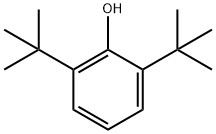
| 2,6-Di-tert-butylphenol Basic information |
| 2,6-Di-tert-butylphenol Chemical Properties |
| Melting point | 34-37 °C(lit.) | | Boiling point | 253 °C(lit.) | | density | 0.91 | | vapor pressure | <0.01 mm Hg ( 20 °C) | | refractive index | 1.5312 | | Fp | 245 °F | | storage temp. | Sealed in dry,2-8°C | | solubility | 0.003g/l | | form | Crystalline Solid | | pka | 12.16±0.40(Predicted) | | color | White to light yellow | | Water Solubility | insoluble | | FreezingPoint | 35.0 to 37.0 ℃ | | BRN | 1841887 | | Stability: | Stable. Incompatible with acid chlorides, acid anhydrides, bases, brass, copper, copper alloys, oxidizing agents. | | LogP | 4.5 at 24℃ | | CAS DataBase Reference | 128-39-2(CAS DataBase Reference) | | NIST Chemistry Reference | Phenol, 2,6-bis(1,1-dimethylethyl)-(128-39-2) | | EPA Substance Registry System | 2,6-Di-tert-butylphenol (128-39-2) |
| 2,6-Di-tert-butylphenol Usage And Synthesis |
| Chemical Properties | white solid | | Uses | Antioxidant for Gasoline, Jet Fuels, and Electrical Insulating Oils | | Uses | Antioxidant Intermediate, Pharmaceuticals | | Uses | Widely used as antioxidant in fuels, lubricants and polymers. Employed as a synthetic intermediate for the production of higher molecular weight phenolic antioxidants. Used as an oxidation inhibitor and stabilizer (e.g. for fuel, oil and gasoline) and also used in plastics and rubber. Also applied as an intermediate and an antioxidant in aviation gasoline. | | General Description | Odorless colorless to light yellow solid or liquid. Floats on water. Freezing point is 97°F. | | Air & Water Reactions | Insoluble in water. | | Reactivity Profile | Phenols, such as 2,6-Di-tert-butylphenol, do not behave as organic alcohols, as one might guess from the presence of a hydroxyl (-OH) group in their structure. Instead, they react as weak organic acids. Phenols and cresols are much weaker as acids than common carboxylic acids (phenol has Ka = 1.3 x 10^[-10]). These materials are incompatible with strong reducing substances such as hydrides, nitrides, alkali metals, and sulfides. Flammable gas (H2) is often generated, and the heat of the reaction may ignite the gas. Heat is also generated by the acid-base reaction between phenols and bases. Such heating may initiate polymerization of the organic compound. Phenols are sulfonated very readily (for example, by concentrated sulfuric acid at room temperature). The reactions generate heat. Phenols are also nitrated very rapidly, even by dilute nitric acid. | | Health Hazard | Irritates eyes and (on prolonged contact) skin. Ingestion causes irritation of mouth and stomach. | | Flammability and Explosibility | Nonflammable | | Purification Methods | Crystallise the phenol from aqueous EtOH or n-hexane. [Beilstein 6 III 2061.] |
| 2,6-Di-tert-butylphenol Preparation Products And Raw materials |
| Raw materials | Phenol-->Isobutylene-->Benzene, 1,3-bis(1,1-dimethylethyl)-2-methoxy--->Benzoic acid, 2,6-bis(1,1-dimethylethyl)--->1,3,5-Triazine, 2-phenyl-4,6-bis(trichloromethyl)--->3,5-Di-tert-butyl-4-hydroxybenzyl alcohol-->Phenol, 2,6-bis(1,1-dimethylethyl)-4-[[[4-pentyl-6-(trichloromethyl)-1,3,5-triazin-2-yl]oxy]methyl]--->1,3-DI-TERT-BUTYLBENZENE-->CARBON DIOXIDE | | Preparation Products | Antioxidant 1010-->Antioxidant 1076-->Antioxidant3114-->Diethyl 3,5-di-tert-butyl-4-hydroxybenzyl phosphate-->Probucol-->4,4'-Methylenebis(2,6-di-tert-butylphenol)-->3,5-di-tert-butyl-4-hydroxybenzyl acetate-->4,4'-Ethylenebis(2,6-ditert-butylphenol) |
|


 日本语
日本语 한국어
한국어 Français
 Deutsch
 España
 Türkiye