Other grades of this product :
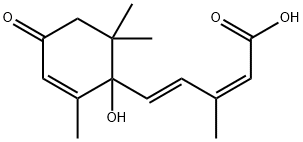
| Product Name: | Abscisic acid | | Synonyms: | Abscisic Acid (synthetic);ABSCISIC ACID extrapure;(±)-Abscisic acid, ABA, Dormin, (2Z,4E)-5-(1-Hydroxy-2,6,6-trimethyl-4-oxo-2-cyclohexen-1-yl)-3-methyl-2,4-pentadienoic acid;ABA, Dormin, (2Z,4E)-5-(1-Hydroxy-2,6,6-trimethyl-4-oxo-2-cyclohexen-1-yl)-3-methyl-2,4-pentadienoic acid;(±)-cis,trans-ABA;(±)-cis-2,trans-4-Abscisic acid;DL-Abscisic acid;(±)-cis,trans-ABSCISIC ACID (ABA) | | CAS: | 14375-45-2 | | MF: | C15H20O4 | | MW: | 264.32 | | EINECS: | | Product Categories: | Inhibitors;Pesticide intermediates;Biochemistry;Plant Growth Regulators;Plant Growth Trgulators (Others);Terpenes;Sesqui-Terpenoids;Terpenes (Others) | | Mol File: | 14375-45-2.mol |
| Abscisic acid Chemical Properties |
| Melting point | 186-188 °C (lit.) | | Boiling point | 458.7±45.0 °C(Predicted) | | density | 1.193±0.06 g/cm3(Predicted) | | Fp | 120°C | | storage temp. | 2-8°C | | solubility | methanol: 50 mg/mL, may be clear to slightly hazy | | pka | 4.87±0.33(Predicted) | | Sensitive | Light Sensitive | | Sublimation | 120 ºC | | Merck | 14,11 | | BRN | 4142666 | | CAS DataBase Reference | 14375-45-2(CAS DataBase Reference) |
| Safety Statements | 24/25 | | WGK Germany | 3 | | F | 8-10 | | HS Code | 29189900 |
| Abscisic acid Usage And Synthesis |
| Description | Abscisic Acid (ABA) is a phytohormone, a naturally occurring compound in plant. ABA is regarded as an inhibitor of plant growth and therefore usually used as a growth retardant in plant tissue culture. To date, ABA has been primarily used to promote the maturation of somatic embryos and the synthesis of storage reserves in embryos during maturation. ABA also acts as a controlling factor of germination and dormancy in somatic embryos and is generally used to induce somatic embryos into a quiescent state during plant tissue culture and synthetic seed studies. ABA stimulates the stomatal closure, thereby reducing transpirational water loss. Thus, it could be used as an anti-transpiration during the acclimatization of tissue culture-raised plants.
| | References | [1] Shintaro Munemasa, Felix Hauser, Jiyoung Park, Rainer Waadt, Benjamin Brandt, Julian I Schroeder (2015) Mechanisms of abscisic acid-mediated control of stomatal aperture, 28, 154-162
[2] Manoj K. Rai, N. S. Shekhawat, Harish, Amit K. Gupta, M. Phulwaria, Kheta Ram, U. Jaiswal (2011) The role of abscisic acid in plant tissue culture: a review of recent progress, 106, 179-190
[3] https://pages.wustl.edu/ipgsa/abscisic-acid
| | Chemical Properties | white to light yellow crystalline powder | | Uses | abscission-accelerant; kinetin neucleotide synthesis inhibitor | | Uses | Abscisic acid (ABA) is an isoprenoid plant hormone (phytohormone) synthesized in all parts of plants and involved in many plant developmental processes. ABA is involved in establishing dormancy and regulation of stress responses. ABA inhibits fruit ripening, seed germination, photosynthesis and kinetin biosynthesis. | | Agricultural Uses | The name abscisic acid (ABA), a weak organic acid, is
derived from the ability of a substance to promote
abscission. Abscission is the natural detachment of
leaves, branches, flowers, etc. from plants. Abscisic acid
is a naturally occurring plant growth inhibitor, and is one
of five major plant hormones. It carries out a number of
important functions in the growth and development of
plants. It is a key factor controlling stomatal movements,
leaf senescence and bud and seed dormancy.
Abscisic acid (ABA) is present in leaves, fruits and
seeds, and is distributed throughout the plant body. The
synthesis of ABA takes place mainly in chloroplasts. The
rate of synthesis of ABA increases when the plant is under
stress.
Chemically, abscisic acid is a member of the
terpenoid family. | | Metabolic pathway | Plant growth regulators: promotion of maturation
of the somatic embryo of white spruce
Somatic embryo suspension cultures of white spruce
containing (?+)-abscisic acid (ABA) metabolize (+?)-
ABA almost completely to yield quantitatively phaseic
acid with slight further transformation into
dihydrophaseic acid within 7 days. (-)-ABA remains
essentially unchanged under the same culture
conditions, and when the cells are supplied with
racemic (±)-ABA, only the (+?) enantiomer is
metabolized. |
| Abscisic acid Preparation Products And Raw materials |
|


 日本语
日本语 한국어
한국어 Français
 Deutsch
 España
 Türkiye