Other grades of this product :
| Propidium iodide Basic information |
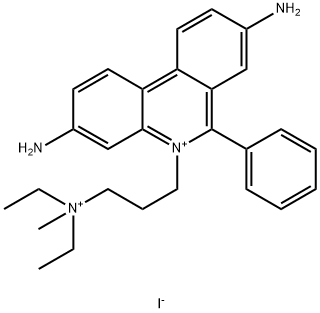
| Product Name: | Propidium iodide | | Synonyms: | 3,8-DIAMINO-5-(3-DIETHYLAMINOPROPYL)-6-PHENYLPHENANTHRIDINIUM IODIDE METHIODIDE;3,8-DIAMINO-5-(3-DIETHYL-AMINOPROPYL)-6-PHENYLPHENANTHRIDIUM IODIDE METHIODIDE;3,8-DIAMINO-5-(3-[DIETHYLMETHYLAMMONIO])-6-PHENYLPHENAN-THRIDINIUM DIIODIDE;3,8-DIAMINO-5-[3-(DIETHYLMETHYLAMMONIO)PROPYL]-6-PHENYLPHENANTHRIDINIUM;3,8-DIAMINO-5-[3-(DIETHYLMETHYLAMMONIO)PROPYL]-6-PHENYLPHENANTHRIDINIUM DIIODIDE;3,8-diamino-5-(3-(diethylmethylammonio)propyl)-6-phenyl-phenanthridiniudii;3,8-diamino-5-(3-(diethylmethylammonio)propyl)-6-phenylphenanthridiniumdiiod;3,8-diamino-5-(3-diethylaminopropyl)-6-phenylphenanthridiniumiodidemethiodi | | CAS: | 25535-16-4 | | MF: | C27H34IN4+ | | MW: | 541.5 | | EINECS: | 247-081-0 | | Product Categories: | Phenanthridine;Inhibitors;Aromatics;Intermediates & Fine Chemicals;Pharmaceuticals;marker;Aromatics Compounds | | Mol File: | 25535-16-4.mol |
| Propidium iodide Chemical Properties |
| Melting point | 220-225 °C (dec.) (lit.) | | density | 1.5072 (estimate) | | storage temp. | 2-8°C | | solubility | Difficult to mix. | | form | Flaky Powder | | color | Dark red | | Water Solubility | Soluble in water at 1mg/ml | | λmax | 493 nm, 535 nm | | Sensitive | Light Sensitive & Hygroscopic | | BRN | 3843838 | | Major Application | Electroluminescent
displays; photoresists | | Biological Applications | Detecting nucleic acids,cancer cells,spores,activity of hydrolase,microorganisms; apoptosis assay; measuring beta-amyloid in Alzheimer’s disease (AD); treating diseases associated with androgens,cancer | | CAS DataBase Reference | 25535-16-4(CAS DataBase Reference) |
| Propidium iodide Usage And Synthesis |
| Description | Propidium iodide (PI) is membrane impermeant and generally excluded from viable cells. However, it can easily penetrate dead or damaged cells and as such is commonly used for identifying cell viability in a population or as a counterstain in multicolor fluorescent techniques. It binds to DNA and RNA by intercalating between the bases. PI is excited at 488-535 nm with an emission maximum of 617 nm. This probe is suitable for fluorescence microscopy and flow cytometry. | | Chemical Properties | Dark Red Solid | | Uses | 1 mg/mL in water | | Uses | Propidium iodide is the most common red-fluorescent nuclear stain. It can also be excited using excitation filters appropriate for green-fluorescent dyes. | | Uses | Antibacterial;Detergent | | Uses | Propidium Iodide is a phenanthridine compound, a class of compounds with reported activity against several species of trypanosomes. Propidium iodide may be used in flow cytometry to evaluate cell viab
ility when used with other dyes that stain viable cells or cells that are early in the apoptosis process. | | Uses | Used as fluorescent stain for nucleic acids,and used in flow cytometry to evaluate cell viability | | General Description | Extinction coefficient(493 nm): 5900 M -1cm-1;(287 nm): 55,700 M -1cm-1; | | Biochem/physiol Actions | Primary TargetMembrane impermeable DNA intercalator | | Purification Methods | It crystallises as red crystals from H2O containing a little KI. It fluoresces strongly with nucleic acids. [Watkins J Chem Soc 3064 1952, Beilstein 22 III/IV 5519.] TOXIC. |
| Propidium iodide Preparation Products And Raw materials |
|


 日本语
日本语 한국어
한국어 Français
 Deutsch
 España
 Türkiye