Other grades of this product :
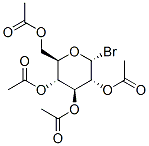
| 2,3,4,6-Tetra-O-acetyl-alpha-D-glucopyranosyl bromide Basic information |
| Product Name: | 2,3,4,6-Tetra-O-acetyl-alpha-D-glucopyranosyl bromide | | Synonyms: | BROMO-2,3,4,6-TETRA-O-ACETYL-ALPHA-D-GLUCOPYRANOSE;BROMO 2,3,4,6-TETRA-O-ACETYL-ALPHA-D-GLUCOPYRANOSIDE;BROMO 2,3,4,6-TETRA-O-ACETYL-A-D-GLUCOPYRANOSE;2,3,4,6-O-tetraacetyl-α-D-glucopyranosyl bromide;Acetobromglucose;Acetobromo-α-D-glucose;Acetobromglucose;Tetraacetyl bromoglucose;Tetraacetyl bromoglucose;ACETOBROMO-ALPHA-D-GLUCOSE, STAB. | | CAS: | 572-09-8 | | MF: | C14H19BrO9 | | MW: | 411.2 | | EINECS: | 209-339-0 | | Product Categories: | Sugars, Carbohydrates & Glucosides;13C & 2H Sugars;Biochemistry;Glucose;Halogenosugars;Sugars;Dextrins、Sugar & Carbohydrates;Carbohydrates & Derivatives;Carbohydrates | | Mol File: | 572-09-8.mol |
| 2,3,4,6-Tetra-O-acetyl-alpha-D-glucopyranosyl bromide Chemical Properties |
| Melting point | 86-89 °C | | alpha | 194.5 º (c=2,chloroform) | | Boiling point | 0.125-30 °C(Press: 0.0005 Torr) | | density | 1.49±0.1 g/cm3(Predicted) | | storage temp. | −20°C | | form | Powder | | color | White to beige | | Water Solubility | decomposes | | Sensitive | Moisture Sensitive | | Merck | 14,60 | | BRN | 96669 | | Stability: | Stable. Combustible. Incompatible with strong oxidizing agents. | | InChIKey | CYAYKKUWALRRPA-RGDJUOJXSA-N | | CAS DataBase Reference | 572-09-8(CAS DataBase Reference) |
| 2,3,4,6-Tetra-O-acetyl-alpha-D-glucopyranosyl bromide Usage And Synthesis |
| Chemical Properties | White Fluffy Solid | | Uses | An Intermediate in synthesis of ∫-glucosides | | Uses | Acetobromo-α-D-glucose acts as an intermediate in the preparation of beta-glucosides. It is also used as a possible poly(ethylene terephthalate) surface modification reagent to enhance its blood compatibility. | | Purification Methods | If nicely crystalline, recrystallise it from Et2O/pentane or pet ether (b 40-60o). Alternatively dissolve it in diisopropyl ether (dried over CaCl2 for 24hours, then over P2O5 for 24hours) by shaking and warming (for as short a period as possible), and filter warm. Cool to ca 45o, then slowly to room temperature and finally at 5o for more than 2hours. Collect the solid, wash it with cold dry diisopropyl ether and dry it in a vacuum over Ca(OH)2 and NaOH. Store it dry in a desiccator in the dark. Solutions can be stabilised with 2% CaCO3. [Redemann & Niemann Org Synth 65 236 1987, Coll Vol III 11 1955, Beilstein 17/6 V 368.] |
| 2,3,4,6-Tetra-O-acetyl-alpha-D-glucopyranosyl bromide Preparation Products And Raw materials |
|


 日本语
日本语 한국어
한국어 Français
 Deutsch
 España
 Türkiye