Other grades of this product :
| Butyl propionate Basic information |
| Butyl propionate Chemical Properties |
| Hazard Codes | Xi | | Risk Statements | 10-36/37/38-41-38 | | Safety Statements | 16-26-36/37/39-39-24/25 | | RIDADR | UN 1914 3/PG 3 | | WGK Germany | 1 | | RTECS | UE8245000 | | Autoignition Temperature | 799 °F | | TSCA | Yes | | HazardClass | 3 | | PackingGroup | III | | HS Code | 29155090 |
| Butyl propionate Usage And Synthesis |
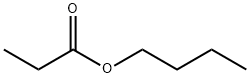
| Chemical Properties | Butyl propionate is a flammable, colorless to
straw-yellow liquid with an apple-like odor. | | Chemical Properties | Butyl propionate has a characteristic earthy, faintly sweet odor and apricot-like taste. | | Occurrence | Reported found in fresh apple, apple juice, melon, strawberry, Gruyere de Comte cheese and plum. | | Uses | Butyl propionate is a moderately fast evaporating solvent. Its linear structure contributes to effective viscosity reduction and improves solvent diffusion from coating films.Butyl propionate is used solvent for nitrocellulose, retarder in lacquer thinner, ingredient of perfumes, flavors. | | Preparation | By esterification of propionic acid with n-butyl alcohol in the presence of concentrated H2SO4 or p-toluene sulfonic acid. | | Aroma threshold values | Detection: 25 to 440 ppb | | Synthesis Reference(s) | Tetrahedron Letters, 14, p. 1823, 1973 DOI: 10.1016/S0040-4039(01)96249-5 | | General Description | A water-white liquid with an apple-like odor. Less dense than water. Flash point 90°F. May irritate skin and eyes. Used to make perfumes and flavorings. | | Air & Water Reactions | Highly flammable. Very slightly soluble in water. | | Reactivity Profile | BUTYL PROPIONATE is an ester. Esters react with acids to liberate heat along with alcohols and acids. Strong oxidizing acids may cause a vigorous reaction that is sufficiently exothermic to ignite the reaction products. Heat is also generated by the interaction of esters with caustic solutions. Flammable hydrogen is generated by mixing esters with alkali metals and hydrides. | | Hazard | Skin and eye irritant. Flammable, moderate
fire risk.
| | Health Hazard | Contact will cause eye and skin irritation. Vapor exposure may cause eye and respiratory tract irritation. | | Fire Hazard | Special Hazards of Combustion Products: Irritating and toxic gases, such as carbon dioxide and carbon monoxide, may be produced in fire. | | Flammability and Explosibility | Flammable | | Safety Profile | Mildly toxic by
ingestion. A skin irritant. Dangerously
flammable when exposed to heat or flame.
To fight fire, use foam, CO2, dry chemical.
Incompatible with oxidizing materials. See
also ESTERS, n-BUTYL ALCOHOL, and
PROPIONIC ACID. | | Potential Exposure | It is used as a solvent or lacquer thinner; and in perfumes and flavoring | | Shipping | UN1914 Butyl propionates, Hazard Class: 3;
Labels: 3—Flammable liquid | | Incompatibilities | Vapor may form explosive mixture with
air. Incompatible with oxidizers (chlorates, nitrates, peroxides, permanganates, perchlorates, chlorine, bromine, fluorine, etc.); contact may cause fires or explosions. Keep
away from alkaline materials, strong bases, strong acids,
oxoacids, epoxides. May accumulate static electrical
charges and cause ignition of its vapors. | | Waste Disposal | Dissolve or mix the material
with a combustible solvent and burn in a chemical incinerator equipped with an afterburner and scrubber. All federal,
state, and local environmental regulations must be
observed. |
| Butyl propionate Preparation Products And Raw materials |
|


 日本语
日本语 한국어
한국어 Français
 Deutsch
 España
 Türkiye