Other grades of this product :
| Sapropterin Hydrochloride Basic information |
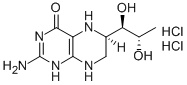
| Product Name: | Sapropterin Hydrochloride | | Synonyms: | (6r-(6r*(1r*,2s*)))-chlorid;(6r)-tetrahydrobiopterinhydrochloride;5,6,7,8-tetrahydro-2-amino-6-(1,2-dihydroxypropyl)-4(1h)-pteridinondihydro;6R-BH4 dihydrochloride;Sapropterin DiHCl;Tetrahydrobiopterin Dihydrochloride, R-THBP Dihydrochloride;Sapropterin dihydrochloride, >98%;2-AMINO-6R-(1R,2S-DIHYDROXYPROPYL)-5,6,7,8-TETRAHYDRO-4(1H)-PTERIDINONE, DIHYDROCHLORIDE | | CAS: | 69056-38-8 | | MF: | C9H17Cl2N5O3 | | MW: | 314.17 | | EINECS: | 663-669-3 | | Product Categories: | Amines;Chiral Reagents;Chemical Amines;Heterocycles;Nitric Oxide Reagents;Nitric Oxide | | Mol File: | 69056-38-8.mol |
| Sapropterin Hydrochloride Chemical Properties |
| Melting point | 245-246° (dec) | | alpha | D25 -6.81° (c = 0.665 in 0.1 M HCl) | | storage temp. | -20°C | | solubility | water, oxygen free: soluble19.60 - 20.40mg/mL, clear to slightly hazy, colorless to faintly yellow | | form | White to off-white powder. | | CAS DataBase Reference | 69056-38-8(CAS DataBase Reference) |
| Hazard Codes | Xn | | Risk Statements | 22 | | WGK Germany | 3 | | RTECS | UO3516500 | | Toxicity | LD50 oral in rat: 1gm/kg |
| Sapropterin Hydrochloride Usage And Synthesis |
| Description | Sapropterin hydrochloride is a monoamine biosynthesis enhancer introduced for the
treatment of hyperphenylalaninemia.Animal studies indicate that sapropterin
hydrochloride increases brain levels of serotonin and enhances the release of
acetylcholine from nerve terminals. The compound is also being investigated as a
potential cognitive enhancer. | | Description | (6R)-5,6,7,8-tetrahydro-L-Biopterin (hydrochloride) (BH4) is a cofactor that, in the presence of enzyme site iron, binds to phenylalanine hydroxylase, tryptophan or tyrosine hydroxylase, and nitric oxide synthase (NOS), to facilitate the production of aromatic amino acids, neurotransmitters, and nitric oxide (NO), respectively. It is formed de novo from GTP with GTP cyclohydrolase-1 (GCH1) catalyzing the rate limiting conversion of GTP to 7,8-dihydroneopterin (NH2TP) followed by subsequent processing by TS and SPR to convert NH2TP to BH4. BH4 acts as a radical-trapping antioxidant that inhibits phospholipid oxidation in lipid membranes. It inhibits IKE- or RSL3-induced ferroptosis in HT-1080 cells (EC50s = 21 and 69 μM), as well as ferroptosis induced by knockout of glutathione peroxidase (Gpx4-/-) in immortalized mouse fibroblasts. BH4 also reduces RLS3-induced lipid peroxidation in murine fibroblasts and HT-1080 cells when used at a concentration of 50 μM. | | Chemical Properties | White Crystalline Solid | | Originator | Suntory (Japan) | | Uses | Tetrahydrobiopterin is a naturally occurring essential cofactor of the three aromatic amino acid hydroxylase enzymes, used in the degradation of amino acid phenylalanine and in the biosynthesis of the neurotransmitters serotonin, melatonin, dopamine, norepinephrine , epinephrine, and is a cofactor for the production of nitric oxide by the nitric oxide synthases. Chemically, its structure is that of a reduced pteridine derivative. | | Uses | A natural cofactor for phenylalanine hydroxylase, tyrosine hydroxylase, tryptophan hydroxylase, and nitric oxide synthase.
An essential cofactor for the production of neurotransmitters such as catecholamines, serotonin, and nitric oxide. Increasing | | Definition | ChEBI: The dihydrochloride salt of sapropterin. It is used for the diagnosis and treatment of variant forms of phenylketonuria (hyperphenylalaninaemia) associated with tetrahydrobiopterin deficiency. Natural cofactor for phenylalanine hydroxylase, tyrosine hydrox
lase, tryptophan hydroxylase, and nitric oxide synthetase. | | Brand name | Biopten | | General Description | Tetrahydrobiopterin is a natural cofactor for phenylalanine hydroxylase, tyrosine hydroxylase, tryptophan hydroxylase, nitric oxide synthase and alkylglycerol monooxygenase. | | Biochem/physiol Actions | Lack of tetrahydrobiopterin may cause hyperphenylalaninemia. Diseases like, Parkinson′s, autism, depression and Alzheimer′s shows low concentration of tetrahydrobiopterin in the cerebrospinal fluid. This coenzyme participates in dopamine (DA) synthesis. | | Purification Methods | Recrystallisation of BH4.2HCl from HCl enriches BH4 in the natural 6R isomer. Dissolve the salt (~6g) in conc HCl (15mL) under gentle warming, then add EtOH (30mL) dropwise, chill and collect the colourless needles (67%, up to 99% if the mother liquors are concentrated), and dry it in vacuo immediately over P2O5 and KOH. It is stable indefinitely at -20o in a dry atmosphere. Better store it in sealed ampoules under dry N2. It can be recrystallised from 6N aqueous HCl. It has UV max (in 2N HCl) at 264nm ( 16,770; pH 3.5 phosphate buffer) 265nm ( 13,900); (in pH 7.6) at 297nm ( 9,500) and 260nm sh ( 4,690). It has been separated from the 6S-isomer by HPLC on a Partisil-10SCX column using 30mM ammonium phosphate buffer (pH 3.0) containing 3mM NaHSO3 (2mL/minute flow rate; 275nm detector) with retention times of 5.87minutes (6R) and 8.45minutes (6S). It is stable in acidic solutions and can be stored for extended periods at -20o in 0.04M HCl. Above pH 7 the neutral species are obtained, and these are readily oxidised by the oxygen in the solvent to the quinonoid species, and then further oxidation and degradation occurs at room temperature. These changes are slower at 0o. The sulfate salt can be obtained by recrystallisation from 2M H2SO4 and is less soluble in water than the hydrochloride salt. The 6R-2,5,1',2'-tetraacetylbiopterin derivative has m 292o(dec) after recrystallisation from MeOH (100 parts) and [] 20 -144o (c 0.5, CHCl3), [] 589 +12.8o (c 0.39, Me2SO). [NMR, UV: Matsuura et al. Heterocycles 23 3115 1985, Viscontini et al. Helv Chim Acta 62 2577 1979, Armarego et al. Aust J Chem 37 355 1984, Beilstein 26 III/IV 4032.] |
| Sapropterin Hydrochloride Preparation Products And Raw materials |
|


 日本语
日本语 한국어
한국어 Français
 Deutsch
 España
 Türkiye