Other grades of this product :
| 3-Hydroxytyramine hydrochloride Chemical Properties |
| Melting point | 248-250 °C(lit.) | | density | 1.4 g/cm3 | | Fp | 11℃ | | storage temp. | Store below +30°C. | | solubility | alcohol: 20 mg/mL | | form | Crystalline Powder | | color | light tan | | Water Solubility | soluble | | Sensitive | Air & Light Sensitive | | Merck | 14,8462 | | BRN | 3656720 | | Stability: | Stable. Incompatible with strong oxidizing agents. Combustible. | | InChIKey | CTENFNNZBMHDDG-UHFFFAOYSA-N | | CAS DataBase Reference | 62-31-7(CAS DataBase Reference) | | EPA Substance Registry System | 1,2-Benzenediol, 4-(2-aminoethyl)-, hydrochloride (62-31-7) |
| 3-Hydroxytyramine hydrochloride Usage And Synthesis |
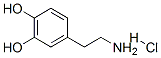
| pharmacological action | Dopamine hydrochloride is a precursor for the synthesis of epinephrine in the body. It has β (mainly β1 receptor) receptor agonism and α receptor agonism, and can also promote the release of norepinephrine. It can enhance myocardial contractility, increase cardiac output, and accelerate the heart rate to a lesser extent (not as obvious as isoproterenol); stimulate the α-receptors of blood vessels in tissues such as skin and muscles, so that blood vessels constrict and blood supply is reduced; it stimulates visceral blood vessels ( The dopamine receptors in the kidney, mesentery, and heart) dilate and increase blood flow. The change of total peripheral resistance is not obvious, but it is beneficial to improve the blood supply of vital organs during shock. | | Description | Dopamine (hydrochloride) is an endogenous catecholamine neurotransmitter synthesized from the amino acid L-tyrosine that acts as an agonist at dopamine receptors (D1-5). Dopamine is mainly synthesized in the substantia nigra and ventral tegmental area, and is a precursor in norepinephrine and epinephrine biosynthesis. Dopamine-containing neurons in the brain are involved in reward-motivated behavior, motor control, and hormone release. Dopamine is also synthesized in the adrenal glands where it exerts peripheral paracrine functions including control of vasodilation, sodium excretion, insulin production, gastrointestinal motility, and the activity of lymphocytes. Loss or damage of dopaminergic neurons in the substantia nigra is associated with Parkinson’s disease. | | Chemical Properties | Dopamine hydrochloride is designated chemically as 3,4-dihydroxyphenethylamine hydrochloride, a white crystalline powder freely soluble in water. Dopamine (also referred to as 3-hydroxytyramine) is a naturally occurring biochemical catecholamine precursor of norepinephrine. | | Uses | Endogenous catecholamine with α and β-adrenergic activity. Cardiotonic; antihypotensive. | | Uses | dopaminergic: Dopamine (DA) works as neurotransmitter in the central nervous system. It is a catecholamine made from the amino acid L-tyrosine. It also works as a hormone in vesicles of the adrenal medulla, thereby controlling heart beat rate and blood pressure. Absence of DA-containing neurons is associated with parkinson′s disease. | | Uses | A neurotransmitter and vasopressor that modulates cortical activation. Dopamine hydrochloride is a vasopressor that moderates cortical activation. It is used as a precursor to norepinepherine and epinephrine. It is an important neurotransmitter and chemical messenger that helps in the transmission of signals in the brain and other vital areas. | | Indications | Dopamine HCl is indicated for the correction of hemodynamic imbalances present in the shock syndrome due to myocardial infarction, trauma, endotoxic septicemia, open-heart surgery, renal failure, and chronic cardiac decompensation as in congestive failure. | | Application | Dopamine hydrochloride has been used to study dopamine-mediated transient modulation of the physiological responses in whiteleg shrimp, Litopenaeus vannamei.It has been used to study dopamine-mediated changes in immunity susceptibility to Lactococcus garvieae in the freshwater giant prawn, Macrobrachium rosenbergii.It has been used to study the molecular link between dopamine-induced oxidative stress and mHtt (mutant Huntingtin) toxicity in relation to the activation of the autophagy pathway in an 'in vitro' model of parkinsonian Huntington's Disease. | | Brand name | Intropin (Mayne). | | General Description | Pharmaceutical secondary standards for application in quality control, provide pharma laboratories and manufacturers with a convenient and cost-effective alternative to the preparation of in-house working standards.Dopamine is a neurotransmitter which is a naturally occurring catecholamine. Dopamine hydrochloride salt is indicated as a medicine for the treatment of acute congestive and renal failures. | | Biological Activity | Endogenous neurotransmitter that acts as an agonist at dopamine D 1-5 receptors. Synthesized in the substantia nigra and ventral tegmental area, and is a precursor in noradrenalin and adrenalin biosynthesis. | | Clinical Use | Cardiogenic shock in infarction or cardiac surgery | | Drug interactions | Potentially hazardous interactions with other drugsAlpha-blockers: avoid with tolazoline.Anaesthetics: risk of ventricular arrhythmias with
isoflurane - avoid.Antidepressants: risk of hypertensive crisis with
MAOIs and moclobemide.Ciclosporin: may reduce risk of ciclosporin
nephrotoxicityDopaminergics: effects possibly enhanced
by entacapone; avoid with rasagiline; risk of
hypertensive crisis with selegiline. | | Metabolism | Dopamine is a metabolic precursor of noradrenaline
and, whereas a proportion is excreted as the metabolic
products of noradrenaline, the majority is mainly
metabolised into 3,4,-dihydroxyphenylacetic acid
(DOPAC) and 3-methoxy-4-hydroxyphenylacetic
(HVA) which are rapidly excreted in the urine. |
| 3-Hydroxytyramine hydrochloride Preparation Products And Raw materials |
|


 日本语
日本语 한국어
한국어 Français
 Deutsch
 España
 Türkiye