Other grades of this product :
| 1,3,5-Tris(2-hydroxyethyl)cyanuric acid Basic information |
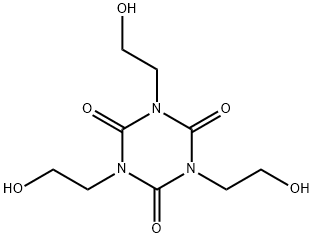
| Product Name: | 1,3,5-Tris(2-hydroxyethyl)cyanuric acid | | Synonyms: | 1,3,5-TRIS(2-HYDROXYETHYL)-1,3,5-TRIAZINE-2,4,6(1H,3H,5H)-TRIONE;1,3,5-TRIS(2-HYDROXYETHYL) 1,3,5-TRIAZINE-2,4,6(1H,3H,6H)TRIONE;1,3,5-TRIS(2-HYDROXYETHYL)CYANURIC ACID;1,3,5-TRIS(2-HYDROXYETHYL)-HEXAHYDRO-S-TRIAZINE-2,4,6-TRIONE;1,3,5-TRIS(2-HYDROXYETHYL)ISOCYANURIC ACID;ISOCYANURIC ACID TRIS(2-HYDROXYETHYL) ESTER;THEIC;TRIS(HYDROXYETHYL) ISOCYANURATE | | CAS: | 839-90-7 | | MF: | C9H15N3O6 | | MW: | 261.23 | | EINECS: | 212-660-9 | | Product Categories: | Organics;Intermediates | | Mol File: | 839-90-7.mol |
| 1,3,5-Tris(2-hydroxyethyl)cyanuric acid Chemical Properties |
| Melting point | 136-140 °C(lit.) | | Boiling point | 526.7±45.0 °C(Predicted) | | density | 1.498±0.06 g/cm3(Predicted) | | vapor pressure | 0.001Pa at 50℃ | | Fp | 241℃ | | storage temp. | Store below +30°C. | | solubility | 1150g/l | | pka | 14.03±0.10(Predicted) | | form | Solid | | color | White to Off-White | | PH | 7 (100g/l, H2O, 20℃) | | Water Solubility | 572g/L at 20℃ | | Stability: | Stable. Incompatible with strong oxidizing agents. | | LogP | -1.63 at 23℃ | | CAS DataBase Reference | 839-90-7(CAS DataBase Reference) | | EPA Substance Registry System | Tris(2-hydroxyethyl)isocyanurate (839-90-7) |
| 1,3,5-Tris(2-hydroxyethyl)cyanuric acid Usage And Synthesis |
| Chemical Properties | white powder | | Uses | Additive to plastics, especially to impart thermal
stability. | | Uses | 1,3,5-Tris(2-hydroxyethyl)cyanuric Acid, is a building block that can be used in polymer science. It has also shown to have synergistic flame retardancy properties. | | Synthesis Reference(s) | The Journal of Organic Chemistry, 28, p. 85, 1963 DOI: 10.1021/jo01036a019 | | General Description | White powder. | | Air & Water Reactions | Water soluble. | | Reactivity Profile | An organo-isocyanate. Isocyanates and thioisocyanates are incompatible with many classes of compounds, reacting exothermically to release toxic gases. Reactions with amines, aldehydes, alcohols, alkali metals, ketones, mercaptans, strong oxidizers, hydrides, phenols, and peroxides can cause vigorous releases of heat. Acids and bases initiate polymerization reactions in these materials. Some isocyanates react with water to form amines and liberate carbon dioxide. | | Fire Hazard | Flash point data for 1,3,5-Tris(2-hydroxyethyl)cyanuric acid are not available, but 1,3,5-Tris(2-hydroxyethyl)cyanuric acid is probably combustible. | | Flammability and Explosibility | Notclassified |
| 1,3,5-Tris(2-hydroxyethyl)cyanuric acid Preparation Products And Raw materials |
|


 日本语
日本语 한국어
한국어 Français
 Deutsch
 España
 Türkiye