Other grades of this product :
| Ethyl benzoate Basic information |
| Ethyl benzoate Chemical Properties |
| Melting point | -34 °C | | Boiling point | 212 °C(lit.) | | density | 1.045 g/mL at 25 °C(lit.) | | vapor density | 5.17 (vs air) | | vapor pressure | 1 mm Hg ( 44 °C) | | refractive index | n20/D 1.504(lit.) | | FEMA | 2422 | ETHYL BENZOATE | | Fp | 184 °F | | storage temp. | Store below +30°C. | | solubility | 0.5g/l | | form | Liquid | | color | Clear colorless to pale yellow | | Relative polarity | 0.228 | | explosive limit | 1%(V) | | Water Solubility | INSOLUBLE | | Merck | 14,3766 | | JECFA Number | 852 | | BRN | 1908172 | | Stability: | Stable. Combustible. Incompatible with strong oxidizing agents. | | LogP | 2.59 at 23℃ | | CAS DataBase Reference | 93-89-0(CAS DataBase Reference) | | NIST Chemistry Reference | Benzoic acid, ethyl ester(93-89-0) | | EPA Substance Registry System | Benzoic acid, ethyl ester (93-89-0) |
| Hazard Codes | N | | Risk Statements | 51/53 | | Safety Statements | 24/25-61 | | RIDADR | UN 3082 9 / PGIII | | WGK Germany | 1 | | RTECS | DH0200000 | | Autoignition Temperature | 914 °F | | TSCA | Yes | | HS Code | 29163100 | | Toxicity | LD50 orally in rats: 6.48 g/kg, Smyth et al., Arch. Ind. Hyg. Occup. Med. 10, 61 (1954) |
| Ethyl benzoate Usage And Synthesis |
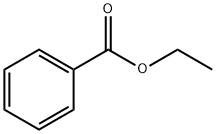
| Description | Ethyl benzoate, C9H10O2, is the ester formed by the condensation of benzoic acid and ethanol. It is a colorless liquid that is almost insoluble in water, but miscible with most organic solvents. As with many volatile esters, ethyl benzoate has a pleasant odor which could be described similar to wintergreen mint. It is a component of some artificial fruit flavors. | | Chemical Properties | Ethyl benzoate is a colourless liquid that has a somewhat fruity odor similar to ylang-ylang, but milder than methyl benzoate. Soluble in ethanol, ethyl ether, petroleum ether, propylene glycol, mineral oil and most non-volatile oils, insoluble in water and glycerin. | | Occurrence | Reported found in volatiles from hard, mature peaches, pineapple and currant. Also reported found in apple
juice, banana, guava, cranberry, raspberry, sweet cherry, Parmesan cheese, butter, milk, white wine, red wine, cider, whiskies, cocoa,
black tea, fresh plum, apple brandy, cherry brandy, Bourbon vanilla, naranjilla fruit, ceriman or pinanona, pimento berry, olive and
passion fruit. | | Uses | Ethyl Benzoate acts as an aroma and flavour compound due to the volatile ester group in its structure. In perfumery under the name Essence de Niobe; in manufacture of Peau d'Espagne; artificial fruit essence. | | Uses | Ethyl benzoate is used as a perfume scent. It acts as a food flavoring agent. It is an active component of artificial fruit flavors. Further, it is used in cosmetics and personal care products as fragrance ingredients and preservatives. | | Preparation | By esterification of ethyl alcohol and benzoic acid in the presence of anhydrous aluminum sulfate and a trace of sulfuric
acid; by transesterification of methyl benzoate with ethanol in the presence of potassium ethylate | | Definition | ChEBI: Ethyl benzoate is a benzoate ester obtained by condensation of benzoic acid and ethanol. It is a volatile oil component found in ripe kiwifruit, cranberry juice, and palm kernel oil. It has a role as a flavouring agent, a fragrance and a volatile oil component. It is a benzoate ester and an ethyl ester. | | Aroma threshold values | Detection: 100 ppb; recognition: 150 ppb | | Taste threshold values | Taste characteristics at 30 ppm: sweet, medicinal, green, minty, fruity, birch beer and wintergreen-like. | | Synthesis Reference(s) | The Journal of Organic Chemistry, 25, p. 1703, 1960 DOI: 10.1021/jo01080a004Synthetic Communications, 20, p. 2267, 1990 DOI: 10.1080/00397919008053167Tetrahedron Letters, 22, p. 1509, 1981 DOI: 10.1016/S0040-4039(01)90363-6 | | General Description | Natural occurrence: Feijoa, guava, plum, raspberry, rum, strawberry, Virginia tobacco. | | Flammability and Explosibility | Notclassified | | Biochem/physiol Actions | Taste at 10 ppm | | Safety Profile | Moderately toxic by
ingestion. Mildly toxic by skin contact. A
skin and eye irritant. Combustible liquid
when exposed to heat or flame; can react
with oxidizing materials. To fight fire, use
foam, CO2, dry chemical. When heated to
decomposition it emits acrid smoke and
irritating fumes. See also ESTERS |
| Ethyl benzoate Preparation Products And Raw materials |
| Raw materials | Aluminum sulfate-->Uridine, 5-methyl-, 2',3',5'-tribenzoate-->5-Methyluridine | | Preparation Products | Ethyl benzoylacetate-->Benzyl benzoate-->Benzohydroxamic acid-->Benzoylacetonitrile-->Benoxinate Hydrochloride-->Alibendol-->2-PHENYL-2-PROPANOL-->1,2-Ethanediyl, 1-phenyl- (9CI)-->6-phenylundecane-->1-(2-HYDROXYPHENYL)-3-PHENYL-1,3-PROPANEDIONE-->2-P-ANISYL-1,3-INDANDIONE-->BENZYL-ALPHA,ALPHA-D2-AMINE-->1-PHENYL-1-CYCLOPROPANOL-->ETHYL 4-(4,4,5,5-TETRAMETHYL-1,3,2-DIOXABOROLAN-2-YL)BENZOATE-->3-Phenylpropene-3-ol |
|


 日本语
日本语 한국어
한국어 Français
 Deutsch
 España
 Türkiye