Other grades of this product :
| Potassium bisulfate Basic information |
| Potassium bisulfate Chemical Properties |
| Melting point | 214 °C(lit.) | | Boiling point | decomposes [STR93] | | density | 2.32 g/mL at 25 °C(lit.) | | storage temp. | Store at +5°C to +30°C. | | solubility | H2O: 1 M at 20 °C, clear, colorless | | form | Solid | | Specific Gravity | 2.322 | | color | White | | PH | 1 (50g/l, H2O, 20℃) | | Water Solubility | soluble | | Sensitive | Hygroscopic | | Merck | 14,7613 | | Stability: | Stable. Moisture sensitive. | | CAS DataBase Reference | 7646-93-7(CAS DataBase Reference) | | EPA Substance Registry System | Potassium bisulfate (7646-93-7) |
| Hazard Codes | C | | Risk Statements | 34-37 | | Safety Statements | 26-36/37/39-45 | | RIDADR | UN 2509 8/PG 2 | | WGK Germany | 1 | | RTECS | TS7200000 | | F | 3 | | TSCA | Yes | | HS Code | 2833 29 80 | | HazardClass | 8 | | PackingGroup | II | | Toxicity | LD50 orally in Rabbit: 2340 mg/kg |
| Potassium bisulfate Usage And Synthesis |
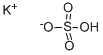
| Chemical Properties | Also known as acid potassium sulfate and potassium acid sulfate, KHS04 is water soluble, white deliquescent crystals,which melt at 214°C. It is used in wine making, fertilizer manufacture, and as a flux and food preservative.
| | Uses | As flux in analysis of ores and siliceous Compounds. | | Uses | Potassium hydrogen sulfate is used in the conversion of tartrates to bitartrates in wine. It serves as a disintegrating agent in analytical chemistry and as an intermediate in the preparation of potassium persulfate by electrolysis. It is also employed in the manufacturing of fertilizers. | | Uses | Potassium bisulfate may be used:- As a catalyst for the preparation of butyl paraben from p-hydroxybenzoic acid and n-butyl alcohol.
- As a promoter for the synthesis of 3,4-dihydropyrimidin-2(1H)-one derivatives via Biginelli reaction in ethylene glycol.
- As an acid catalyst for the synthesis of ethyl tert-butyl ether (ETBE) from ethanol and tert-butyl alcohol via reactive distillation.
- As a dehydrating agent for the synthesis of pyruvic acid from tartaric acid.
| | General Description | Potassium bisulfate is a colorless crystalline solid with a sulfur odor. Potassium bisulfate may cause illness from ingestion. If heated to high temperatures Potassium bisulfate may emit toxic fumes. Potassium bisulfate is used to make fertilizers and wine. | | Air & Water Reactions | Fused salt is deliquescent, Soluble in water, yielding a corrosive acidic solution. | | Reactivity Profile | Acidic salts, such as Potassium bisulfate , are generally soluble in water. The resulting solutions contain moderate concentrations of hydrogen ions and have pH's of less than 7.0. They react as acids to neutralize bases. These neutralizations generate heat, but less or far less than is generated by neutralization of inorganic acids, inorganic oxoacids, and carboxylic acid. They usually do not react as either oxidizing agents or reducing agents but such behavior is not impossible. Many of these compounds catalyze organic reactions. | | Health Hazard | TOXIC; inhalation, ingestion or skin contact with material may cause severe injury or death. Contact with molten substance may cause severe burns to skin and eyes. Avoid any skin contact. Effects of contact or inhalation may be delayed. Fire may produce irritating, corrosive and/or toxic gases. Runoff from fire control or dilution water may be corrosive and/or toxic and cause pollution. | | Fire Hazard | Non-combustible, substance itself does not burn but may decompose upon heating to produce corrosive and/or toxic fumes. Some are oxidizers and may ignite combustibles (wood, paper, oil, clothing, etc.). Contact with metals may evolve flammable hydrogen gas. Containers may explode when heated. | | Safety Profile | Moderately toxic by
ingestion. A corrosive irritant to the skin,
eyes, and mucous membranes. When heated
to decomposition it emits toxic fumes of SOx and K2O. Can form an explosive
mixture. See also SULFATES. | | Purification Methods | Crystallise it from H2O (1mL/g) between 100o and 0o. It is also formed when a warm solution of K2SO4 in conc H2SO4 is cooled down. |
| Potassium bisulfate Preparation Products And Raw materials |
|


 日本语
日本语 한국어
한국어 Français
 Deutsch
 España
 Türkiye