Other grades of this product :
| Megestrol acetate Basic information |
| Megestrol acetate Chemical Properties |
| Melting point | 214°C | | Boiling point | 431.17°C (rough estimate) | | alpha | D24 +5° (chloroform) | | density | 1.0474 (rough estimate) | | refractive index | 11 ° (C=2, CHCl3) | | storage temp. | Sealed in dry,Room Temperature | | solubility | Practically insoluble in water, soluble in acetone, sparingly soluble in alcohol. | | form | neat | | color | White | | Merck | 14,5805 | | BRN | 1917291 | | CAS DataBase Reference | 595-33-5(CAS DataBase Reference) | | NIST Chemistry Reference | Megestrol acetate(595-33-5) | | EPA Substance Registry System | Megestrol acetate (595-33-5) |
| Hazard Codes | Xn | | Risk Statements | 40-48 | | Safety Statements | 22-24/25 | | WGK Germany | 3 | | RTECS | TU4075000 | | HS Code | 29372390 | | Toxicity | LD50 intravenous in mouse: 56mg/kg |
| Megestrol acetate Usage And Synthesis |
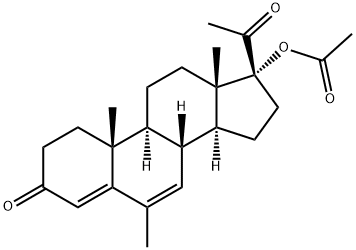
| Description | Megestrol Acetate is the acetate salt form of megestrol, a synthetic derivative of the naturally occurring female sex hormone progesterone with potential anti-estrogenic and antineoplastic activity. It is frequently used in the treatment of patients with metastatic breast cancer. It is generally well tolerated, except that it may cause undesirable weight gain. Subsequently, it was shown that megestrol acetate produced weight gain in a variety of cachectic cancer patients. Significant reduction inserum levels of IL-1a and b,IL-2,IL-6, and TNF-o were observed in cancer patientstreated with megestrol acetate which may bear on the mechanism of improved appetite and body weight gain.It has also been postulated that the effect is, at least in part,mediated by NPY,a potent central appetite stimulant. | | Chemical Properties | Crystalline Solid | | Originator | Megestat,Bristol,W. Germany,1964 | | Uses | Megestrol acetate USP (Megace) is used to treat Carcinoma of the breast or endorometrium. | | Uses | Megestrol acetate (Megace), a semi-synthetic progestational steroid, is the most effective known appetite stimulant at present. Previously used in patients with cancer and acquired immunodeficiency syndrome, only a few studies have considered the applicability of this drug in malnourished older persons. Megestrol acetate is useful if profound anorexia is the main manifestation of cachexia and if expected survival is weeks to months. Megace has been shown to significantly increase appetite, but not survival. In patients with a shorter predicted survival, a brief course of corticosteroids may be useful to stimulate appetite and have positive effects on nausea, pain, and asthenia. | | Definition | ChEBI: Megestrol acetate is a steroid ester resulting from the formal condensation of the hydroxy group of megestrol with the carboxy group of acetic acid. It is an appetite stimulant used for the treatment of anorexia and cachexia. Also used for birth control and for the treatment of breast cancer. It has a role as an antineoplastic agent, an appetite enhancer, a contraceptive drug, a progestin and a synthetic oral contraceptive. It is a steroid ester, an acetate ester, a 20-oxo steroid and a 3-oxo-Delta(4) steroid. It derives from a megestrol. | | Manufacturing Process | The following preparation is given in US Patent 3,356,573. 17α-Acetoxy-3βhydroxy-6-methylpregn-5-ene-20-one (1 g), aluminum tert-butoxide (1 g) and p-benzoquinone (6 g) were dissolved in dry benzene (100 ml) and the mixture was heated under reflux for 30 minutes. The reaction mixture was cooled and washed with potassium hydroxide solution until the benzene layer was colorless. The benzene was washed with water, dried and evaporated to dryness under reduced pressure. The residue crystallized from aqueous methanol to give 17α-acetoxy-6-methylpregna-4,6-diene-3,20-dione, needles, MP 214° to 216°C. | | Brand name | Megace (Bristol-Myers Squibb); Megace (Par). | | Therapeutic Function | Cancer chemotherapy | | General Description | Megestrol acetate, 17-hydroxy-6-methylpregna-4,6-diene-3,20-dione acetate(Megace), is a progestin used primarily for the palliativemanagement of recurrent, inoperable, or metastatic endometrialor breast carcinoma. Megestrol acetate has also beenindicated for appetite enhancement in patients with AIDS.The biochemical basis for this use of megestrol is unclear. | | Clinical Use | Progestin activity is further enhanced when a double bond is introduced between positions 6 and 7, as is found in megestrol
acetate. Megestrol is used primarily in the treatment of breast and endometrial carcinomas and in postmenopausal
women with advanced hormone-dependent carcinoma. | | Safety Profile | Suspected carcinogen
with experimental carcinogenic and
teratogenic data. Poison by intravenous
route. Human reproductive effects bp
ingestion and implant routes: effects on
ovaries and fallopian tubes, menstrual cycle
changes, and female fertility index changes.
Mutation data reported. Experimental
reproductive effects. When heated to
decomposition it emits acrid smoke and
irritating fumes. An FDA proprietary drug
used to treat endometriosis and breast
cancer. A steroid. | | Veterinary Drugs and Treatments | Megestrol acetate (Ovaban?—Schering) is approved by FDA for use
in dogs only for the postponement of estrus and the alleviation of
false pregnancy. In male dogs, it has been used for benign prostatic
hypertrophy. It is used clinically for many dermatologic and behavior-
related conditions, primarily in the cat. See the Dosage section
for specific indications and dosages for both dogs and cats.
Megestrol acetate is indicated in humans for the palliative treatment
of advanced carcinoma of the breast or endometrium. | | Drug interactions | Potentially hazardous interactions with other drugs
Antibacterials: metabolism of progestogens
accelerated by griseofulvin and rifamycins.
Anticoagulants: progestogens antagonise
anticoagulant effect of phenindione; may enhance or
reduce anticoagulant effect of coumarins.
Antiepileptics: metabolism accelerated by
carbamazepine, eslicarbazepine, fosphenytoin,
oxcarbazepine, phenobarbital, phenytoin, primidone,
rufinamide and topiramate; concentration of
lamotrigine reduced; concentration reduced by high
dose perampanel.
Antivirals: metabolism accelerated by nevirapine.
Ciclosporin: progestogens inhibit metabolism of
ciclosporin (increased plasma concentration).
Dopaminergics: concentration of selegiline increased
- avoid. | | Metabolism | Less than 10% of an oral dose undergoes metabolism. Several major
metabolites appear in the urine (e.g., 2-hydroxy and 6-hydroxymethyl megestrol and their glucuronide conjugates). | | references | [1] zhang k1, chow pk. the effect of megestrol acetate on growth of hepg2 cells in vitro and in vivo. clin cancer res. 2004 aug 1; 10(15):5226-32. |
| Megestrol acetate Preparation Products And Raw materials |
|


 日本语
日本语 한국어
한국어 Français
 Deutsch
 España
 Türkiye