Other grades of this product :
| Fluorescein isothiocyanate isomer I Basic information |
| Fluorescein isothiocyanate isomer I Chemical Properties |
| Melting point | >360 °C(lit.) | | Boiling point | 708.6±60.0 °C(Predicted) | | density | 1.3423 (rough estimate) | | refractive index | 1.5060 (estimate) | | storage temp. | 2-8°C | | solubility | Slightly soluble in DMSO, ethanol, methanol DMF and acetone | | pka | 2.2, 4.4, 6.7(at 25℃) | | form | powder | | color | White | | PH Range | Weak green uorescence (6.0) to strong green uorescence (7.2) | | Water Solubility | practically insoluble | | Sensitive | Moisture Sensitive | | λmax | 490nm | | BRN | 1407295 | | Stability: | Stability Stable, but moisture-sensitive. Incompatible with strong oxidizing agents, strong bases, amines, acids. | | Major Application | Magnetic nanowires, immunoassays, analyzing proteins, identifying chromosomes, Salmonella mosomes, diagnosis of cancer, kidney diseases, detecting pathogens, genes, Salmonella cells, toxoplasmosis, enzyme-mediated nucleic acid cleavage, surface molecules on colorectal cancers, treating cancer, chronic lymphocytic leukemia | | Biological Applications | Analyzing sugar
chain; detecting iodide/iodate or total iodine;
detecting/imaging thiols; detecting/quantifying biotin
derivatives;16 diagnosing classical Hodgkin lymphoma
(CHL) in lymph nodes; cellulose nanocrystals for
bioimaging applications; treating neuroinflammation;
treating/diagnosing cancer; PEO-PCL-PEO triblock
copolymers for topical delivery; polymersomes in
biomedical or cosmetic applications;apoptosis assay;
as a substrate for measuring heparanase activity, human
immunodeficiency virus (HIV-1) proteinase activity,
kinase activity, phosphatase activity, β-lactamase
activity, transglutaminase (TG2) activity; implantable
drug-delivery devicess | | InChIKey | MHMNJMPURVTYEJ-UHFFFAOYSA-N | | CAS DataBase Reference | 3326-32-7(CAS DataBase Reference) | | EPA Substance Registry System | Spiro[isobenzofuran-1(3H),9'-[9H]xanthen]-3-one, 3',6'-dihydroxy-5-isothiocyanato- (3326-32-7) |
| Fluorescein isothiocyanate isomer I Usage And Synthesis |
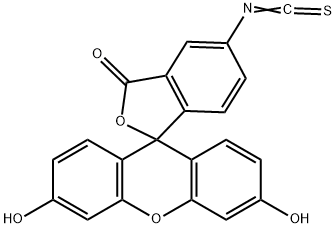
| Description | Fluorescein 5-isothiocyanate (5-FITC) is an isomer of fluorescein isothiocyanate (FITC), which is commonly used as a mixture of the 5- and 6-isothiocyanate isomers. It reacts with amine and thiol groups to form conjugates with proteins, lipids, and other molecules for detection by a variety of fluorescent-based applications. 5-FITC displays excitation/emission maxima of 494/519 nm, respectively. | | Chemical Properties | Orange-yellow cryst. | | Uses | Fluorescein -5-isothiocyanate is a kind of fluorescent marker for biochemical applications. Reacts under mild conditions with primary amines and it is also used in modification of actin at lys-61, labelling of FAB and the modification of thiol groups.
| | Uses | Fluorescein isothiocyanate isomer I has been used for the staining of conidia. | | Uses | Fluorescein isothiocyanate is used as fluorescent labeling reagent for proteins and for rapid identification of pathogens in fluorescent antibody technique. It is also used as a reagent for microsequencing of proteins and peptides (HPLC). On celite it is used for the labeling of fibrinogen. | | Uses | Fluorescent labeling reagent for proteins. Used in the fluorescent antibody technique for rapid identification of pathogens | | Definition | ChEBI: The 5-isomer of fluorescein isothiocyanate. Acts as a fluorescent probe capable of being conjugated to tissue and proteins; used as a label in fluorescent antibody staining procedures as well as protein- and amino acid-binding techniques. | | General Description | In immuno histology/ cytology, Fluorescein-5-isothiocyanate (FITC) for biochemistry and for fluorescence microscopy, serve as marker substance for the visualization and for the detection of tissue-bound bio molecules like e.g. antigens, lectins, various proteins, peptides, nucleic acids, oligo- and polysaccharides in samples of human origin. FITC-marked antibodies bind specifically to the appropriate target structures in the tissue. An optimum FITC-protein (antibody) ratio is important for a good result.FITC is an IVD registered product and CE certified, thus can be used for clinical diagnostic purposes. For more details, please see instructions for use (IFU). The IFU can be downloaded from this webpage. | | Purification Methods | It is made from the pure 5-amino isomer. Purify it by dissolving it in boiling Me2CO, filtering and adding pet ether (b 60-70o) until it becomes turbid. If an oil separates, then decant it and add more pet ether to the supernatant and cool. Orange-yellow crystals separate, collect and dry them in vacuo. It should give one spot on TLC (silica gel) in EtOAc/pyridine/AcOH (50:1:1) and in Me2NCHO/CHCl3/28% NH4OH (10:5:4). IR (Me2SO): 2110 (NCS) and 1760 (C=O) cm-1. The max 1HNMR spectra in Me2CO-d6 of the 5-and 6-isomers are distinctly different for the protons in the *benzene ring; the UV in phosphate buffer pH 8.0 shows a at ~490nm. [Sinsheimer et al. Anal Biochem 57 2271974, McKinney et al. Anal Biochem 7 74 1964, Beilstein 19 III/IV 4337.] |
| Fluorescein isothiocyanate isomer I Preparation Products And Raw materials |
|


 日本语
日本语 한국어
한국어 Français
 Deutsch
 España
 Türkiye