Other grades of this product :
| Diallyl phthalate Basic information |
| Diallyl phthalate Chemical Properties |
| Diallyl phthalate Usage And Synthesis |
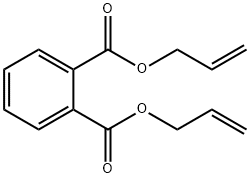
| Chemical Properties | clear colourless to light yellow liquid | | Uses | Diallyl Phthalate is used as a reagent in ring-closing ruthenium based reactions. | | Preparation | Diallyl phthalate (DAP) is prepared by reaction of phthalic anhydride and allyl alcohol:
| | General Description | Clear pale-yellow liquid. Odorless. | | Air & Water Reactions | Incompatible with water and oxygen. Should be stored air tight, with inhibitor, to prevent polymerization reaction . | | Reactivity Profile | Diallyl phthalate can react with oxidizers. Diallyl phthalate can also react with acids and alkalis. Diallyl phthalate is incompatible with water and oxygen. | | Fire Hazard | Diallyl phthalate is combustible. | | Flammability and Explosibility | Notclassified | | Safety Profile | Suspected carcinogen
with experimental carcinogenic data.
Moderately toxic by ingestion, skin contact,
intraperitoneal, and subcutaneous routes. An
eye irritant. Mutation data reported.
Combustible when exposed to heat or
flame; can react with oxidzing materials. To
fight fire, use CO2 or dry chemical. When
heated to decomposition it emits acrid
smoke and irritating fumes. See also ALLYL
COMPOUNDS and ESTERS. | | Carcinogenicity | In the 103-week study referred
to previously, a slight increase in MNCL was seen in
female rats treated with 50 or 100 mg/kg/day of DAP. MNCL
occurs in F344 control rats at a high incidence; however, the
incidence of 51% in female rats at the high dose level was
above historical control data for the laboratory (29%). No
significant increases in tumor incidences were seen in male
rats. Based on this study, DAP was considered to have
demonstrated equivocal evidence for carcinogenicity in
female F344 rats according to the NTP.
In male and female B6C3F1 mice receiving 300 mg/kg of
DAP by gavage for 103 weeks (5 days/week), the incidence
of forestomach papillomas was significantly greater than that
of controls. Because of the rarity of forestomach
papillomas in control B6C3F1 mice and the concomitant
observation of dose-related forestomach hyperplasia, the
development of these tumors was considered to be test
substance related. Compared to controls, a slight increase
in the incidence of lymphomas was observed in males
receiving 300 mg/kg/day of DAP. Because the increase
was not statistically significant compared to historical control
data, this effect was not considered to be test substance
related. |
| Diallyl phthalate Preparation Products And Raw materials |
|


 日本语
日本语 한국어
한국어 Français
 Deutsch
 España
 Türkiye