Other grades of this product :
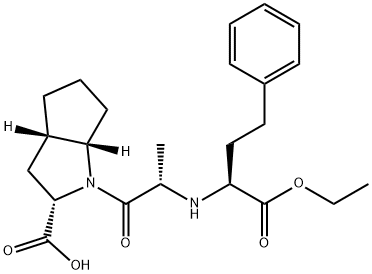
| Product Name: | Ramipril | | Synonyms: | 2-[[1-(2-ethoxycarbonyl-3,3a,4,5,6,6a-hexahydro-2H-cyclopenta[b]pyrrol-1-yl)-1-oxopropan-2-yl]amino]-4-phenylbutanoic acid;(2S,3aS,6aS)-1-[(2S)-2-[[(1S)-1-(Ethoxycarbonyl)-3-phenylpropyl]amino]-1-oxopropyl]octahydrocyclopenta[b]pyrrole-2-carboxylic acid;(2S,3aS,6aS)-1-[(2S)-2-{[(2S)-1-ethoxy-1-oxo-4-phenylbutan-2-yl]aMino}propanoyl]-octahydrocyclopenta[b]pyrrole-2-carboxylic acid;RaMipril(Altace);(2S,3aS,6aS)-;RaMipril API;Ranipril;(2s-(1(r*(r*)),2-alpha,3a-beta,6a-beta))-henylpropyl)amino)-1-oxopropyl | | CAS: | 87333-19-5 | | MF: | C23H32N2O5 | | MW: | 416.51 | | EINECS: | 642-904-3 | | Product Categories: | Ramipril;Angiotensin;Aromatics;Heterocycles;API;Cardiovascular & Blood System Agents;Active Pharmaceutical Ingredients;Intermediates & Fine Chemicals;Pharmaceuticals | | Mol File: | 87333-19-5.mol |
| Ramipril Chemical Properties |
| Melting point | 106-108°C | | alpha | D24 +33.2° (c = 1 in 0.1N ethanolic HCl) | | Boiling point | 616.2±55.0 °C(Predicted) | | density | 1.200±0.06 g/cm3(Predicted) | | storage temp. | 2-8°C | | solubility | DMSO: ~18mg/mL | | pka | pKa 3.30±0.01(H2O
t = 25.0
I = 0.15 (KCl)) (Uncertain);5.75±0.00(H2O
t = 25.0
I = 0.15 (KCl)) (Uncertain) | | form | powder | | color | white | | CAS DataBase Reference | 87333-19-5(CAS DataBase Reference) |
| Hazard Codes | Xi | | Risk Statements | 36/38 | | Safety Statements | 26-37/39 | | WGK Germany | 2 | | RTECS | GY5879600 | | HS Code | 2933995300 | | Hazardous Substances Data | 87333-19-5(Hazardous Substances Data) | | Toxicity | LD50 (14 day) in male, female mice, male, female rats (mg/kg): 1194, 1158, 687, 608 i.v.; 10933, 10048, >10000, >10000 orally (Donaubauer, Mayer) |
| Ramipril Usage And Synthesis |
| Description | Ramipril (brand name: Altace) is a kind of prodrug which is capable of inhibiting the angiotensin-converting enzyme (ACE) which converting angiotensin I to angiotensin II. It is metabolized to ramiprilat in the liver which exerts the effect of ACE inhibition. It is used for the treatment of hypertension, congestive heart failure and nephropathy. It can also be used for the prevention of heart attack, stroke and cardiovascular death. It can also be used for the treatment of kidney damage due to diabetes with protein-containing urine. Ramiprilat, is the competitive inhibitor of ATI for binding to ACE, further inhibiting the enzymatic proteolysis of ATI to ATII, alleviating the effect of ATII on blood pressure.
| | References | https://en.wikipedia.org/wiki/Ramipril
https://www.drugbank.ca/drugs/DB00178
| | Description | Ramipril, a prodrug of ramiprilat, is a long-acting, tissue-specific and non-sulfhydryl ACE
inhibitor useful in the treatment of mild to moderate hypertension. In animal studies
ramipril exerted cardioprotective effects resembling those of bradykinin in cardiac
reperfusion injuries. Ramipril is also reportedly useful in congestive heart failure. | | Chemical Properties | White Solid | | Originator | Hoechst AG (W. Germany) | | Uses | An antihypertensive. An angiotensin converting enzyme (ACE) inhibitor, converted to active, diacid metabolite | | Uses | cardiotonic | | Uses | An inhibitor of the angiotensin- coverting enzyme (ACE) | | Uses | Angiotensin-converting enzyme (ACE) removes the C-terminal dipeptide from angiotensin I to form angiotensin II, a powerful vasoconstrictor. ACE is a key regulator of the renin-angiotensin system and an important drug target for the treatment of hypertension, congestive heart failure, and heart attacks, and also in preventing renal and retinal complications in diabetes. Ramipril is a second generation ACE inhibitor (IC50 = 4 nM) that acts as a prodrug, which is hydrolyzed in vivo to the active metabolite ramiprilat. The antihypertensive and cardioprotective efficacy of ramipril has been demonstrated in large-scale noncomparative studies and clinical trials.[Cayman Chemical] | | Definition | ChEBI: A dipeptide that is the prodrug for ramiprilat, the active metabolite obtained by hydrolysis of the ethyl ester group. An angiotensin-converting enzyme (ACE) inhibitor, used to treat high blood pressure and congestive heart failure. | | Brand name | Altace (King);Triatec. | | General Description | Ramipril, (2S, 3aS, 6aS)-1-[(S)-N-[(S)-1-carboxy-3-phenylpropyl]alanyl]octahydrocyclopenta[b]-pyrrole-2-carboxylic acid 1-ethyl ester (Altace), ishydrolyzed to ramiprilat, its active diacid form, faster thanenalapril is hydrolyzed to its active diacid form. Peak serumconcentrations from a single oral dose are achieved between1.5 and 3 hours. The ramiprilate formed completely suppresses ACE activity for up to 12 hours, with 80% inhibitionof the enzyme still observed after 24 hours. | | Biochem/physiol Actions | Angiotensin converting enzyme (ACE) inhibitor. | | Clinical Use | Angiotensin-converting enzyme inhibitor:
Hypertension
Secondary prevention of myocardial infarction (MI),
stroke or cardiovascular death
Heart failure
Diabetic nephropathy | | Veterinary Drugs and Treatments | Ramipril is a long-acting angiotensin converting enzyme (ACE) inhibitor
that may be useful in treating heart failure or hypertension
in dogs or cats. It is an approved product in the UK for treating
heart failure in dogs. In cats, ramipril has been used for treating
arterial hypertension. A recent study (MacDonald, Kittleson et al.
2006) did not show any significant benefit using ramipril in treating
Maine Coon cats with hypertrophic cardiomyopathy without
heart failure.
Like other ACE inhibitors, it may potentially be useful as adjunctive
treatment in chronic renal failure and protein losing nephropathies.
In dogs with moderate renal impairment (such as might be
found with CHF), there is apparently no need to adjust ramipril
dosage. | | Drug interactions | Potentially hazardous interactions with other drugs
Anaesthetics: enhanced hypotensive effect.
Analgesics: antagonism of hypotensive effect and
increased risk of renal impairment with NSAIDs;
hyperkalaemia with ketorolac and other NSAIDs.
Antihypertensives: increased risk of hyperkalaemia,
hypotension and renal failure with ARB’S and aliskiren.
Bee venom extract: possible severe anaphylactoid
reactions when used together.
Ciclosporin: increased risk of hyperkalaemia and
nephrotoxicity.
Cytotoxics: increased risk of angioedema with
everolimus.
Diuretics: enhanced hypotensive effect;
hyperkalaemia with potassium-sparing diuretics.
ESAs: increased risk of hyperkalaemia; antagonism
of hypotensive effect.
Gold: flushing and hypotension with sodium
aurothiomalate.
Lithium: reduced excretion (possibility of enhanced
lithium toxicity).
Potassium salts: increased risk of hyperkalaemia.
Tacrolimus: increased risk of hyperkalaemia and
nephrotoxicity | | Metabolism | Ramipril is metabolised in the liver to its active
metabolite, ramiprilat, and other inactive metabolites.
It is excreted mainly in the urine, as ramiprilat, other
metabolites, and some unchanged drug. About 40% of an
oral dose appears in the faeces; this may represent both
biliary excretion and unabsorbed drug. |
| Ramipril Preparation Products And Raw materials |
| Raw materials | Ethyl acetate-->Dichloromethane-->Acetic acid-->Cyclohexane-->Formamide-->Pyrrolidine-->L-Alanine-->Methyl propionate-->Cyclopentene-->Palladium carbon fine chemical catalyzer-->Ethyl 3-benzoylacrylate-->2-Azabicyclo[3.3.0]octane-3-carboxylic acid-->Benzenebutanoic acid, α-[[(1S)-2-chloro-1-methyl-2-oxoethyl]amino]-, ethyl ester, hydrochloride (αS)--->2-[N-[(S)-1-ETHOXYCARBONYL-3-PHENYLPROPYL]-L-ALANYL]-(1S,3S,5S)-2-AZABICYCLO[3.3.0]OCTANE-3-CARBOXYLIC ACID, BENZYL ESTER-->Ethyl (S)-2-[(S)-4-methyl-2,5-dioxo-1,3-oxazolidin-3-yl]-4-phenylbutyrate | | Preparation Products | (2R,3aR,6aR)-Ramipril |
|


 日本语
日本语 한국어
한국어 Français
 Deutsch
 España
 Türkiye