Other grades of this product :
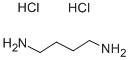
| 1,4-Diaminobutane dihydrochloride Basic information |
| Product Name: | 1,4-Diaminobutane dihydrochloride | | Synonyms: | DIAMINOBUTANE DIHYDROCHLORIDE;1,4-BUTANEDIAMINE DIHYDROCHLORIDE;1,4-BUTANEDIAMMONIUM DICHLORIDE;1,4-DIAMINOBUTANE 2HCL;1,4-Diaminobutane dihydrochloride,1,4-Butanediamine dihydrochloride, 1,4-Diaminobutane dihydrochloride, Putrescine dihydrochloride, Tetramethylenediamine dihydrochloride;Putrescine dihydrochloride,1,4-Butanediamine dihydrochloride, 1,4-Diaminobutane dihydrochloride, Tetramethylenediamine dihydrochloride;1,4-DiaMinobutane dihydrochloride, 99+% 25GR;Putrescine 2HCl | | CAS: | 333-93-7 | | MF: | C4H14Cl2N2 | | MW: | 161.07 | | EINECS: | 206-375-9 | | Product Categories: | Heterocyclic Compounds;antibiotic | | Mol File: | 333-93-7.mol |
| 1,4-Diaminobutane dihydrochloride Chemical Properties |
| Melting point | 280 °C (dec.)(lit.) | | Boiling point | 265.47°C (rough estimate) | | density | 1.2524 (rough estimate) | | refractive index | 1.6300 (estimate) | | storage temp. | Store below +30°C. | | solubility | H2O: 100 mg/mL | | form | powder | | color | White | | Water Solubility | almost transparency | | Sensitive | Hygroscopic | | Merck | 14,7947 | | BRN | 3906680 | | Stability: | Stable, but hygroscopic. Substances to be avoided: strong oxidizing agents. Combustible. | | InChIKey | XXWCODXIQWIHQN-UHFFFAOYSA-N | | CAS DataBase Reference | 333-93-7(CAS DataBase Reference) | | EPA Substance Registry System | 1,4-Diaminobutane dihydrochloride (333-93-7) |
| 1,4-Diaminobutane dihydrochloride Usage And Synthesis |
| Chemical Properties | white powder | | Uses | Putrescine dihydrochloride has been used as medium component in F-12 + GlutaMax medium for mice ganglia culture, retinal ganglion cell culture and in HCT116 colon carcinoma cells for ornithine decarboxylase (ODC) assay. | | General Description | Putrescine is an end product of fatty acid metabolism in dead tissues. It is a volatile diamine with pungent odour. It is synthesized by the decarboxylation of ornithine in the presence of enzyme, ornithine decarboxylase. Molecular docking studies reveal the binding of putrescine to human receptors called the trace amine-associated receptors (TAAR6 and TAAR8), present in olfactory epithelium. | | Biochem/physiol Actions | Binds to the polyamine modulatory site of the NMDA receptor and potentiates NMDA-induced currents; precursor of spermidine. | | Purification Methods | Crystallise the salt from EtOH/H2O. [Beilstein 4 IV 1284.] |
| 1,4-Diaminobutane dihydrochloride Preparation Products And Raw materials |
|


 日本语
日本语 한국어
한국어 Français
 Deutsch
 España
 Türkiye