Other grades of this product :
| Spiramycin Basic information |
| Spiramycin Chemical Properties |
| Melting point | 126-128 °C | | Boiling point | 914℃ | | alpha | D20 -80° (methanol) | | refractive index | 81 ° (C=2, 10% AcOH) | | Fp | >110°(230°F) | | storage temp. | 2-8°C | | solubility | ethanol: 50 mg/mL, clear to slightly hazy, light-yellow | | form | powder | | color | white to light yellow | | optical activity | [α]/D -85 to -80° in water (Specific rotation (dry basis)) | | Water Solubility | Soluble in methanol. Slightly soluble in water | | Merck | 14,8752 | | CAS DataBase Reference | 8025-81-8 |
| Spiramycin Usage And Synthesis |
| Chemical Properties | An antibiotic substance.
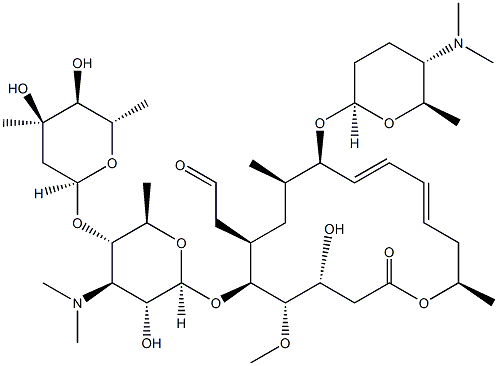
| | Originator | Rovamycine,Specia,France,1972 | | Uses | antibacterial | | Uses | vitamin A | | Uses | Spiramycin I (foromacidin A) is the major analogue of a complex of 16-membered macrocyclic lactones produced by S. ambofaciens and S. spiramyceticus that have broad spectrum antibiotic activity. Spiramycins are unusual among the macrocyclic lactones in that they contain two basic sugars. Spiramycin complex has been used in both human and animal health but its use has not been widespread. | | Manufacturing Process | The process for producing spiramycin comprises inoculating an aqueous
nutrient medium with a culture of the NRRL No. 2420, allowing aerobic
fermentation to take place and separating from the culture medium the
spiramycin thus formed. The culture medium also contains the antibiotic
substance known as Congocidin which, however, does not possess the same
useful properties as spiramycin and which can be isolated in crystalline form.
The separation of the two antibiotic substances is readily achieved. | | Brand name | Rovamycin (Rhone-Poulenc Rorer). | | Therapeutic Function | Antibacterial | | Antimicrobial activity | Enterobacteriaceae are resistant. Spiramycin is also active against anaerobic species: Actinomyces israelii (MIC 2–4 mg/L), Cl. perfringens (MIC 2–8 mg/L) and Bacteroides spp. (MIC 4–14 mg/L). It is also active against Tox. gondii. | | Hazard | Poison; moderately toxic; teratogen; muta-
gen; can cause hypermotility, diarrhea, nausea, or
vomiting.
| | Pharmaceutical Applications | A fermentation product of Streptomyces ambofaciens, composed of several closely related compounds. Spiramycin 1 is the major component (c. 63%); spiramycins 2 and 3 are the acetate and monopropionate esters, respectively. It is available for oral administration and as spiramycin adipate for intravenous infusion. Spiramycins are relatively stable in acid conditions. A derivative, acetylspiramycin, is available in Japan. | | Pharmacokinetics | Oral absorption: Variable Cmax 1 g oral: 2.8 mg/L after 2 h Plasma half-life:4–8h Volume of distribution :383 LPlasma protein binding :15%In healthy volunteers given 2 g orally followed by 1 g every 6 h, peak plasma levels were 1.0–6.7 mg/L. After 1 g orally the AUC was 10.8 mg.h/L, with an apparent elimination halflife of 2.8 h. It is widely distributed in the tissues. It does not reach the CSF. Levels 12 h after a dose of 1 g were 0.25 mg/L in serum, 5.3 mg/L in bone and 6.9 mg/L in pus. Levels of 10.6 mg/L have been found 4 h after dosing in saliva, and concentrations at least equal to those in the serum are seen in bronchial secretions. A concentration of 27 mg/g was found in prostate tissues after repeated dosage. Only 5–15% is recovered from the urine. Most is metabolized, but significant quantities are eliminated via the bile, in which concentrations up to 40 times those in the serum may be found. | | Side effects | Spiramycin is generally well tolerated, the most common adverse reactions being gastrointestinal disturbances, notably abdominal pain, nausea and vomiting, rashes and sensitization following contact. |
| Spiramycin Preparation Products And Raw materials |
|


 日本语
日本语 한국어
한국어 Français
 Deutsch
 España
 Türkiye