Other grades of this product :
| (2-Bromoethyl)benzene Basic information |
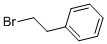
| Product Name: | (2-Bromoethyl)benzene | | Synonyms: | 1-BROMO-2-PHENYLETHANE;PHENYL ETHYL BROMIDE;PHENETHYL BROMIDE;(2-bromoethyl)-benzen;.beta.-Phenylethylbromide;2-Phenethyl bromide;2-phenethylbromide;2-Phenyl-1-bromoethane | | CAS: | 103-63-9 | | MF: | C8H9Br | | MW: | 185.06 | | EINECS: | 203-130-8 | | Product Categories: | fine chemicals;103-63-9 | | Mol File: | 103-63-9.mol |
| (2-Bromoethyl)benzene Chemical Properties |
| Melting point | -56 °C | | Boiling point | 220-221 °C(lit.) | | density | 1.355 g/mL at 25 °C(lit.) | | refractive index | n20/D 1.556(lit.) | | Fp | 193 °F | | storage temp. | 2-8°C | | solubility | 0.039g/l | | form | Liquid | | color | Clear colorless to pale yellow | | Water Solubility | INSOLUBLE | | BRN | 507487 | | Stability: | Stable. Incompatible with strong oxidizing agents. | | InChIKey | WMPPDTMATNBGJN-UHFFFAOYSA-N | | CAS DataBase Reference | 103-63-9(CAS DataBase Reference) | | NIST Chemistry Reference | 1-Bromo-2-phenylethane(103-63-9) | | EPA Substance Registry System | Benzene, (2-bromoethyl)- (103-63-9) |
| (2-Bromoethyl)benzene Usage And Synthesis |
| Description | Phenethylbromide is an analytical reference material that is structurally categorized as an organobromide. It is used in the synthesis of a variety of compounds, including fentanyl. Phenethylbromide is combined with 4-piperidinone to produce N-phenethyl-4-piperidone, which, as a precursor in the synthesis of fentanyl (Item Nos. ISO60197 | 14719), is scheduled as a List I chemical in the United States. Phenethylbromide may be found as in impurity in samples of fentanyl produced using this pathway. | | Chemical Properties | colourless to yellow liquid. It is miscible with ether and benzene, but insoluble in water. | | Uses | (2-Bromoethyl)benzene is used in the preparation of phenelzine by reacting with hydrazine. It is also used as a starting material to prepare various beta-phenethyl derivatives, active pharmaceutical ingredients, and fragrances. It finds application as a flame retardant. | | Preparation | (2-Bromoethyl)benzene is synthesized by the reaction of phenethyl alcohol with hydrogen bromide.Reaction: The phenethyl alcohol was heated to 110°C, hydrogen bromide was slowly introduced, and the reaction was refluxed. The reaction was completed, cooled, washed with water, 10% sodium carbonate solution, and water in turn. After drying with anhydrous potassium carbonate, fractional distillation under reduced pressure was carried out to collect fractions at 97-99°C (2.0 kPa) with a yield of over 90%. | | Synthesis Reference(s) | The Journal of Organic Chemistry, 29, p. 2317, 1964 DOI: 10.1021/jo01031a051Synthetic Communications, 20, p. 2349, 1990 DOI: 10.1080/00397919008053179 | | Synthesis | Phenethylbromide is usually manufactured by the free-radical addition of HBr to styrene.The typical batch process is run in a glasslined reactor by sparging gaseous HBr through a solution of styrene in an inert solvent containing a free-radical initiator. The reaction, which is rapid and moderately exothermic, can be controlled by introducing HBr at about the rate it is consumed. When styrene is completely converted, any excess HBr that is present can be recovered by various techniques prior to recovery of solvent and product by distillation. | | Purification Methods | Wash the bromide with conc H2SO4, water, aqueous 10% Na2CO3 and water again, then dry it with CaCl2 and fractionally distil it just before use. [Beilstein 5 IV 907.] |
| (2-Bromoethyl)benzene Preparation Products And Raw materials |
|


 日本语
日本语 한국어
한국어 Français
 Deutsch
 España
 Türkiye