Other grades of this product :
| Parthenolide Basic information |
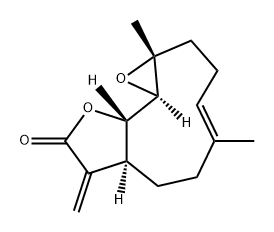
| Product Name: | Parthenolide | | Synonyms: | Parthenolide, Tanacetum parthenium - CAS 20554-84-1 - Calbiochem;Factory Price Parthenolide 20554-84-1;Natural Plant Extracts Parthenolide 20554-84-1 High Purity HPLC>98%;Feverfew P.E Parthenlide;[1aR-(1aR*,4E,7aS*,10aS*,-10bR*)]-2,3-6,7,7a,8,10a,10b-Octahydro-1a,5-dimethyl-8-methyleneoxireno[9,10]cyclodeca[1,2-b]furan-9(1aH)-one;(1aR,4E,7aS,10aS,10bS)-2,3,6,7,7a,8,10a,10b-Octahydro-1a,5-dimethyl-8-methyleneoxireno[9,10]cyclodeca[1,2-b]furan-9(1aH)-one;4,5α-Epoxy-6β-hydroxygermacra-1(10),11(13)-dien-12-oic acid γ-lactone;4,5alpha-epoxy-6beta-hydroxy-germacra-1(10),11(13)-dien-12-oic acid gamma-lactone | | CAS: | 20554-84-1 | | MF: | C15H20O3 | | MW: | 248.32 | | EINECS: | 692-532-0 | | Product Categories: | inhibitor;chemical reagent;pharmaceutical intermediate;phytochemical;reference standards from Chinese medicinal herbs (TCM).;standardized herbal extract;Sesqui-Terpenoids;Isoprenoid/terpenoidNeurotransmitters;Anti-Proliferative AgentsNutrition Research;Antitumor Agents;Biochemicals Found in Plants;Cancer Research;Others;Natural Product;Serotonergics;Prostanoid receptor and related | | Mol File: | 20554-84-1.mol |
| Parthenolide Chemical Properties |
| Melting point | 115-116 °C (lit.) | | alpha | D20 -81.4° (c = 1.04 in chloroform); D22 -71.4° (c = 0.220 in CH2Cl2) | | Boiling point | 394.1±42.0 °C(Predicted) | | density | 1.13±0.1 g/cm3(Predicted) | | storage temp. | -20°C | | solubility | Soluble in DMSO (up to 100 mg/ml) or in Ethanol (up to 20 mg/ml) | | form | White solid | | color | White | | Merck | 14,7048 | | Stability: | Stable for 1 year from date of purchase as supplied. Solutions in DMSO or ethanol may be stored at -20° for up to 3 months. | | CAS DataBase Reference | 20554-84-1 |
| Parthenolide Usage And Synthesis |
| Description | Parthenolide is an allergen in feverfew (Tanacetum
parthenarium). | | Chemical Properties | White solid | | Uses | Antiinflammatory;MAP kinase inhibitor | | Uses | Parthenolide is a sesquiterpene lactone from the plant feverfew (T. parthenium). It inhibits the growth of the promastigote form of L. amazonensis (IC50 = 3.6 μg/ml). Parthenolide also induces apoptosis in cancer cells, at least in part by inhibiting NF-κB- and STAT-mediated anti-apoptotic gene transcription. This compound has also been shown to block inflammation by inhibiting signaling through NF-κB. Inhibition of NF-κB by parthenolide can be achieved by direct binding of the pattern recognition receptor NOD2 by parthenolide. | | Uses | Parthenolide is an anti-inflammatory agent used in the treatment of ischemic injury. Also acts as an anti-tumor and anti0leukemia agent targetting acute myeloid leukemia. | | Definition | ChEBI: A sesquiterpene lactone and active principle of Feverfew (Tanacetum parthenium). | | General Description | This substance is a primary reference substance with assigned absolute purity (considering chromatographic purity, water, residual solvents, inorganic impurities). The exact value can be found on the certificate. Produced by PhytoLab GmbH & Co. KG | | Biological Activity | The active principle of feverfew (Chrysanthemum parthenium), widely used as a herbal remedy for arthritis and migraine and as a febrifuge. Parthenolide is antisecretory, anti-inflammatory, spasmolytic and inhibits the release of 5-HT from blood platelets. Also inhibits generation of leukotriene B 4 and thromboxane B 2 . | | Biochem/physiol Actions | Parthenolide is a sesquiterpene lactone present abundantly in the leaves and flowers of Tanacetum parthenium. It exhibits anti-cancer properties for the treatment of invasive cancers. Parthenolide exhibits therapeutic effects against inflammation and migraine. It plays a role in signal transduction and activation of transcription (STAT)-inhibition-mediated transcriptional repression of pro-apoptotic genes. | | Contact allergens | Parthenolide is a sesquiterpene lactone found Asteraceae-
Compositae such as feverfew (Tanacetum parthenium
Schultz-Bip.) or congress grass (Parthenium hysterophorus
L.). | | References | 1) Kwok et al. (2001), The anti-inflammatory natural product parthenolide from the medicinal herb Feverfew directly binds to and inhibits IkappaB kinase; Chem. Biol., 8 759
2) Hwang et al. (1996), Inhibition of the expression of inducible cyclooxygenase and proinflammatory cytokines by sequiterpene lactones in macrophages correlates with the inhibition of MAP kinases; Biochem. Biophys. Res. Commun., 226 810
3) Barsby et al. (1992), Feverfew extracts and parthenolide irreversibly inhibit vascular responses of the rabbit aorta; J. Pharm. Pharmacol., 44 737
4) Sumner et al. (1992), Inhibition of 5-lipoxygenase and cyclo-oxygenase in leukocytes by feverfew. Involvement of sesquiterpene lactones and other components; Biochem. Pharmacol., 43 2313
5) Groenewegen et al. (1990), A comparison of the effects of an extract of feverfew and parthenolide, a component of feverfew, on human platelet activity in-vitro; J. Pharm. Pharmacol., 42 553 |
| Parthenolide Preparation Products And Raw materials |
|


 日本语
日本语 한국어
한국어 Français
 Deutsch
 España
 Türkiye