Other grades of this product :
| Mirtazapine Basic information |
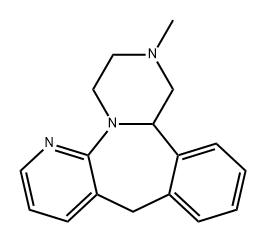
| Product Name: | Mirtazapine | | Synonyms: | 1,2,3,4,10,14B-HEXAHYDRO-2-METHYLPYRAZINO[2,1-A]PYRIDO[2,3-C][2]BENZAZEPINE;(rs)-1,2,3,4,10,14b-hexahydro-2-methylpyrazino-[2,1-a]pyrido[2,3-c][2]benzazepine;REMERON;ORG-3770;MIRTAZANINE;MIRTAZAPINE;MIRTAZEPINE;ZISPIN | | CAS: | 85650-52-8 | | MF: | C17H19N3 | | MW: | 265.35 | | EINECS: | 288-060-6 | | Product Categories: | Other APIs;Serotonin receptor;Heterocycles;Intermediates & Fine Chemicals;Pharmaceuticals | | Mol File: | 85650-52-8.mol |
| Mirtazapine Chemical Properties |
| Melting point | 114-116°C | | Boiling point | 432.4±45.0 °C(Predicted) | | density | 1.22±0.1 g/cm3(Predicted) | | Fp | 9°C | | storage temp. | 2-8°C | | solubility | DMSO: ~8 mg/mL, soluble | | form | solid | | pka | 8.10±0.20(Predicted) | | color | white | | CAS DataBase Reference | 85650-52-8(CAS DataBase Reference) |
| Hazard Codes | Xn | | Risk Statements | 22 | | Safety Statements | 22-24/25 | | RIDADR | UN1230 - class 3 - PG 2 - Methanol, solution | | WGK Germany | 3 | | RTECS | UQ4410250 | | HS Code | 29339900 |
| Mirtazapine Usage And Synthesis |
| Chemical Properties | White Solid | | Uses | Mirtazapine (Remeron, Avanza) is a potent tetracyclic antidepressant. Mirtazapine (Remeron, Avanza) used primarily in the treatment of depression. It is also sometimes used as a hypnotic, antiemetic, and appetite stimulant, and for the treatment of anxiet | | Uses | Mirtazapine is an α2-Adrenergic blocker; analogue of Mianserin. Antidepressant. | | Uses | An α2-Adrenergic blocker; analogue of Mianserin. Antidepressant. | | Brand name | Remeron (Organon). | | General Description | Mirtazapine is a tetracyclic antidepressant marketed under the trade names Remeron?, Avanza, or Zispin for treatment of depression.?This Certified Spiking Solution? is suitable for LC/MS or GC/MS applications in forensic analysis, clinical toxicology, or urine drug testing. | | Biological Activity | Antidepressant agent; potent 5-HT 2 , 5-HT 3 and histamine H 1 receptor antagonist and moderately potent α 2 -adrenoceptor antagonist (pK i values are 8.05, ~ 8.1, 9.3 and 6.95 respectively). Enhances noradrenalin (NA) release in rat brain via inhibition of α 2 -adrenergic autoreceptors and displays only weak affinity for monoamine transporters (pK i values are 5.6, < 5 and < 5.1 for inhibition of NA, dopamine and 5-HT uptake respectively). Increases hippocampal NA and 5-HT levels in rats following systemic administration in vivo . | | Biochem/physiol Actions | Mirtazapine is a noradrenergic and specific serotonergic antidepressant (NaSSA). Mirtazapine agonizes selective adrenergic and serotonergic receptors so that both NE release and 5-HT1A mediated serotonergic signaling are increased. | | Clinical Use | Antidepressant | | Veterinary Drugs and Treatments | Currently, the only FDA approved indication for mirtazapine is
depression in humans. Reported veterinary uses include treatment
of chemotherapy-induced nausea and vomiting (CINV); anorexia
associated with renal failure (azotemia), congestive heart failure,
gastro-intestinal disorders, liver disease, or neoplasia. Other uses
suggested include stress induced diseases; insomnia; post-pyometra
symptoms; and post-operative inappetance. Studies have shown
that mirtazapine also alleviated sleep apnea in rats and humans.
There are case reports published in human literature of mirtazapine
use as treatment for non-mechanical vomiting after gastric
bypass, CINV, obsessive-compulsive disorder, nocioception
and chronic pain, migraine headache prophylaxis, anti-psychotic
induced akathisia, idiopathic nausea and vomiting, serotonin syndrome
induced nausea, anorexia, irritable bowel syndrome, resistant
hyperemesis gravidarum, and for the treatment of negative
symptoms of schizophrenia. Studies in rats have also shown that
mirtazapine significantly improves memory. | | Drug interactions | Potentially hazardous interactions with other drugs
Alcohol: increased sedative effect.
Antidepressants: possibly increased risk of
serotonergic effects with fluoxetine, fluvoxamine or
venlafaxine; CNS excitation and hypertension with
MAOI and moclobemide - avoid.
Antimalarials: avoid with artemether and
lumefantrine and piperaquine with artenimol.
Methylthioninium: risk of CNS toxicity - avoid if
possible. | | Metabolism | Extensively metabolised in the liver via CYP2D6,
CYP1A2, and CYP3A4. The major biotransformation
pathways are demethylation and oxidation followed by
glucuronide conjugation. The N-desmethyl metabolite is
pharmacologically active.
Elimination is via urine and faeces (15%). |
| Mirtazapine Preparation Products And Raw materials |
|


 日本语
日本语 한국어
한국어 Français
 Deutsch
 España
 Türkiye