Other grades of this product :
| 5-Aminolevulinic acid hydrochloride Basic information |
| 5-Aminolevulinic acid hydrochloride Chemical Properties |
| Melting point | ~150 °C (dec.) | | Fp | 155-157°C | | storage temp. | -20°C | | solubility | H2O: 50 mg/mL | | form | powder | | color | White to pale yellow | | PH | pH (10g/l, 25℃) : 2.5~3.0 | | Water Solubility | Soluble in dimethyl sulfoxide, methanol and water. | | Decomposition | 155-157 ºC | | Sensitive | Hygroscopic | | Merck | 14,446 | | BRN | 3690651 | | InChIKey | ZLHFONARZHCSET-UHFFFAOYSA-N | | CAS DataBase Reference | 5451-09-2(CAS DataBase Reference) |
| 5-Aminolevulinic acid hydrochloride Usage And Synthesis |
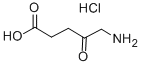
| Chemical Properties | white to pale yellow crystals or | | Originator | Levulan Kerastick,DUSA
Pharmaceuticals Inc. | | Uses | 5-Aminolevulinic acid hydrochloride finds an important role as a precursor in the synthesis of tetrapyrroles such as chlorophyll and heme. It is widely utilized in photodynamic therapy of diseases namely, Paget?s disease and human papillomavirus (HPV) infection-associated cervical condylomata acuminata. | | Uses | Naturally occurring amino acid; precursor of tetrapyrroles in the biosynthesis of chlorophyll and heme. Antineoplastic (photosensitizer). | | Uses | 5-Aminolevulinic acid hydrochloride has been used as a supplement for culturing Escherichia coli cells for heme biosynthesis. | | Definition | ChEBI: A hydrochloride that is the monohydrochloride of 5-aminolevulinic acid. It is metabolised to protoporphyrin IX, a photoactive compound which accumulates in the skin. Used in combination with blue light illumination for the treatment of minimally to moderat
ly thick actinic keratosis of the face or scalp. | | Manufacturing Process | 1) Oxidation Step
2.27 g (10.0 mmol) of N-furfurylphthalimide was charged into a three-necked
glass flask equipped with an oxygen feed tube, a thermometer, and a reflux
condenser, and dissolved in 100 ml of anhydrous pyridine. After the addition
of 7.0 mg of Rose Bengal, oxygen gas was fed at a rate of 20 ml/min at 10°-
20°C under irradiation by light. A 27 W white fluorescent lamp was used as a
light source and the radiation was performed from the outside of the flask.
After 7 hours, the irradiation was terminated and the pyridine was evaporated
under reduced pressure to obtain 2.47 g of a light brown, semi-crystalline
product.
2) Reduction Step (Hydrogenation)
2.00 g of the semi-crystalline solid obtained in (1) was dissolved in 40 ml of
methanol and stirred at 50°C in a hydrogen atmosphere under atmospheric
pressure in the presence of 200 mg of 5% palladium-on-carbon catalyst.
After five hours, the reaction was terminated and the mixture was allowed to
cool to room temperature. The catalyst was removed by filtration and
methanol was evaporated to obtain 2.11 g of white crystals.
The crystals were identified to be 5-phthalimidolevulinic acid by NMR analysis.
The yield was 97%.
3) Hydrolysis Step
100 ml of 6 N hydrochloric acid was added to 2.11 g of the white crystals (2),
and the mixture was heated under reflux for 5 hours.
After evaporating the hydrochloric acid under reduced pressure, a brown solid
product was obtained and dissolved in ethanol. Acetone was added to the
solution and the crystals produced were collected by filtration to obtain 0.689
g of 5-aminolevulinic acid hydrochloride. The yield based on Nfurfurylphthalimide
was 51%.
NMR spectrum data conformed to 5-aminolevulinic acid hydrochloride | | Therapeutic Function | Photosensitizer | | Biochem/physiol Actions | 5-Aminolevulinic acid (5-ALA) is an intermediate in heme biosynthesis and is useful in cancer treatment. It is a non-protein amino acid. 5-ALA also has applications in the field of agriculture. It is being studied as an inducing reagent for protoporphyrin IX (PPIX) dependent fluorescence diagnosis of metastatic lymph nodes. 5-ALA is used for photodynamic therapy of diseases, such as Paget′s disease and HPV infection-associated cervical condylomata acuminata. | | Purification Methods | Dry ALA-HCl in a vacuum desiccator over P2O5 overnight, then crystallise it by dissolving it in cold EtOH and adding dry Et2O. Also crystallis |
| 5-Aminolevulinic acid hydrochloride Preparation Products And Raw materials |
|


 日本语
日本语 한국어
한국어 Français
 Deutsch
 España
 Türkiye