Other grades of this product :
| Quinoxaline Basic information |
| Quinoxaline Chemical Properties |
| Melting point | 29-32 °C (lit.) | | Boiling point | 220-223 °C (lit.) | | density | 1.124 g/mL at 25 °C (lit.) | | refractive index | nD48 1.6231 | | Fp | 209 °F | | storage temp. | 2-8°C | | solubility | alcohol: freely soluble(lit.) | | pka | 0.56(at 20℃) | | form | Crystalline Low Melting Solid | | color | Light yellow to brown | | Water Solubility | SOLUBLE | | Merck | 14,8078 | | BRN | 109351 | | Stability: | Light Sensitive | | CAS DataBase Reference | 91-19-0(CAS DataBase Reference) | | NIST Chemistry Reference | Quinoxaline(91-19-0) | | EPA Substance Registry System | Quinoxaline (91-19-0) |
| Hazard Codes | Xi | | Risk Statements | 36/37/38-36/38 | | Safety Statements | 26-36-37/39 | | WGK Germany | 3 | | RTECS | VD1225000 | | Hazard Note | Irritant | | TSCA | Yes | | HS Code | 29339990 |
| Quinoxaline Usage And Synthesis |
| Chemical Properties | light yellow to brown crystalline | | Uses | Organic synthesis.
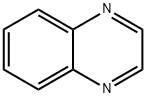
| | Uses | Quinoxaline is a reagent used in the synthesis of quinoxaline diimides as small molecule non-fullerene acceptors for organic solar cells. | | Definition | ChEBI: A naphthyridine in which the nitrogens are at positions 1 and 4. | | Synthesis Reference(s) | Journal of the American Chemical Society, 69, p. 795, 1947 DOI: 10.1021/ja01196a015The Journal of Organic Chemistry, 55, p. 1744, 1990 DOI: 10.1021/jo00293a014Organic Syntheses, Coll. Vol. 4, p. 824, 1963 | | General Description | Transition metal-free acylation of quinoxaline derivatives, by cross dehydrogenative coupling (CDC) reaction, were studied. | | Purification Methods | Crystallise quinoxaline from pet ether. It crystallises as the monohydrate on addition of water to a pet ether solution. It has UV: at 242 and 331nm (Ho –2); 234 and 316nm (pH 7.1). The picrate has m 161-162o.[Albert & Phillips J Chem Soc 1294 1956, Beilstein 23 H 176, 23 II 177, 23 III/IV 1226, 23/7 V 135.] |
| Quinoxaline Preparation Products And Raw materials |
| Raw materials | Sodium bisulfite-->o-Phenylenediamine-->Glyoxal-->QUINOXALINE, 6-BROMO-1,2,3,4-TETRAHYDRO--->5,8-DibroMoquinoxaline-->5-Bromoquinoxaline | | Preparation Products | Olaquindox-->2,3-Pyrazinedicarboxylic acid-->2,3-Pyrazinecarboxylic anhydride-->1,2,3,4-TETRAHYDRO-QUINOXALINE-->6-Bromoquinoxaline |
|


 日本语
日本语 한국어
한국어 Français
 Deutsch
 España
 Türkiye