Other grades of this product :
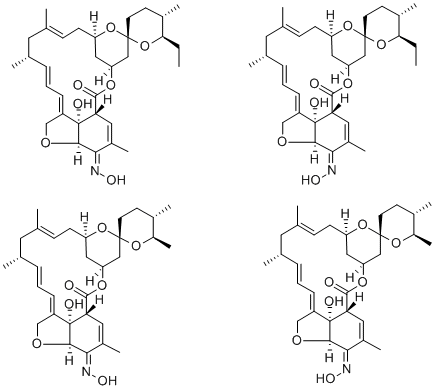
| Product Name: | Milbemycin oxime | | Synonyms: | Milbemycin oxime;Milbemycin Oxime (200 mg);Milbemite;Milbemycin oxime CRS;Milbemycin Oxime (Mixture of Milbemycin Oxime A3 and A4);Milbemycin OximeQ: What is
Milbemycin Oxime Q: What is the CAS Number of
Milbemycin Oxime Q: What is the storage condition of
Milbemycin Oxime;Milbemycin Oxime (1443806);β-phenylacrylophenone | | CAS: | 129496-10-2 | | MF: | 2C32H45NO7.2C31H43NO7 | | MW: | 2194.78 | | EINECS: | 206-141-6 | | Product Categories: | APIs for Veterinary;Inhibitors;API | | Mol File: | 129496-10-2.mol |
| Milbemycin oxime Chemical Properties |
| Melting point | 169.6-177.4° | | Fp | 412℃ | | InChIKey | LKMMLHTWKLEARD-MGZQXKBQSA-N |
| RIDADR | 2588 | | WGK Germany | 3 | | HazardClass | 6.1(b) | | PackingGroup | III | | HS Code | 2932206000 | | Toxicity | LD50 orally in mice: 1000-1500 mg/kg (Ciba-Geigy) |
| Milbemycin oxime Usage And Synthesis |
| Description | Milbemycin is an oral medication used as a dewormer and heartworm preventive. This medication should not be used in doses higher than the recommended heartworm prevention dose, except under veterinary supervision. Studies support the safety of milbemycin products in Collies and other breeds prone to the MDR-1 gene mutation when used at the recommended heartworm prevention dose. | | Uses | Milbemycin Oxime is active against a broad spectrum of nematodes, although it is less potent against heartworms than ivermectin. Its miticide spectrum includes Sarcoptes and Demodex. The USA FDA approval for milbemycin oxime as formulated alone does not indicate insecticidal activity.
The substance is often combined with other parasiticides to achieve a broader spectrum of action. Such products include:
Milbemax (with praziquantel)
Sentinel Flavor Tabs (with lufenuron)
Recently the drug has been used in marine reef aquaria to control parasitic harptacoid copepod (Tegastidae) infestations on captive hard coral colonies. It is an effective full tank treatment for these parasites because it is not toxic to corals in the dosage required to kill the parasites. Shrimps, crabs and other crustaceans should be removed prior to treatment, as they will be killed by the treatment. | | Drug Interactions | Milbemycin should not used in combination with cyclosporine, quinidine or ketoconazole. | | Uses | Intestinal parasite deworming in dogs and for heartworm prevention in dogs and cats. | | Mechanism of action | Like avermectins, milbemycins are products of fermentation by Streptomyces species. They have a similar mechanism of action, but a longer half-life than the avermectins. Milbemycin Oxime is produced by Streptomyces hygroscopicus aureolacrimosus. It opens glutamate sensitive chloride channels in neurons and myocytes of invertebrates, leading to hyperpolarisation of these cells and blocking of signal transfer. | | Side Effects | The drug is tolerated well, even by dogs with multiple drug resistance. In high doses, it can cause side effects like stupor, tremor and ataxia. | | Uses | Milbemycin oxime is a semi-synthetic macrocyclic lactone prepared by the oxidation and oximation of a mixture of two natural products, milbemycin A3 and A4 (in ~30:70 ratio). Milbemycin oxime is used therapeutically for the prevention of intestinal parasites in dogs. Like the other milbemycin/avermectins, it was developed for intestinal parasite control in animals and acts by opening glutamate sensitive chloride channels in neurons of invertebrates leading to paralysis by hyperpolarisation of these cells and signal transfer blocking. | | Uses | controls intestinal parasites in animals | | Veterinary Drugs and Treatments | Milbemycin tablets are labeled as a once-a-month heartworm
preventative (Dirofilaria immitis) and for hookworm control
(Ancylostoma caninum). It has activity against a variety of other
parasites, including adult hookworms (A. caninum), adult roundworms
(T. canis, T. leonina) and whipworms (Trichuris vulpis). In
cats, milbemycin has been used successfully to prevent larval infection
of Dirofilaria immitis.
Milbemycin, like ivermectin can be used for treatment of generalized
demodicosis in dogs, but treatment can be significantly more
expensive. It is likely safer to use in breeds susceptible to mdr1 genetic
mutation (Collies, Shelties, Australian shepherds, etc.) at the
doses used for this indication, but neuro toxicity is possible. Older
dogs, those that have had a long duration of disease prior to treatment,
and dogs with pododemodicosis appear have a lower success
rate with milbemycin treatment. |
| Milbemycin oxime Preparation Products And Raw materials |
|

 日本语
日本语 한국어
한국어 Français
 Deutsch
 España
 Türkiye