Other grades of this product :
| 5,7-dihydroxychromone Basic information |
| 5,7-dihydroxychromone Chemical Properties |
| Melting point | 232-273℃ | | Boiling point | 399℃ | | density | 1.563 | | Fp | 171℃ | | storage temp. | 2-8°C | | solubility | insoluble in H2O; ≥5.41 mg/mL in EtOH with gentle warming; ≥7.05 mg/mL in DMSO | | form | solid | | pka | 6.57±0.20(Predicted) |
| 5,7-dihydroxychromone Usage And Synthesis |
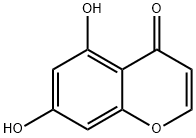
| Description | 5,7-Dihydroxychromone is a flavone decomposition product that has been found in A. hypogaea and has diverse biological activities, including antimicrobial, antioxidant, and neuroprotective properties. It reduces radial growth of the soil pathogenic fungi R. solani and S. rolfsii (IC50s = 18 and 26 μM, respectively) but has no effect on soil pathogenic bacteria of the genus Bradyrhizobium. 5,7-Dihydroxychromone (0.4, 2, and 10 μM) reduces increases in apoptosis and the levels of reactive oxygen species (ROS) induced by 6-OHDA in SH-SY5Y neuroblastoma cells. It also increases the levels of HO-1, NQO1, and GCLc in SH-SY5Y cells when used at concentrations ranging from 0.08 to 10 μM. | | in vitro | 5,7-dihydroxychromone (dhc) (0.4–10 μm) was found to protect against neuronal cell death and the ros generation in a dose-dependent manner in 6-ohda-induced sh-sy5y cells. dhc (0.08–10 μm) also dose-dependently increased the induction of nuclear nrf2, which has a binding affinity to are and activates are-driven phase ii antioxidant enzymes; nqo1, ho-1, and gclc[1]. daphniphyllum macropodum fruit extract (dme) administration in vivo and its major component 5,7-dihydroxychromone (1, 5, and 10 μg/ml) treatment in vitro dose dependently increased the mrna expressions of pparγ and lxrα in 3t3-l1 cells, 5,7-dihydroxychromone (1 μg/ml ) also potently increased adipocyte differentiation, suggesting that it functions as a pparγ agonist and has anti-diabetic properties[2]. 5,7-dihydroxychromone also demonstrated significant activity against hiv replication in h9 lymphocyte cells[3]. | | references | [1]. kim d w, lee k, kwon j, et al. neuroprotection against 6-ohda-induced oxidative stress and apoptosis in sh-sy5y cells by 5, 7-dihydroxychromone: activation of the nrf2/are pathway[j]. life sciences, 2015, 130: 25-30.[2]. koo h j, kwak j h, kang s c. anti-diabetic properties of daphniphyllum macropodum fruit and its active compound[j]. bioscience, biotechnology, and biochemistry, 2014, 78(8): 1392-1401.[3]. wu p l, lin f w, wu t s, et al. cytotoxic and anti-hiv principles from the rhizomes of begonia nantoensis[j]. chemical and pharmaceutical bulletin, 2004, 52(3): 345-349. |
| 5,7-dihydroxychromone Preparation Products And Raw materials |
|


 日本语
日本语 한국어
한국어 Français
 Deutsch
 España
 Türkiye