Other grades of this product :
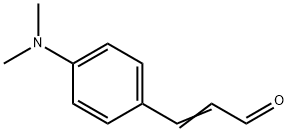
| 4-(Dimethylamino)cinnamaldehyde Basic information |
| 4-(Dimethylamino)cinnamaldehyde Chemical Properties |
| Hazard Codes | Xi | | Risk Statements | 36/37/38 | | Safety Statements | 26-36 | | RIDADR | UN 1789 8/PG 3 | | WGK Germany | 3 | | F | 8-10-23 | | TSCA | Yes | | HS Code | 29124990 |
| 4-(Dimethylamino)cinnamaldehyde Usage And Synthesis |
| Chemical Properties | white to light yellow crystal powde | | Uses | 4-(Dimethylamino)cinnamaldehyde is a reagent for assay of indole product of apotryptophanase and tryptophanase. It has been used in a chromogenic method for quantifying proanthocyandines in cranberry powder.
| | Uses | 4-(Dimethylamino)cinnamaldehyde is a reagent used in the assay of apotryptophanase and tryptophanase. It has been used in a chromogenic method for quantifying proanthocyandines in cranberry powder. | | Uses | Used to determine the ability of an organism to split indole from the tryptophan molecule. | | General Description | DMACA is basically a selective staining reagent. It helps identify the flavanols by staining them blue in color. | | Biochem/physiol Actions | Reagent for assay of indole product of apotryptophanase and tryptophanase. DMAC produces colored adducts with flavanols for subsequent HPLC. It has been used in a chromogenic method for quantifying proanthocyandines in cranberry powder. | | Purification Methods | The aldehyde crystallises from EtOH or ligroin and is dried in vacuo. The oxime has m 157o (from ligroin). The phenylhydrazone has m 169o (form MeOH). It is used as a reagent for amines (with NH3, UV has max at 630nm). [K.nig et al. Chem Ber 61 2075 2075, Quareshi & Kahn Anal Chim Acta 86 309 1976, Beilstein 14 III 184, 14 IV 197.] |
| 4-(Dimethylamino)cinnamaldehyde Preparation Products And Raw materials |
|


 日本语
日本语 한국어
한국어 Français
 Deutsch
 España
 Türkiye