Other grades of this product :
| Oxalic acid dihydrate Basic information |
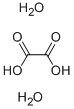
| Product Name: | Oxalic acid dihydrate | | Synonyms: | Oxalate Acid;Two water oxalic acid;OXALIC ACID 2HYD XTL;Oxalic acid test solution(ChP);Has two acid;Oxalic acid dihydrate Manufacturer;OXALIC ACID SOLUTION, 10% W/VOXALIC ACID SOLUTION, 10% W/VOXALIC ACID SOLUTION, 10% W/VOXALIC ACID SOLUTION, 10% W/V;OXALIC ACID, DIHYDRATE, HIGH PURITYOXALIC ACID, DIHYDRATE, HIGH PURITYOXALIC ACID, DIHYDRATE, HIGH PURITYOXALIC ACID, DIHYDRATE, HIGH PURITY | | CAS: | 6153-56-6 | | MF: | C2H6O6 | | MW: | 126.07 | | EINECS: | 612-167-2 | | Product Categories: | others;Aromatic Carboxylic Acids, Amides, Anilides, Anhydrides & Salts;C1 to C5;Essential Chemicals;Inorganic Salts;Lipid Library;Metabolic Pathways;Metabolites and Cofactors on the Metabolic Pathways Chart;Reagent Plus;Research Essentials;Solutions and Reagents;Building Blocks;Carbonyl Compounds;Carboxylic Acids;Chemical Synthesis;Lipid;Metabolic Libraries;Metabolomics;Organic Building Blocks;ACS Grade | | Mol File: | 6153-56-6.mol |
| Oxalic acid dihydrate Chemical Properties |
| Melting point | 104-106 °C(lit.) | | Boiling point | 108-109°C | | density | 1,65 g/cm3 | | vapor density | 4.4 (vs air) | | vapor pressure | <0.01 mm Hg ( 20 °C) | | Fp | 157°C | | storage temp. | Store at +5°C to +30°C. | | solubility | H2O: soluble1M at 20°C, clear, colorless | | form | Powder/Solid | | Specific Gravity | 1.65 | | color | Yellow to yellow-green | | PH | ~1.0 (25℃, 1M in H2O) | | PH Range | 6 - 8 at 25 °C | | Water Solubility | 138 g/L (20 ºC) | | Sublimation | 157 ºC | | Merck | 14,6911 | | BRN | 3679436 | | Exposure limits | TLV-TWA for anhydrous acid 1 mg/m3
(ACGIH, MSHA, and OSHA); TLV-STEL
2 mg/m3 (ACGIH). | | Stability: | Stable. Incompatible with bases, acid chlorides, steel, silver, silver compounds, moisture. Avoid contact with metals. | | InChIKey | GEVPUGOOGXGPIO-UHFFFAOYSA-N | | CAS DataBase Reference | 6153-56-6(CAS DataBase Reference) | | NIST Chemistry Reference | Oxalic acid dihydrate(6153-56-6) | | EPA Substance Registry System | Oxalic acid dihydrate (6153-56-6) |
| Hazard Codes | Xn,C | | Risk Statements | 21/22-41 | | Safety Statements | 24/25-39-37-36-26 | | RIDADR | UN 3261 8/PG 3 | | WGK Germany | 1 | | RTECS | RO2450000 | | TSCA | Yes | | HazardClass | 8 | | PackingGroup | III | | HS Code | 29171100 | | Toxicity | LD50 orally in Rabbit: 375 mg/kg |
| Oxalic acid dihydrate Usage And Synthesis |
| Chemical Properties | white crystals | | Uses | Oxalic acid dihydrate is a purifying agent in pharmaceutical industry, special in antibiotic medication, such as Oxytetracycline , Chloramphenicol , etc; * Precipitating agent in Rare-earth mineral processing; * Bleaching agent in the textile activities, wood pulp bleaching; * Rust-remover for Metal treatment; * Grinding agent, such as Marble polishing; * Waste water treatment, removing calcium from water.
| | Uses | A diprotic reducing agent used as a buffer. | | Uses | Oxalic acid occurs in the cell sap of Oxalisand Rumex species of plants as the potassium and calcium salt. It is the metabolicproduct of many molds (Merck 1989). Thereare a large number of applications of thiscompound, including indigo dyeing; calicoprinting; removal of paint, rust, and inkstains; metal polishing; bleaching leather; inpesticide compositions and manufacture ofoxalates. It is also used as an analyticalreagent and as a reducing agent in organicsynthesis.Addition of oxalic acid to chromic acid forthe anodizing of Al alloy has been reported tomodify the morphology and improve the corrosion performance of anodic films (Moutarlier et al. 2004). Also, it is a very effectiveadditive for the ozone treatment of cellulose.It prevents the degradation of cellulose fromozone bleaching. | | General Description | Oxalic acid dihydrate (OAD) crystals are reported to be monoclinic with P21/n space group. The electron density of OAD has been obtained using X-ray diffraction studies under high resolution. | | Reactivity Profile | At high temperatures oxalic acid decomposes, producing toxic carbon monoxide, andformic acid. Mixing with warm sulfuric acidmay produce the same products: CO2, CO,and formic acid. It reacts with many silvercompounds, forming explosive silver oxalate(NFPA 1986). An explosion occurred whenwater was added to an oxalic acid/sodiumchlorite mixture in a stainless steel beaker.There was also evolution of highly toxicchlorine dioxide gas (MCA 1962). Oxalicacid reacts violently with strong oxidizingsubstances. | | Health Hazard | Oxalic acid is a strong poison. The toxicsymptoms from ingestion include vomiting, diarrhea, and severe gastrointestinaldisorder, renal damage, shock, convulsions,and coma. Death may result from cardiovascular collapse. The toxicity arises asoxalic acid reacts with calcium in the tissuesto form calcium oxalate, thereby upsettingthe calcium/potassium ratio (ACGIH 1986).Deposition of oxalates in the kidney tubulesmay result in kidney damage (Hodgson et al.1988).Oxalic acid may be absorbed into the bodythrough skin contact. It is corrosive to theskin and eyes, producing burns. Dilute solutions of 10% strength may be a mild irritantto human skin. However, the inhalation toxicity is low because of its low vapor pressure.Airborne dusts can produce eyeburn and irritation of the respiratory tract.LD50 value, oral (rats): 375 mg/kg. | | Purification Methods | Crystallise oxalic acid from distilled water. Dry it in a vacuum over H2SO4. The anhydrous acid can be obtained by drying at 100o overnight. [Beilstein 2 IV 1819.] |
| Oxalic acid dihydrate Preparation Products And Raw materials |
|


 日本语
日本语 한국어
한국어 Français
 Deutsch
 España
 Türkiye