Other grades of this product :
| Bornyl acetate Basic information |
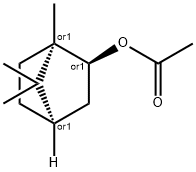
| Product Name: | Bornyl acetate | | Synonyms: | 1-BORNYLACETATE;Acetic acid isobornyl ester;(1,7,7-trimethyl-6-bicyclo[2.2.1]heptanyl) acetate;Bicyclo[2.2.1]heptan-2-ol, 1,7,7-trimethyl-, acetate, (1R,2S,4R)-;1,7,7-Trimethylbicyclo[2.2.1]heptane-2-yl=acetate;Acetic acid 1,7,7-trimethylbicyclo[2.2.1]heptan-2-yl;Acetic acid 1,7,7-trimethylbicyclo[2.2.1]heptan-2-yl ester;Acetic acid isobornyl | | CAS: | 76-49-3 | | MF: | C12H20O2 | | MW: | 196.29 | | EINECS: | 200-964-4 | | Product Categories: | A-B;Alphabetical Listings;Flavors and Fragrances;Inhibitors | | Mol File: | 76-49-3.mol |
| Bornyl acetate Chemical Properties |
| Bornyl acetate Usage And Synthesis |
| Chemical Properties | Bornyl acetate occurs in its optically active forms and
as a racemate in many essential oils.
(1S,2R,4S)-(?)-Bornyl acetate is a characteristic component of
most conifer oils. It has a camphoraceous, pine-needle-like odor. Both (1R,2S,4R)-
(+)-bornyl acetate and (?)-bornyl acetate form colorless crystals;
the racemate is a colorless liquid. Bornyl acetate is prepared by
esterification of borneol with acetic anhydride or via the process described under
borneol.
Due to its characteristic pine-needle odor, bornyl acetate is frequently used in
conifer needle compositions, soaps, bath products, room sprays, and pharmaceutical
products. | | Chemical Properties | Bornyl acetate has a fresh, strong, piney odor and a fresh, burning taste. | | Occurrence | Reported found in the oils of Abies canadensis, A. concolor, Picea canadensis, P. rubens, P. orientalis, Pinus
densiflora, Larix americana, Callitris drum-mondi, Abies alba, Pinus punulio, Abies sibirica L., and in coriander, thyme and valerian
oil; it has been identified in the essence from flowers of Chrysanthemum sincuse Sabin, in the distillate of Teucrium chamaedris
L., and in the fresh rhizomes of Valeriana officinalis L.; d-bornyl acetate is found in the essential oils of Callitris glauca, C. robusta,
C. gracilis, C. verrucosa and C. calcarata; the presence of acetate has been excluded from the essence of lavender and lavandin. | | Uses | Antineoplastic; radioactive agent. | | Aroma threshold values | Detection: 75 ppb to 1.38 ppm | | Taste threshold values | Taste characteristics at 10 ppm: camphoreous, woody, mentholic, berry and seedy with soapy, woody
nuances. | | Synthesis | l-Bornyl acetate occurs naturally in many oils distilled from the leaves of plants of the family Pinaceae; d-bornyl acetate is
found in the oils distilled from plants of the family Cupressaceae; bornyl acetate, therefore may be isolated by distillation and crystallization
from these; however, it is commonly prepared by direct acetylation of borneol; the first synthesis dates to 1889. |
| Bornyl acetate Preparation Products And Raw materials |
|


 日本语
日本语 한국어
한국어 Français
 Deutsch
 España
 Türkiye