Other grades of this product :
| Ethyl heptanoate Chemical Properties |
| Hazard Codes | Xi | | Risk Statements | 36/37/38-22 | | Safety Statements | 37/39-26-24/25 | | RIDADR | UN 1993 / PGIII | | WGK Germany | 1 | | RTECS | MJ2087000 | | TSCA | Yes | | HS Code | 29159080 | | Toxicity | LD50 orally in rats: >34640 mg/kg (Jenner) |
| Ethyl heptanoate Usage And Synthesis |
| Description | Ethyl heptanoate has a fruity odor reminiscent of cognac with a
corresponding taste. It is also reported with a winy-brandy odor. It
is used as a flavor ingredient in foods. | | References | [1] George A. Burdock, Fenaroli's Handbook of Flavor Ingredients,
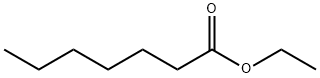
Sixth Edition, 2010 | | Description | Ethyl heptanoate is the ester resulting from the condensation of heptanoic acid and ethanol. It is used in the flavor industry because of its odor that is similar to grape. | | Chemical Properties | Ethyl heptanoate has a fruity odor reminiscent of cognac with a corresponding taste. It has been also reported to have
a winy-brandy odor | | Chemical Properties | clear colorless liquid | | Chemical Properties | Ethyl Heptanoate is a colorless
liquid with a fruity odor reminiscent of cognac. It is found in fruits and alcoholic
beverages and is used in appropriate aroma compositions. | | Occurrence | Reported found in apple, tangerine peel, grape, pineapple, strawberry, peas, hops beer, apricot, Vitis labrusca,
cheeses, butter, milk, beer, cognac, brandy, whiskey, rum, grape wines, cocoa, filberts, olive, passion fruit, plums, corn oil and
nectarines.
| | Uses | Ethyl heptanoate was used in a nickel nanoparticles-catalysed, transfer hydrogenation of olefins. | | Uses | In the manufacture of liqueurs. Plays an important part in the formulation of raspberry, gooseberry, grape, cherry, apricot, currant, bourbon, and other artificial essences. | | Definition | ChEBI: The fatty acid ethyl ester of heptanoic acid. | | Preparation | By esterification of heptoic acid; by reacting the silver salt of the acid with ethyl-iodide or with ethyl alcohol in the presence of mineral acids. | | Aroma threshold values | Detection: 2 ppb | | Taste threshold values | Taste characteristics at 10 ppm: fruity and waxy with a green winey nuance. | | General Description | Ethyl heptanoate, an aroma compound, was released from a series of sodium caseinate-stabilized, n-eicosane emulsions during the investigation of solid and liquid lipid droplet concentration. | | Flammability and Explosibility | Notclassified | | Safety Profile | Low toxicity by
ingestion and skin contact. Flammable liquid
when exposed to heat, sparks, or flame.
When heated to decomposition it emits
acrid smoke and irritating fumes. |
| Ethyl heptanoate Preparation Products And Raw materials |
|


 日本语
日本语 한국어
한국어 Français
 Deutsch
 España
 Türkiye