Other grades of this product :
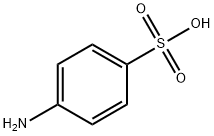
| Product Name: | Sulfanilic acid | | Synonyms: | 4-aminobenzenesulfonate;SULFANILIC ACID, ANHYDROUS, REAGENT (ACS)SULFANILIC ACID, ANHYDROUS, REAGENT (ACS)SULFANILIC ACID, ANHYDROUS, REAGENT (ACS)SULFANILIC ACID, ANHYDROUS, REAGENT (ACS);Diazobenzenesulfonic acid test solution(ChP);SULFANILIC ACID ANHYD PWD;Mesalazine EP Impurity O;Sulfanilic acid puriss. p.a., >=99.0% (T);Sulfanilic acid Vetec(TM) reagent grade, 99%;BES SODIUM SALT HIGH PURITY GRADE | | CAS: | 121-57-3 | | MF: | C6H7NO3S | | MW: | 173.19 | | EINECS: | 204-482-5 | | Product Categories: | Organics;INORGANIC & ORGANIC CHEMICALS;Intermediates of Dyes and Pigments;Amines;Aromatics;Sulfur & Selenium Compounds;bc0001 | | Mol File: | 121-57-3.mol |
| Sulfanilic acid Chemical Properties |
| Melting point | >300 °C(lit.) | | Boiling point | 288 ℃ | | density | 1.485 | | vapor pressure | 0Pa at 25℃ | | refractive index | 1.5500 (estimate) | | storage temp. | Store below +30°C. | | solubility | 10g/l | | pka | 3.24(at 25℃) | | form | solid | | color | White to Off-White | | PH | 2.5 (10g/l, H2O, 20℃) | | Water Solubility | 0.1 g/100 mL (20 ºC) | | Merck | 14,8926 | | BRN | 908765 | | Stability: | Stable. Incompatible with strong oxidizing agents. | | InChIKey | HVBSAKJJOYLTQU-UHFFFAOYSA-N | | LogP | -2.3 at 25℃ | | CAS DataBase Reference | 121-57-3(CAS DataBase Reference) | | NIST Chemistry Reference | Benzenesulfonic acid, 4-amino-(121-57-3) | | EPA Substance Registry System | Sulfanilic acid (121-57-3) |
| Sulfanilic acid Usage And Synthesis |
| Synthesize | Sulfanilic acid can be used for the determination of nitrite.
Biochemical Research. Organic Synthesis. Sulfanilic acid is an important
intermediate of sulfonamide drugs. This product has strong
antibacterial effect on hemolytic streptococcus, meningitis and coccus,
but due to poor efficacy and high toxicity, it is rarely used for oral
administration. It is also rarely used. It is used as an intermediate
for the synthesis of other sulfonamides, and is also used as a raw
material for the synthesis of agricultural "Huangcaoling" abroad.
Sulfanilic acid can also be used as an analytical reagent, such as a
reagent for the photometric determination of nitrite and sodium
nitroferricyanide. For biochemical research, organic synthesis and
pharmaceutical industry. Sulfanilic acid is the main raw material for
synthesizing sulfonamides. In addition to preparing crystalline
sulfonamides for external anti-inflammatory, it can also synthesize
other sulfonamides such as sulfamidine, sulfamethoxazine, and
sulfamethazine. | | Description | Sulfanilic acid (4-amino benzene sulfonic acid ) is an off-white crystalline solid which finds application in quantitative analysis of nitrate and nitrite ions. The solid acid exists as a zwitterion, and has an unusually high melting point. | | Chemical Properties | greyish-white crystals or powder | | Uses | A toxic metabolite of Tartrazine (T007700). Used as Ehrlich’s reagent, for detecting of nitrites. Antibacterial. | | Uses | Sulfanilic Acid (Sulfadimethoxine EP Impurity D) is a toxic metabolite of Tartrazine (T007700). Used as Ehrlich’s reagent, for detecting of nitrites. Antibacterial. | | Uses | Sulfanilic acid may be used for the functionalization of single-walled carbon nanotubes (SWNTs) with aryl sulfonate groups. | | Definition | ChEBI: An aminobenzenesulfonic acid that is aniline sulfonated at the para-position. | | Application | As the compound readily form diazo compounds, it is used to make dyes and sulpha drugs . This property is also used for the quantitative analysis of nitrate and nitrite ions by diazonium coupling reaction with N-(1-Naphthyl) ethylene diamine , resulting in an azo dye, and the concentration of nitrate or nitrite ions were deduced from the color intensity of the resulting red solution by colorimetry. It is also used as a standard in combustion analysis. | | General Description | White powder with faint purple tinge. Grayish-white flat crystals. Becomes anhydrous at around 212°F. Low toxicity (used medicinally). | | Air & Water Reactions | Insoluble in water. | | Reactivity Profile | Sulfanilic acid is an amino acid. Reacts weakly with both acids and bases. | | Fire Hazard | Flash point data for Sulfanilic acid are not available, however Sulfanilic acid is probably combustible. | | Synthesis | Sulfanilic acid can be produced by sulfonation of aniline. | | Purification Methods | Crystallise the acid (as dihydrate) from boiling water. Dry it at 105o for 2-3hours, then over 90% H2SO4 in a vacuum desiccator. The S-benzylisothiuronium salt has m 187o (from aqueous EtOH). [Beilstein 14 IV 2655.] |
| Sulfanilic acid Preparation Products And Raw materials |
|


 日本语
日本语 한국어
한국어 Français
 Deutsch
 España
 Türkiye