Other grades of this product :
| N,N-Dimethylcyclohexylamine Basic information |
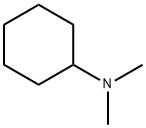
| Product Name: | N,N-Dimethylcyclohexylamine | | Synonyms: | N,N-Dimethylcyclohex;Lupragen N100Dimethylcyclohexylamine);N,N-Dimethylcyclohexylamine (Lupragen N100);N-Cyclohexyldimethylamine
Dimethylaminocyclohexane;N,N-diMethylcyclohaxylaMine;Cyclohexanamine,N,N-dimethyl-;Cyclohexylamine, N,N-dimethyl-;Cyclohexylamine,N,N-dimethyl- | | CAS: | 98-94-2 | | MF: | C8H17N | | MW: | 127.23 | | EINECS: | 202-715-5 | | Product Categories: | pharmaceutical | | Mol File: | 98-94-2.mol |
| N,N-Dimethylcyclohexylamine Chemical Properties |
| Melting point | -60 °C | | Boiling point | 158-159 °C (lit.) | | density | 0.849 g/mL at 25 °C (lit.) | | vapor pressure | 3.6 mm Hg ( 20 °C) | | refractive index | n20/D 1.454(lit.) | | Fp | 108 °F | | storage temp. | Store below +30°C. | | solubility | 10 g/L (20°C) | | form | Liquid | | pka | pK1:10.72(+1) (25°C) | | color | Clear | | PH | 12 (5g/l, H2O, 20℃) | | explosive limit | 3.6-19%(V) | | Water Solubility | 10 g/L (20 ºC) | | FreezingPoint | | Sensitive | Air Sensitive | | BRN | 1919922 | | InChIKey | SVYKKECYCPFKGB-UHFFFAOYSA-N | | LogP | 2.31 at 25℃ | | CAS DataBase Reference | 98-94-2(CAS DataBase Reference) | | NIST Chemistry Reference | Cyclohexanamine, N,N-dimethyl-(98-94-2) | | EPA Substance Registry System | N,N-Dimethylcyclohexylamine (98-94-2) |
| N,N-Dimethylcyclohexylamine Usage And Synthesis |
| Chemical Properties | CLEAR LIQUID | | Uses | Dimethylcyclohexylamine is used
in polyurethane plastics and textiles and as a chemical
intermediate. | | Uses | N,N-Dimethylcyclohexylamine has been used:- as switchable hydrophilicity solvent (SHS) for the extraction of lipids from freeze-dried samples of Botryococcus braunii microalgae for biofuel production
- as catalyst in three-component organocatalyzed Strecker reaction on water
| | Definition | ChEBI: A tertiary amine consisting of cyclohexane having a dimethylamino substituent. | | Production Methods | N,N-Dimethylcyclohexylamine is manufactured either by the reaction of methyl
chloride or formaldehyde and hydrogen with cyclohexylamine (HSDB 1989). | | Synthesis Reference(s) | Journal of the American Chemical Society, 93, p. 2897, 1971 DOI: 10.1021/ja00741a013Organic Syntheses, Coll. Vol. 6, p. 499, 1988 | | General Description | Colorless liquid with a musky ammonia odor. Less dense than water. | | Air & Water Reactions | Highly flammable. Water soluble. | | Reactivity Profile | N,N-Dimethylcyclohexylamine neutralizes acids in exothermic reactions to form salts plus water. May be incompatible with isocyanates, halogenated organics, peroxides, phenols (acidic), epoxides, anhydrides, and acid halides. Flammable gaseous hydrogen may be generated in combination with strong reducing agents, such as hydrides. | | Health Hazard | Inhalation of high concentration of vapor will will produce irritation of the respiratory tract and lungs. Inhalation of large quantities of vapor may be fatal. | | Health Hazard | Industrial hygiene studies in polyurethane manufacturing plants have identified
levels of 0.007-0.81 p.p.m. N-N-dimethylcyclohexylamine in air; however, these
levels were not regarded as hazardous (Reisdorf and Haggerty 1982). There are no
current exposure standards for N-N-dimethylcyclohexylamine and no documentation
of human toxicological effects. | | Fire Hazard | Behavior in Fire: Dangerous when exposed to heat or flame. Can react vigorously with oxidizing materials. | | Industrial uses | This amine is used as a catalyst in the production of polyurethane foams. It is also
used as an intermediate for rubber accelerators and dyes and in the treatment of
textiles. | | Safety Profile | Poison by ingestion.
Moderately toxic by inhalation. Whenheated to decomposition it emits toxic
fumes of NOx | | Metabolism | There is no record of any metabolic studies with MTV-dime thy ley clohexylamine.
However, one can predict that it would be oxidized to the N-oxide by either a
cytochrome P-450 system (Damani 1982) or the flavin-containing monooxygenase
(Ziegler 1988). Mixed function oxidase enzymes would be expected to produce
demethylation (Lindeke and Cho 1982). Many studies describe the metabolism of
the parent compound cyclohexylamine (Henderson 1990). |
| N,N-Dimethylcyclohexylamine Preparation Products And Raw materials |
|


 日本语
日本语 한국어
한국어 Français
 Deutsch
 España
 Türkiye