Other grades of this product :
| Nigericin sodium salt Basic information |
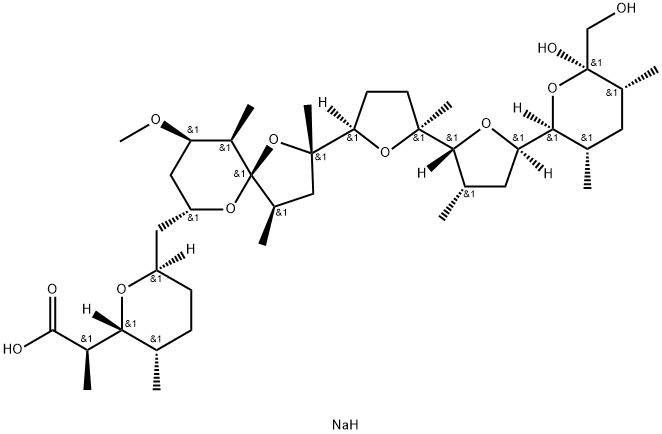
| Product Name: | Nigericin sodium salt | | Synonyms: | Nigericin sodium salt;Polyetherin A, Azalomycin M, Helixin C, Antibiotic K178, Antibiotic X-464;Antibiotic K178, Antibiotic X464, Azalomycin M, Helexin C, Polyetherin A;Sodium (2R)-2-[(3S,6R)-6-[[(2S,4R,5R,7R,9R,10R)-2-[(5S)-5-[(2R,3S,5R)-5-[(2S,3S,5R,6R)-6-hydroxy-6-(hydroxymethyl)-3,5-dimethyloxan-2-yl]-3-methyloxolan-2-yl]-5-methyloxolan-2-yl]-9-methoxy-2,4,10-trimethyl-1,6-dioxaspiro[4.5]decan-7-yl]methyl]-3-methyloxan-2-yl]propanoate;Nigericin, monosodium salt;Nsc292567;Nigericin sodium salt,Antibiotic K178, Antibiotic X464, Azalomycin M, Helexin C, Polyetherin A;Nigericin sodiuM sa | | CAS: | 28643-80-3 | | MF: | C40H69NaO11 | | MW: | 748.97 | | EINECS: | 608-231-4 | | Product Categories: | API | | Mol File: | 28643-80-3.mol |
| Nigericin sodium salt Chemical Properties |
| Melting point | approximate 255℃ | | storage temp. | 2-8°C | | solubility | Soluble in chloroform, methanol or ethanol | | form | solution | | color | White | | Merck | 13,6569 | | BRN | 3892398 | | Stability: | Stable for 2 years from date of purchase as supplied. Solutions in DMSO or ethanol may be stored at -20° for up to 2 months. | | InChIKey | MOYOTUKECQMGHE-NTQCAYBPSA-M |
| Hazard Codes | T | | Risk Statements | 25-36/37/38 | | Safety Statements | 26-36/37/39-45 | | RIDADR | UN 3462 6.1/PG 3 | | WGK Germany | 3 | | RTECS | QT6840000 | | HazardClass | 6.1 | | HS Code | 29419090 |
| Nigericin sodium salt Usage And Synthesis |
| Description | Nigericin Na (28643-80-3) is a polyether ionophore which disrupts membrane potential and stimulates ATPase activity in mitochondria. Induces apoptosis resulting from intracellular acidification. Ion selectivity for nigericin Na is K+> Rb+> Cs+>>Na+. Cell permeable. | | Chemical Properties | NIGERICIN SODIUM SALT is white powder
| | Uses | Nigericin sodium is the atypical salt of nigericin. Since nigericin is an ionophore, its very high affinity for monovalent cations such as Na+ and K+ means that formation of a salt is a facile possess occurring during purification under any but highly acidic conditions. Typically, the salts of polyether ionophores like the free acid, are readily extracted into organic solvents. The sodium ion is stabilised within a polar pocket of the structure, effectively making the salt and free acid different chemical moieties with the potential for differing pharmacology, a fact not readily appreciated in the literature. | | Uses | Nigericin sodium is a salt of the atypical polyether antibiotic, nigericin. Since nigericin is an ionophore, its very high affinity for monovalent cations such as Na+ and K+ means that formation of a salt is a facile possess occurring during purification under any but highly acidic conditions. Typically, the salts of polyether ionophores like the free acid, are readily extracted into organic solvents. The sodium ion is stabilised within a polar pocket of the structure, effectively making the salt and free acid different chemical moieties with the potential for differing pharmacology, a fact not readily appreciated in the literature. | | Uses | Nigericin sodium salt is a polyether ionophore which catalyzes the electroneutral exchange of alkali metal (K+) for H+ (antiport). It disrupts membrane potential and stimulates ATPase activity in mitochondria. It transports monovalent cations across membranes with the following specificity: K+ >Rb+ >Cs+ >>Na. It kills bacteria by facilitating the diffusion of ions across membranes. It is widely used in studies of the consequences of changes in membrane potential in variable systems. | | General Description | A monocarboxylate that catalyzes the electroneutral exchange of an alkali metal for H+ (antiport). Transports monovalent cations across membranes with the following specificities: K+>Rb+>Cs+>>Na+. An antibiotic that kills bacteria by facilitating the diffusion of ions across membranes. Disrupts the membrane potential and stimulates mitochondrial ATPase activity. | | Biochem/physiol Actions | Product does not compete with ATP. | | References | 1) Akhmedov et al. (2010), Mitochondrial matrix pH controls oxidative phosphorylation and metabolism-secretion coupling in INS-1E clonal beta cells; FASEB J., 24 4613
2) Gong et al. (2010), Chemical probing reveals insights into the signaling mechanism of inflammasome activation; Cell Res., 20 1289 |
| Nigericin sodium salt Preparation Products And Raw materials |
|


 日本语
日本语 한국어
한국어 Français
 Deutsch
 España
 Türkiye