Other grades of this product :
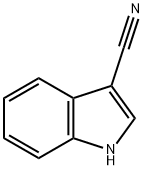
| 3-Cyanoindole Basic information |
| 3-Cyanoindole Chemical Properties |
| Melting point | 179-182 °C (lit.) | | Boiling point | 249.72°C (rough estimate) | | density | 1.1777 (rough estimate) | | refractive index | 1.6211 (estimate) | | storage temp. | Keep in dark place,Sealed in dry,Room Temperature | | solubility | Chloroform (Slightly), Methanol (Slightly) | | form | Solid | | pka | 14.61±0.30(Predicted) | | color | Orange to Brown | | Water Solubility | Insoluble in water. | | Sensitive | Air & Light Sensitive | | BRN | 120888 | | CAS DataBase Reference | 5457-28-3(CAS DataBase Reference) | | NIST Chemistry Reference | 3-Indolecarbonitrile(5457-28-3) |
| 3-Cyanoindole Usage And Synthesis |
| Chemical Properties | brown-grey to brown crystalline powder | | Uses | 3-Cyanoindole (cas# 5457-28-3) is a compound useful in organic synthesis. | | Uses | Reactant for preparation of:- Tryptophan dioxygenase inhibitors pyridyl-ethenyl-indoles as potential anticancer immunomodulators
- Inhibitors of the C-terminal domain of RNA polymerase II with antitumor activities
- 4-substituted β-lactams
- Biologically active Indoles
- Inhibitors of glycogen synthase kinase 3β (GSK-3)
- HIV-1 integrase inhibitors
- Indole fragments as inosine monophosphate dehydrogenase (IMPDH) inhibitors
- Aziridinomitosene skeleton
- Potential antiviral agents
Reactant for:- Intramolecular oxidative C-H coupling reactions with applications in medium-ring synthesis techniques
| | Synthesis Reference(s) | Organic Syntheses, Coll. Vol. 5, p. 656, 1973Tetrahedron, 50, p. 6549, 1994 DOI: 10.1016/S0040-4020(01)89685-XTetrahedron Letters, 18, p. 4417, 1977 DOI: 10.1016/S0040-4039(01)83524-3 | | General Description | 3-Cyanoindole undergoes regiospecific bromination to afford 6-bromo-3-cyanoindole. 3-Cyanoindole is formed during the flash vacuum thermolysis (FVT) of 3-azidoquinoline. |
| 3-Cyanoindole Preparation Products And Raw materials |
|


 日本语
日本语 한국어
한국어 Français
 Deutsch
 España
 Türkiye