Other grades of this product :
| Tenoxicam Basic information |
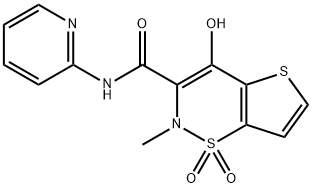
| Product Name: | Tenoxicam | | Synonyms: | 4-Hydroxy-2-methyl-N-pyridin-2-yl-2H-thieno[2,3-e][1,2]thiazine-3-carboxamide 1,1-dioxide (Tenoxicam);MOBIFLEX;tilcotil;3-Chlorosulfonyl-2-thiophene carboxylic acid methy;Do1men;4-Hydroxy-2-methyl-N-2-pyridinyl-2H-thieno[2,3-e]-1,2-thiazine-3-carboxamidel,1-dioxide;2H-Thieno(2,3-e)-1,2-thiazine-3-carboxamide, 4-hydroxy-2-methyl-N-2-pyridinyl-, 1,1-dioxide;4-Hydroxy-2-methyl-N-2-pyrimidinyl-2H-thieno[2,3-e]-1,2-thiazine-3-carboxamide 1,1-dioxide | | CAS: | 59804-37-4 | | MF: | C13H11N3O4S2 | | MW: | 337.37 | | EINECS: | 620-500-8 | | Product Categories: | Active Pharmaceutical Ingredients;Lipid signaling;Amines;Heterocycles;Sulfur & Selenium Compounds;Pharmaceutical raw material;Tenoxicam;Intermediates & Fine Chemicals;Pharmaceuticals;Fused Ring Systems;API;TARACTAN | | Mol File: | 59804-37-4.mol |
| Tenoxicam Chemical Properties |
| Melting point | 209-2130C (dec) | | density | 1.4737 (rough estimate) | | refractive index | 1.6390 (estimate) | | storage temp. | 2-8°C | | solubility | Practically insoluble in water, sparingly soluble in methylene chloride, very slightly soluble in anhydrous ethanol. It dissolves in solutions of acids and alkalis. | | form | neat | | pka | pKa1 5.3, pKa2 1.1(at 25℃) | | color | White to Yellow to Green | | Water Solubility | 61.9mg/L(32 ºC) | | CAS DataBase Reference | 59804-37-4 |
| Tenoxicam Usage And Synthesis |
| Description | Tenoxicam is a non-steroidal antiinflammatory agent with a profile similar to related
piroxicam and now withdrawn isoxicam (55). It is useful in the treatment of rheumatoid
arthritis, osteoarthritis and related disorders. | | Chemical Properties | Yellow Crystalline Powder | | Originator | Hoffmann-La Roche (Switzerland) | | Uses | Tenoxicam has been used:- as a non-steroidal anti-inflammatory agent (NSAID) to study its effects on root gravitropism in Arabidopsis thaliana
- as a standard in microanalysis of NSAIDs by spectrophotometry
- to test its effect on surface potential andmembrane fluidity modification in phosphoglyceride monolayers
| | Uses | antipsychotic | | Uses | Nonsteroidal anti-inflamatory agent | | Definition | ChEBI: A thienothiazine-derived monocarboxylic acid amide obtained by formal condensation of the carboxy group of 4-hydroxy-2-methylthieno[2,3-e][1,2]thiazine-3-carboxylic acid 1,1-dioxide with the amino group of 2-aminopyridine. Used for the treatm
nt of pain and inflammation in osteoarthritis and rheumatoid arthritis. It is also indicated for short term treatment of acute musculoskeletal disorders including strains, sprains and other soft-tissue injuries. | | Brand name | Tilcotil | | Biochem/physiol Actions | Tenoxicam (TX) possesses antipyretic?and analgesic effects. It elicits radical scavenging activity and has the potential to treat enkylosing spondylitis, extra-articular diseases, acute gout, and rheumatic diseases. It is also effective in treating primary dysmenorrhea, postpartum uterine contraction pain, and post-operation backaches. TX is capable of inhibiting prostaglandin synthesis. | | Clinical Use | NSAID and analgesic | | Drug interactions | Potentially hazardous interactions with other drugs
ACE inhibitors and angiotensin-II antagonists:
antagonism of hypotensive effect; increased risk of
nephrotoxicity and hyperkalaemia.
Analgesics: avoid concomitant use of 2 or more
NSAIDs, including aspirin (increased side effects);
avoid with ketorolac (increased risk of side effects
and haemorrhage).
Antibacterials: possibly increased risk of convulsions
with quinolones.
Anticoagulants: effects of coumarins and
phenindione enhanced; possibly increased risk of
bleeding with heparins, dabigatran and edoxaban -
avoid long term use with edoxaban.
Antidepressants: increased risk of bleeding with
SSRIs and venlaflaxine.
Antidiabetic agents: effects of sulphonylureas
enhanced.
Antiepileptics: possibly increased phenytoin
concentration.
Antivirals: increased risk of haematological toxicity
with zidovudine; concentration possibly increased by
ritonavir.
Ciclosporin: may potentiate nephrotoxicity.
Cytotoxics: reduced excretion of methotrexate;
increased risk of bleeding with erlotinib.
Diuretics: increased risk of nephrotoxicity;
antagonism of diuretic effect; hyperkalaemia with
potassium-sparing diuretics.
Lithium: excretion decreased.
Pentoxifylline: increased risk of bleeding.
Tacrolimus: increased risk of nephrotoxicity. | | Metabolism | Metabolised in the liver via cytochrome P450 2C9 to
several pharmacologically inactive metabolites (mainly
5'-hydroxy-tenoxicam).
Metabolites are excreted mainly in the urine; there is
some biliary excretion of glucuronide conjugates of the
metabolites. |
| Tenoxicam Preparation Products And Raw materials |
|


 日本语
日本语 한국어
한국어 Français
 Deutsch
 España
 Türkiye