Other grades of this product :
| Acalabrutinib Basic information |
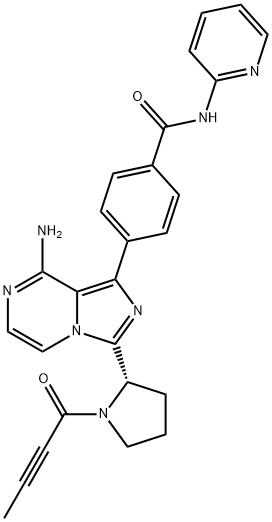
| Product Name: | Acalabrutinib | | Synonyms: | ACP196;ACP-196;acalabrutinib;Benzamide, 4-[8-amino-3-[(2S)-1-(1-oxo-2-butyn-1-yl)-2-pyrrolidinyl]imidazo[1,5-a]pyrazin-1-yl]-N-2-pyridinyl-;ACP196,Acalabrutinib;4-[8-Amino-3-[(2S)-1-(1-oxo-2-butyn-1-yl)-2-pyrrolidinyl]imidazo[1,5-a]pyrazin-1-yl]-N-2-pyridinylbenzamide;EOS-60753;(S)-4-(8-amino-3-(1-but-2-ynoylpyrrolidin-2-yl)imidazo[1,5-a]pyrazin-1-yl)-N-(pyridin-2-yl)benzamide | | CAS: | 1420477-60-6 | | MF: | C26H23N7O2 | | MW: | 465.51 | | EINECS: | 814-272-0 | | Product Categories: | | Mol File: | 1420477-60-6.mol |
| Acalabrutinib Chemical Properties |
| Melting point | >133°C (dec.) | | density | 1.37±0.1 g/cm3(Predicted) | | storage temp. | Refrigerator | | solubility | Soluble in DMSO (up to at least 25 mg/ml) | | pka | 11.47±0.70(Predicted) | | form | solid | | color | Yellow | | Stability: | Stable for 1 year from date of purchase as supplied. Solutions in DMSO may be stored at -20°C for up to 3 months. |
| Acalabrutinib Usage And Synthesis |
| Description | Acalabrutinib (ACP-196) is a selective second-generation Bruton's tyrosine kinase (BTK) inhibitor with an IC50 of 3 nM, which prevents the activation of the B-cell antigen receptor (BCR) signaling pathway. ACP-196 has improved target specificity over ibrutinib with 323-, 94-, 19- and 9-fold selectivity over the other TEC kinase family members (ITK, TXK, BMX, and TEC, respectively) and no activity against EGFR. | | Uses | Acalabrutinib, is an experimental anti-cancer drug and a selective Bruton's tyrosine kinase (BTK) inhibitor. This kinase transmits signals from B-cell Receptor (BCR), and thus any genetic BTK mutation causes B-Cell immunodeficiency. Therefore, BTK inhibitors targeting B-cell signaling has shown great promise for the treatment of chronic lymphocytic leukemia (CLL). | | in vitro | In the in vitro signaling assay on primary human CLL cells, acalabrutinib inhibits tyrosine phosphorylation of downstream targets of ERK, IKB, and AKT. Acalabrutinib demonstrates higher selectivity for BTK with IC50 determinations on nine kinases with a cysteine residue in the same position as BTK. Importantly, unlike ibrutinib, acalabrutinib does not inhibit EGFR, ITK, or TEC. acalabrutinib has no effect on EGFR phosphorylation on tyrosine residues Y1068 and Y1173. Compared with ibrutinib, acalabrutinib has much higher IC50(>1000 nM) or virtually no inhibition on kinase activities of ITK, EGFR, ERBB2, ERBB4, JAK3, BLK, FGR, FYN, HCK, LCK, LYN, SRC, and YES1. | | in vivo | Oral administration of ACP-196 in mice results in dose-dependent inhibition of anti-IgM-induced CD86 expression in CD19+ splenocytes with an ED50 of 0.34 mg/kg compared to 0.91 mg/kg for ibrutinib. A similar model is used to compare the duration of Btk inhibition after a single oral dose of 25 mg/kg. ACP-196 inhibits CD86 expression >90% at 3h postdose. | | IC 50 | 3 nm | | References | 1) Wu et al.?(2016),?Acalabrutinib (ACP-196): a second-generation BTK inhibitor;?J. Hematol. Oncol.?9?21
2) Barf?et al.?(2017),?Acalabrutinib (ACP-196): A covalent Bruton Tyrosine Kinase Inhibitor with a Differentiated Selectivity and In Vivo Potency Profile;?J. Pharmacol. Exp. Ther.?363?240
3) Herman?et al.?(2017),?The Bruton’s tyrosine kinase (BTK) inhibitor acalabrutinib demonstrates potent on-target effects and efficacy in two mouse models of chronic lymphocytic leukemia;?Clin. Cancer Res.?23?2831
4) Weber et al.?(2017),?Bruton’s Tyrosine Kinase: An Emerging Key Player in Innate Immunity; Front. Immunol.?8?1454 |
| Acalabrutinib Preparation Products And Raw materials |
|


 日本语
日本语 한국어
한국어 Français
 Deutsch
 España
 Türkiye