Other grades of this product :
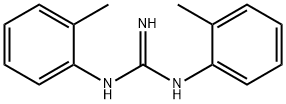
| Di-o-tolylguanidine Basic information |
| Di-o-tolylguanidine Chemical Properties |
| Melting point | 176-178 °C(lit.) | | Boiling point | 371.98°C (rough estimate) | | density | 1.1000 | | vapor pressure | 0Pa at 25℃ | | refractive index | 1.4560 (estimate) | | storage temp. | Keep in dark place,Sealed in dry,Room Temperature | | solubility | water: soluble70mg/mL at 20°C | | pka | 10.32±0.10(Predicted) | | form | solid | | color | White | | Water Solubility | 70mg/L at 20℃ | | Stability: | Stable for 1 year from date of purchase as supplied. Solutions in DMSO may be stored at -20°C for up to 3 months. | | LogP | 2.9 at 25℃ | | CAS DataBase Reference | 97-39-2(CAS DataBase Reference) | | NIST Chemistry Reference | Guanidine, 1,3-di-o-tolyl-(97-39-2) | | EPA Substance Registry System | 1,3-Di-o-tolylguanidine (97-39-2) |
| Hazard Codes | Xn | | Risk Statements | 22 | | Safety Statements | 26-36 | | RIDADR | UN 2811 | | WGK Germany | 3 | | RTECS | MF1400000 | | TSCA | Yes | | HazardClass | 6.1(b) | | PackingGroup | III | | HS Code | 29252900 | | Hazardous Substances Data | 97-39-2(Hazardous Substances Data) |
| Di-o-tolylguanidine Usage And Synthesis |
| Description | DTG (97-39-2) is an agonist of the sigma (σ) receptor1?with roughly equal potency against both subtypes (σ1 and σ2 IC50’s ~ 30nM)2. | | Uses | DTG is a selective ligand for the sigma-binding site. DTG has high binding affinity. | | General Description | 1,3-Di-o-tolylguanidine is a selective σ-receptor agonist. 1,3-Di-o-tolylguanidine is σ site ligand and its interaction with dopamine drugs were studied in Wistar rats and Albino Swiss mice. | | Flammability and Explosibility | Nonflammable | | Biological Activity | Displays high and roughly equal affinity for both σ 1 and σ 2 receptors. | | Safety Profile | Poison by ingestion and
intraperitoneal routes. When heated to
decomposition it emits toxic fumes of NOx. | | Purification Methods | The guanidine crystallises from aqueous EtOH. The sulfate has m 253-254o(dec, H2O). [Beilstein 12 H 803, 12 II 445, 12 III 1871, 16 IV 1764] | | References | 1) Weber?et al.?(1986),?1,3-Di(2-[5-3H]tolyl)guanidine: a selective ligand that labels sigma-type receptors for psychotomimetic opiates and antipsychotic drugs; Proc. Natl. Acad. Sci. USA,?83?8784
2) Scherz?et al.?(1990),?Synthesis and Structure-Activity Relationships of N,N’-Di-o-tolylguanidine Analogues, High-Affinity Ligands for the Haloperidol-Sensitive σ Receptor; J. Med. Chem.,?33?2421 |
| Di-o-tolylguanidine Preparation Products And Raw materials |
|


 日本语
日本语 한국어
한국어 Français
 Deutsch
 España
 Türkiye