Other grades of this product :
| 4-MERCAPTOPHENYLACETIC ACID Basic information |
| 4-MERCAPTOPHENYLACETIC ACID Chemical Properties |
| Melting point | 105-109 °C (lit.) | | Boiling point | 336.0±17.0 °C(Predicted) | | density | 1.299±0.06 g/cm3(Predicted) | | storage temp. | 2-8°C | | pka | 4.21±0.10(Predicted) | | Water Solubility | Slightly soluble in water. Soluble in Dichloromethane, Ethanol and Methanol | | Sensitive | Air Sensitive |
| Hazard Codes | Xi | | Risk Statements | 37/38-41 | | Safety Statements | 26-36/37/39 | | RIDADR | UN 3335 | | WGK Germany | 3 | | HS Code | 2930909899 |
| 4-MERCAPTOPHENYLACETIC ACID Usage And Synthesis |
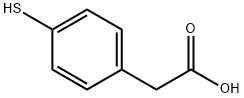
| Chemical Properties | 4-MERCAPTOPHENYLACETIC ACID is White Powder
| | Uses | 4-Mercaptophenylacetic acid has been used in the preparation of small ubiquitin-like modifier peptides from bis(2-sulfanylethyl)amido peptide via sequential native chemical ligation.It can be used: - On-resin preparation of peptide-α thiophenylesters which are used in a chemical ligation process for the chemical synthesis of peptides.
- In one pot deprotection of (acetamido-methyl)cysteine following native chemical ligation and/or desulfurization method for the preparation of peptides.
- Palladium facilitated deprotection of N-terminal cysteine through native chemical ligation method for the preparation of synthetically challenging proteins.
| | Uses | 4-MERCAPTOPHENYLACETIC ACID is a redox buffer that increases the folding rate of disulfide-containing proteins realative to traditional buffers such as glutathione and glutathione-disulfide. A useful synthetic intermediate for the preparation of novel antiinflammatory agents.
|
| 4-MERCAPTOPHENYLACETIC ACID Preparation Products And Raw materials |
|


 日本语
日本语 한국어
한국어 Français
 Deutsch
 España
 Türkiye