Other grades of this product :
| hexafluorobenzene Basic information |
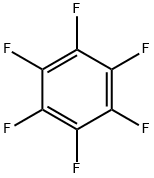
| Product Name: | hexafluorobenzene | | Synonyms: | 1,2,3,4,5,6-Hexafluorobenzene;1,2,3,4,5,6-hexafluoro-benzene;benzene,hexafluoro-;CP 28;CP28;HEXAFLUOROBENZENE FOR SYNTHESIS;hexafluorobenzene radical cation;HEXAFLUOROBENZENE, NMR GRADE | | CAS: | 392-56-3 | | MF: | C6F6 | | MW: | 186.05 | | EINECS: | 206-876-2 | | Product Categories: | Fluorobenzene;Fluorous Chemistry;Fluorous Solvents;Synthetic Organic Chemistry;Aryl;C6;Halogenated Hydrocarbons;C6Stable Isotopes;Alphabetical Listings;G-HStable Isotopes;NMR;NMR - Solvents;NMR Solvents and Reagents;organofluorine compounds | | Mol File: | 392-56-3.mol |
| hexafluorobenzene Chemical Properties |
| Melting point | 3.7-4.1 °C (lit.) | | Boiling point | 80-82 °C (lit.) | | density | 1.612 g/mL at 25 °C (lit.) | | refractive index | n20/D 1.377(lit.) | | Fp | 50 °F | | storage temp. | Sealed in dry,Room Temperature | | form | Liquid | | Specific Gravity | 1.612 | | color | Clear colorless to slightly yellow | | Water Solubility | Immiscible with water. | | Merck | 14,4686 | | BRN | 1683438 | | Stability: | Stable. Incompatible with strong oxidizing agents. May form complexes with transition metals which can explode when heated. Highly flammable. | | CAS DataBase Reference | 392-56-3(CAS DataBase Reference) | | NIST Chemistry Reference | Benzene, hexafluoro-(392-56-3) | | EPA Substance Registry System | Benzene, hexafluoro- (392-56-3) |
| Hazard Codes | F,Xi | | Risk Statements | 11-36/37/38 | | Safety Statements | 16-33-7/9-29-26-37/39 | | RIDADR | UN 1993 3/PG 2 | | WGK Germany | 3 | | RTECS | DA3050000 | | F | 10 | | Hazard Note | Highly Flammable | | TSCA | Yes | | HazardClass | 3 | | PackingGroup | II | | HS Code | 29039990 |
| hexafluorobenzene Usage And Synthesis |
| Description | Hexafluorobenzene, HFB, C6F6, or perfluorobenzene is an organic, aromatic compound. In this derivative of benzene all hydrogen atoms have been replaced by fluorine atoms. The technical uses of the compound are limited, although it is recommended as a solvent in a number of photochemical reactions. In the laboratory hexafluorobenzene is used as standard in fluorine-19 NMR spectroscopy, solvent and standard in carbon-13 NMR, solvent in proton NMR, solvent when studying some parts in the infrared and solvent in ultraviolet–visible spectroscopy, as hexafluorobenzene itself hardly shows any absorbance in the UV region. | | Chemical Properties | colourless liquid | | Uses | Hexafluorobenzene is used as a solvent in photochemical reactions. It is also used as a reference compound in fluorine-19 NMR, carbon-13 NMR. It is used as a solvent in proton NMR, IR spectrum and UV-spectra. It is used as anticorrosive, antifriction and anti-tumor agents. Further, it is used as a reference molecule to investigate tissue oxygenation in vivo studies. It forms series of 1:1 complexes with naphthalene, anthracene, phenanthrene, pyrene and triphenylene. | | Uses | Hexafluorobenzene can be used as a standard in 19Fluorine NMR (nuclear magnetic resonance) spectroscopy and also as a solvent in 13Carbon and 1H NMR spectroscopy. | | Application | Hexafluorobenzene can react with:Ethyl magnesium bromide in the presence of transition metal halides to form the corresponding perfluoroarylmagnesium compound that can undergo Grignard reactions.The sodium salt of the appropriate phenol in 1,3-dimethyl-2-imidazolidinone (DMEU) to form the corresponding hexakis(aryloxy)benzenes.It can be used:As a ligand to synthesize novel ruthenium(0) and osmium(0) hexafluorobenzene complexes.As a solvent and promoter for the ring-closing metathesis (RCM) to form tetrasubstituted olefins in the presence of a ruthenium-based catalyst. | | Definition | ChEBI: A member of the class of fluorobenzenes that is benzene in which all six hydrogen atom have been replaced by fluorine. | | Reactions | For example, hexafluorobenzene adds chlorine quite readily under rather mild conditions to give hexachlorohexafluorocyclohexane. The catalytic reduction of hexafluorobenzene with hydrogen to penta. and tetra-fluorobenzene at 300 °C, using a platinum catalyst, probably proceeds by a free-radical mechanism. Although the addition of chlorine to hexafluorobenzene is an example of a free-radical addition reaction, the reduction of hexafluorobenzene with hydrogen is classified as a freeradical substitution reaction.One of the earliest and, perhaps, most complicated reactions of hexafluorobenzene is one reported by Desirant. This interesting reaction, whic h is the only example of a high· temperature (above 300°C) reaction of hexafluorobenzene reported to date, involves the pyrolysis of the molecule in a platinum reactor at 850°C. Among the many products produced in this reaction , octafluorotoluene and decafluorobiphenyl were identified. This highly complex reaction probably could also be classified, in some respects, as a free-radical substitution reaction. There is also some less direct evidence that hightemperature reactions of hexafluorobe nzene do occur. In the synthesis of hexafluorobenzene by the pyrolysis of tribromofluoromethane, bromopentafluorobenzene is a signifi'cant by-product. Lesser amounts of higher brominated fluorocarbons are formed as well, along with copious quantities of bromine. This rather complex reaction is illustrated below.CFBr3--630-640℃-->C6F6+Br2+C6F5Br+C6F4Br2+etc. | | General Description | Hexafluorobenzene was repoted to be a sensitive 19F NMR indicator of tumor oxygenation. Rotational Raman spectra of hexafluorobenzenehas been studied under high resolution using a single mode argon laser as the exciting source. Hexafluorobenzene in the gas phase reacts spontaneously with lithium amalgam, to give a solid and intimate mixture of lithium fluoride and elemental polymeric carbon with a small amount of superstoichiometric lithium. Hexafluorobenzene forms series of 1:1 complexes with naphthalene, anthracene,phenanthrene, pyrene and triphenylene. | | Hazard | Toxic by inhalation. Combustible. | | Synthesis | The direct synthesis of hexafluorobenzene from benzene and fluorine is not possible. The synthetic route proceeds via the reaction of alkali-fluorides with halogenated benzene:C6Cl6 + 6 KF → C6F6 + 6 KCl | | Purification Methods | Main impurities are incompletely fluorinated benzenes. Purify it by standing in contact with oleum for 4hours at room temperature, repeating until the oleum does not become coloured. Wash it several times with water, then dry it with P2O5. Finally purify it by repeated fractional crystallisation. [Beilstein 5 III 523, 5 IV 640.] |
| hexafluorobenzene Preparation Products And Raw materials |
| Raw materials | Bicyclo(2.2.0)hexa-2,5-diene, 1,2,3,4,5,6-hexafluoro--->OCTAFLUOROBICYCLO[2,2,1]HEPTA-2,5-DIENE-->1,2,3,4,5,5,6,6-Octafluoro-1,3-cyclohexadiene-->1,2,3,3,4,5,6,6-octafluoro-1,4-cyclohexadiene-->1,3-Cyclohexadiene, 1,2,3,5,5,6,6-heptafluoro--->IODOPENTAFLUOROBENZENE | | Preparation Products | 1,2,4,5-Tetrafluorobenzene-->DIMEFOX-->2,3,4,5,6-Pentafluoroaniline-->1,3-DIAMINO-2,4,5,6-TETRAFLUOROBENZENE-->1,3-DIAMINO-2,4,5,6-TETRAFLUOROBENZENE-->2-Pentafluorophenoxyethanol-->2,3,4,5,6-PENTAFLUOROPHENYLACETONITRILE-->PERFLUOROCYCLOHEXANE |
|


 日本语
日本语 한국어
한국어 Français
 Deutsch
 España
 Türkiye