Other grades of this product :
| CYTOCHALASIN D Basic information |
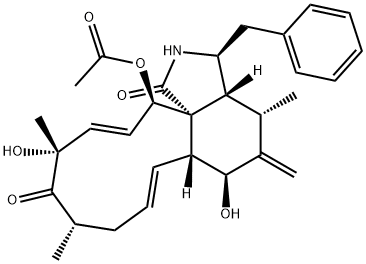
| Product Name: | CYTOCHALASIN D | | Synonyms: | CYTOCHALASIN D;CYTOCHALASIN D, ZYGOSPORIUM MANSONII;CYTOCHALASIN D, ZYGUSPORIUM MANSONII;(7S,13E,16S,18R,19E,21R)-21-(ACETYLOXY)-7,18-DIHYDROXY-16,18-DIMETHYL-10-PHENYL[11]CYTOCHALASA-6(12),13,19-TRIENE-1,17-DIONE;(11)cytochalasa-6(12),13,19-triene-1,17-dione,21-(acetyloxy)-7,18-dihydroxy-16;,12,15-decahydro-6,12,15-trihydroxy-4,10,12-trimethyl-5-methylene-,15-acetate;,18-dimethyl-10-phenyl-,(7s,13e,16s,18r,19e,21r)-;15-decahydro-6,12,15-trihydroxy-4,10,12-trimethyl-5-methylene-115-acetate | | CAS: | 22144-77-0 | | MF: | C30H37NO6 | | MW: | 507.62 | | EINECS: | 244-804-1 | | Product Categories: | antibiotic;Caspases/Apoptosis | | Mol File: | 22144-77-0.mol |
| CYTOCHALASIN D Chemical Properties |
| Melting point | 255-260°C | | Boiling point | 595.84°C (rough estimate) | | density | 1.1764 (rough estimate) | | refractive index | 1.6310 (estimate) | | Fp | 87℃ | | storage temp. | −20°C | | solubility | DMSO: soluble | | form | White solid | | pka | 11.95±0.70(Predicted) | | color | White | | BRN | 1632828 | | Stability: | Stable for 2 years from date of purchase as supplied. Solutions in DMSO or ethanol may be stored at -20° for up to 3 months. | | EPA Substance Registry System | Cytochalasin D (22144-77-0) |
| CYTOCHALASIN D Usage And Synthesis |
| Description | Cytochalasin D (22144-77-0) is a potent inhibitor of actin polymerization which also causes the disruption of actin filaments. More potent that cytochalasin B (10-fold) and does not inhibit monosaccharide transport across cell membranes. Disruption of actin microfilaments leads to activation of p53. Cell permeable | | Chemical Properties | Powder | | Uses | Cytochalasin D acts as an anti-hypertensive drug acting on human intestinal epithelial caco-2 cells. Also has activity in HMG-CoA reductase inhibitors used in the lowering of cholesterol. Actin inhib
itor, actin polymerization inhibitor affecting cell movement, growth, phagocytosis and even secretion. | | Uses | Cytochalasin D is the most studied of the cytochalasins. Like most of the members of this mycotoxin class, cytochalasin D exhibits potent inhibition of actin filament function leading to cell death by apoptosis. This led to early investigation of the metabolite as an antitumour agent. Cytochalasin D has become one of the standard cellular probes for investigating the role of actin in cell biology. | | Uses | A cell cycle arresting compound used in actin polymerization studies and cytological research | | Definition | ChEBI: An organic heterotricyclic compound that is a mycotoxin produced by Helminthosporium and other moulds which is cell permeable and a potent inhibitor of actin polymerisation and DNA synthesis. | | General Description | Needles or fluffy white powder. | | Reactivity Profile | CYTOCHALASIN D may be sensitive to exposure to heat. CYTOCHALASIN D can react with strong oxidizing agents, strong acids and strong bases. . | | Fire Hazard | Flash point data for CYTOCHALASIN D are not available; however, CYTOCHALASIN D is probably combustible. | | Biological Activity | Potent disruptor of actin filament function. Alters tight junction permeability. Unlike cytochalasin B, does not inhibit monosaccharide transport across the plasma membrane. | | Biochem/physiol Actions | Cell permeable fungal toxin; potent inhibitor of actin polymerization. Disrupts actin microfilaments and activates the p53-dependent pathways causing arrest of the cell cycle at the G1-S transition. Inhibits smooth muscle contraction. Inhibits insulin-stimulated, but not basal, transport of glucose. | | Safety Profile | Poison by ingestion,
subcutaneous, and intraperitoneal routes. An
experimental teratogen. Experimental
reproductive effects. Human mutation data
reported. When heated to decomposition it
emits toxic fumes of NOx. | | References | 1)) Goddetteand et al. (1986), Actin polymerization. The mechanism of action of cytochalasin D; J. Biol. Chem., 261 15974
2) Rubtsova et al. (1998), Disruption of actin microfilaments by cytochalasin D leads to activation of p53; FEBS Lett., 430 353 |
| CYTOCHALASIN D Preparation Products And Raw materials |
|


 日本语
日本语 한국어
한국어 Français
 Deutsch
 España
 Türkiye