Other grades of this product :
| Ametryn Basic information |
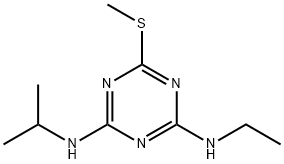
| Product Name: | Ametryn | | Synonyms: | n-ethyl-n’-isopropyl-6-methylthio-1,3,5-triazine-2,4-diyldiamine;N-Ethyl-N'-isopropyl-6-methylthio-1,3,5-triazine-2,4-diamine;N-ethyl-N'-(1-methylethyl)-6-methylthio-1,3,5-triazine-2,4-diamine;ametryn (ISO) 2-ethylamino-4-isopropylamino-6-methylthio-1,3,5-triazine;Ametryn W.P.;EVIK(R);N'-ETHYL-6-METHYLSULFANYL-N-PROPAN-2-YL-1,3,5-TRIAZINE-2,4-DIAMINE;X-SIPAX | | CAS: | 834-12-8 | | MF: | C9H17N5S | | MW: | 227.33 | | EINECS: | 212-634-7 | | Product Categories: | HERBICIDE | | Mol File: | 834-12-8.mol |
| Ametryn Chemical Properties |
| Ametryn Usage And Synthesis |
| Chemical Properties | White, crystalline powder.
Slightly soluble in water; soluble in organic solvents. | | Chemical Properties | Ametryn is a colorless powder | | Uses | Pre-emergence and post-emergence herbicides.
| | Uses | Ametryn is a methylthiotriazine based herbicide which inhibits photosynthesis and other enzymatic processes. Ametryn is used to control broadleaf weeds and annual grasses in pineapple, sugarcane and b
ananas. | | Uses | Herbicide used to control broad-leaved and grass weeds in corn, sugarcane, certain
citrus subtropical fruits (bananas, pineapple) and in noncropland. Preharvest and postharvest desiccant used in potatoes to control both crop and weeds | | Production Methods | Ametryn is a colorless crystal synthesized by reacting atrazine
with methyl mercaptan in the presence of an equivalent
of NaOH or by reacting 2-mercapto-4-ethylamino-6-isopropylamino-
1,3,5-triazine with a methylating agent in the
presence of NaOH. It is stable in slightly acidic or alkaline
media, but is hydrolyzed to the inactive 6-hydroxy derivative
in strong acidic or basic media. | | Definition | ChEBI: A methylthio-1,3,5-triazine that is 2-(methylsulfanyl)-1,3,5-triazine substituted by an ethylamino and an isopropylamino group at positions 4 and 6 respectively. | | General Description | Crystals. Melting point 190-192°F (88-89°C). Used as a herbicide. | | Reactivity Profile | An amine, organosulfide. Organosulfides are incompatible with acids, diazo and azo compounds, halocarbons, isocyanates, aldehydes, alkali metals, nitrides, hydrides, and other strong reducing agents. Reactions with these materials generate heat and in many cases hydrogen gas. Many of these compounds may liberate hydrogen sulfide upon decomposition or reaction with an acid. Amines are chemical bases. They neutralize acids to form salts plus water. These acid-base reactions are exothermic. The amount of heat that is evolved per mole of amine in a neutralization is largely independent of the strength of the amine as a base. Amines may be incompatible with isocyanates, halogenated organics, peroxides, phenols (acidic), epoxides, anhydrides, and acid halides. Flammable gaseous hydrogen is generated by amines in combination with strong reducing agents, such as hydrides. | | Hazard | Toxic by ingestion. | | Health Hazard | Moderately toxic by ingestion; human toxic-ity data not available; a mild irritant to skinand eye.LD50 oral (rat): 508 mg/kgLD50 oral (mouse): 965 mg/kgLD50 skin (rabbit): >5000 mg/kg. | | Flammability and Explosibility | Nonflammable | | Agricultural Uses | Herbicide: Ametryn is a herbicide which inhibits photosynthesis and other enzymatic processes. It is used to control
broadleaf weeds and annual grasses in pineapple, sugarcane and bananas. Uses are being supported in the U.S.
only for the following agricultural crops: field corn, popcorn, sugarcane, and pineapple (EPA, 2005). Used in premixes with atrazine, diuron, simazine, and terbutryn. Not
approved for use in the EU. | | Trade name | AMESIP®; AMERTREX®; AMETREX;
AMETRON SC®; AMETRYNE TECHNICAL®;
AMIGAN®; AMULEX; CRISATRINE®;
CRISATRINA®; DORUPLANT®; EVIK®; G-34162®;
GESAPAX®; HERBIPAK®; KRISMAT®; OXON
PRIMATOL Z 80®; SANCOPAX®; TRINATOX-D® | | Potential Exposure | Ametryn, a triazine and an organosulfide, amine compound A potential danger to those involved in the manufacture, formulation and application of this selective herbicide. | | Carcinogenicity | No carcinogenic response was
observed at the highest dose tested in lifetime studies,
2000 ppm, for both rats and mice. | | Environmental Fate | Biological. Cook and Hütter (1982) reported that bacterial cultures were capable of
degrading ametryne forming the corresponding hydroxy derivative (hydroxyametryne)Soil. Although no products were reported, the half-life in soil is 70–120 days (Worthing
and Hance, 1991)Groundwater. According to the U.S. EPA (1986) ametryn has a high potential to leach
to groundwaterChemical/Physical. Hydrolyzes to the 6-hydroxy analog, especially in the presence ofPhotolytic. The dye-sensitized photodecomposition of ametryn was studied in aqueous,
aerated solutions (Rejto et al., 1983). When an aqueous ametryn solution was irradiated
in sunlight for several hours, 2-(methylthio)-4-(isopropylamino)-6-amino- | | Shipping | UN2763 Triazine pesticides, solid, toxic, Hazard Class: 6.1; Labels: 6.1-Poisonous materials | | Incompatibilities | Triazines are incompatible with nitric acid. Amines are chemical bases, they neutralize acids to form salts plus water with an exothermic reaction. May be incompatible with isocyanates, halogenated organics, peroxides, phenols (acidic), epoxides, anhydrides, and acid halides. Flammable gaseous hydrogen is generated by amines in combination with strong reducing agents such as hydrides, nitrides, alkali metals, and sulfides. | | Waste Disposal | In accordance with 40CFR165, follow recommendations for the disposal of pesticides and pesticide containers. |
| Ametryn Preparation Products And Raw materials |
|


 日本语
日本语 한국어
한국어 Français
 Deutsch
 España
 Türkiye