Other grades of this product :
| 3-Methyl-4-nitrobenzoic acid Basic information |
| 3-Methyl-4-nitrobenzoic acid Chemical Properties |
| 3-Methyl-4-nitrobenzoic acid Usage And Synthesis |
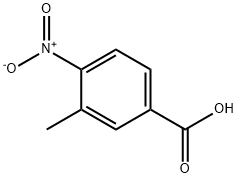
| Chemical Properties | white to light yellow crystal powder | | Uses | 3-Methyl-4-nitrobenzoic Acid is used as a reagent in the synthesis of influenza neuraminidase inhibitors with pyrrolidinobenzoic acid scaffold containing lipophilic side chains. | | Preparation | 3-Methyl-4-nitrobenzoic acid was synthesized via oxidation of 2,4-(dimethylnitrobenzene) with mole-(cular) oxygen catalyzed by cobalt acetate in acetic acid in the presence of an initiator.It was found that the yield of 3-methyl-4-nitrobenzoic acid increased remarkably with the addition of sodium bromide as a co-(catalyst).The reaction was carried out at 130 ℃ for 8 h at 0.8 MPa of oxygen in the presence of 0.017 mol of cobalt acetate,(0.017 mol) of sodium bromide,and 0.30 mol of 2-butanone with 1.00 mole of 2,4-dimethylnitrobenzene.(Under) these conditions 99% of the reactant converted with a selectivity of 52% to 3-methyl-4-(nitrobenzoic) acid,and the yield of 3methyl-4-(nitrobenzoic) acid was 51%.The reaction mechanism and the function of(sodium) bromide were discussed.According to the fact that the reaction could not proceed without the presence of an initiator,it was proposed that the reaction took place via a free radical mechanism,and(sodium) bromide reacted with Co(Ⅲ) to generate bromine radicals,which promoted the formation of benzyl radicals.Synthesis of 3-Methyl-4-nitrobenzoic Acid via Catalytic Oxidation with Molecular OxygenMethod for preparing 3-methyl-4-nitrobenzoic acid by oxidizing with nitric acid | | General Description | Needles or off white powder. | | Air & Water Reactions | Insoluble in water. | | Reactivity Profile | 3-Methyl-4-nitrobenzoic acid is a nitrated carboxylic acid. Carboxylic acids donate hydrogen ions if a base is present to accept them. They react in this way with all bases, both organic (for example, the amines) and inorganic. Their reactions with bases, called "neutralizations", are accompanied by the evolution of substantial amounts of heat. Neutralization between an acid and a base produces water plus a salt. Carboxylic acids with six or fewer carbon atoms are freely or moderately soluble in water; those with more than six carbons are slightly soluble in water. Soluble carboxylic acid dissociate to an extent in water to yield hydrogen ions. The pH of solutions of carboxylic acids is therefore less than 7.0. Many insoluble carboxylic acids react rapidly with aqueous solutions containing a chemical base and dissolve as the neutralization generates a soluble salt. Carboxylic acids in aqueous solution and liquid or molten carboxylic acids can react with active metals to form gaseous hydrogen and a metal salt. Such reactions occur in principle for solid carboxylic acids as well, but are slow if the solid acid remains dry. | | Fire Hazard | Flash point data for 3-Methyl-4-nitrobenzoic acid are not available; however, 3-Methyl-4-nitrobenzoic acid is probably combustible. |
| 3-Methyl-4-nitrobenzoic acid Preparation Products And Raw materials |
|

 日本语
日本语 한국어
한국어 Français
 Deutsch
 España
 Türkiye