Other grades of this product :
| Cilastatin Basic information |
| Cilastatin Chemical Properties |
| Melting point | 156-158°C | | Boiling point | 655.5±55.0 °C(Predicted) | | density | 1.275±0.06 g/cm3(Predicted) | | storage temp. | Keep in dark place,Sealed in dry,Store in freezer, under -20°C | | solubility | DMSO (Slightly), Methanol (Slightly, Sonicated) | | form | Solid | | pka | 2.09±0.10(Predicted) | | color | White to Light Brown | | CAS DataBase Reference | 82009-34-5(CAS DataBase Reference) |
| Cilastatin Usage And Synthesis |
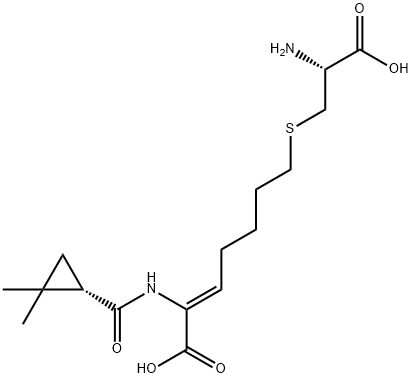
| Description | Cilastatin is an inhibitor of dipeptidase (dehydropeptidase I), a renal dipeptidase. It inhibits human renal dipeptidase (Ki = 0.7 μM), porcine dipeptidase (IC50 = 0.11 μM), and bacterial metallo-β-lactamase CphA from A. hydrophila (IC50 = 178 μM). Cilastatin (200 μg/ml) protects primary porcine renal proximal tubular epithelial cells from nephrotoxicity and apoptosis induced by vancomycin . In a mouse model of systemic infection, cilastatin in combination with imipenem protects mice from S. aureus, E. coli, and P. aeruginosa infection. Cilastatin was designed to inhibit renal metabolism of imipenem and prolong its half-life. Formulations containing cilastatin in combination with imipenem have been used to treat susceptible bacterial infections. | | Chemical Properties | White to Light-Yellow Crystalline Powder | | Uses | Prevents renal metabolism of penem and carbapenem antibiotics by specific and reversible dehydropeptidase I inhibition. Antibacterial adjunct | | Uses | spectrum antibiotic | | Uses | Cilastatin is used for treating diseases caused by polyresistant Gram-negative microorganisms and serious complex infections, including infection of S. aureus. Because of its strong
activity against anaerobic bacteria, cilastatin is effective in monotherapy of intraabdominal infections. It is used for infectious diseases of the lower respiratory tract, urinary tract,
gynecological infections, bacterial septicemia, and infections of the bones, skin, and so on. | | Synthesis | Cilastatin, (Z)-7-[(2-amino-2-carboethoxyethyl)thio]-2-[[2,2-dimethylcyclopropyl) carbonyl] amino]-2-heptenoic acid (32.1.3.6), is synthesized from the ethyl ester of
1,3-dithian-2-carboxylic acid (which is ethyl glyoxylate, protected at the aldehyde group
with 1,3-propanedithiol), which is alkylated by 1,5-dibromopentane in the presence of
sodium amide, forming the ethyl ester of 7-bromo-2-[2-(1,3-dithiano)]hepthanoic acid
(32.1.3.2). Oxidative hydrolysis of this product with N-bromosuccinimide in a mixture of
acetonitrile–water solvents leads to the formation of the ethyl ester of 7-bromo-α-ketoheptanoic acid (32.1.3.3). Acidic hydrolysis of this product using hydrogen bromide in acetic
acid gives 7-bromo-α-ketoheptanoic acid (32.1.3.4). This is reacted with 2,2-dimethylcyclopropancarboxylic acid amide to form the corresponding enamide, (Z)-7-bromo-2-(2,
2-dimethylcycloprotancarboxamido)-2-heptenoic acid (32.1.3.5). The resulting product is
used for S-alkylation of L-cysteine, which results in the production of the desired cilastatin
(32.1.3.6). |
| Cilastatin Preparation Products And Raw materials |
|


 日本语
日本语 한국어
한국어 Français
 Deutsch
 España
 Türkiye