Other grades of this product :
| Benazepril hydrochloride Basic information |
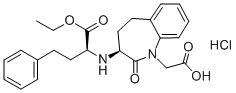
| Product Name: | Benazepril hydrochloride | | Synonyms: | 1h-1-benzazepine-1-aceticacid,2,3,4,5-tetrahydro-3-((1-(ethoxycarbonyl)-3-phe;cgs14824a;monohydrochloride,(s-(r*,r*))-nylpropyl)amino)-2-oxo;BenazeprilHclC24H28N205.HC1;1H-1-Benzazepine-1-acetic acid, 3-(1S)-1-(ethoxycarbonyl)-3-phenylpropylamino-2,3,4,5-tetrahydro-2-oxo-, monohydrochloride, (3S)-;1H-1-Benzazepine-1-acetic acid, 3-[[1-(ethoxycarbonyl)-3-phenylpropyl]amino]-2,3,4,5-tetrahydro-2-oxo-, monohydrochloride, [S-(R*,R*)]-;CGS 14824A HCl;Lotensin | | CAS: | 86541-74-4 | | MF: | C24H29ClN2O5 | | MW: | 460.95 | | EINECS: | 630-414-2 | | Product Categories: | SONATA;API;Intermediates & Fine Chemicals;Amines;Aromatics;Heterocycles;Pharmaceuticals;86541-74-4 | | Mol File: | 86541-74-4.mol |
| Benazepril hydrochloride Chemical Properties |
| Melting point | 188-190°C | | alpha | D -141.0° (c = 0.9 in ethanol) | | storage temp. | 2-8°C | | solubility | DMSO: ~34 mg/mL, soluble | | form | solid | | color | white | | Merck | 14,1031 | | InChIKey | VPSRQEHTHIMDQM-FKLPMGAJSA-N | | CAS DataBase Reference | 86541-74-4(CAS DataBase Reference) |
| Safety Statements | 22-24/25 | | RIDADR | 3077 | | WGK Germany | 2 | | RTECS | CX7065000 | | HS Code | 29337900 |
| Benazepril hydrochloride Usage And Synthesis |
| Description | Benazepril hydrochloride, a prodrug of benazeprilat, is a long-acting angiotensionconverting
enzyme (ACE) inhibitor useful in the treatment of essential hypertension.
In healthy humans, it was well tolerated and showed no phmacokinetic interactions
with furosemide, hydrochlorothiazide, chlorthalidone, digoxin, cimetidine,
atenolol, or naproxen. Benazepril hydrochloride is under investigation as a
cardiostirnulant. | | Description | Benazepril is a prodrug of the angiotensin converting enzyme (ACE) inhibitor benazeprilat . It is metabolized to benazeprilat by hepatic esterases. Benazepril inhibits the in vitro enzymatic activity of partially purified ACE isolated from rabbit lung (IC50 = 2 nM). It decreases the triglyceride and total cholesterol levels in normotensive rats when administered at a dose of 30 mg/kg and decreases aortic atherosclerosis in cholesterol-fed rabbits when administered at a dose of 3 mg/kg per day. Benazepril (0.1-10 mg/kg per day) reduces blood pressure in spontaneously hypertensive rats. It also decreases proteinuria in cats with chronic kidney disease when administered at doses ranging from 0.5 to 1 mg/kg per day. Formulations containing benazepril have been used to treat hypertension, congestive heart failure, and chronic kidney disease in both human and veterinary medicine. | | Chemical Properties | Crystalline Solid | | Originator | Ciba-Geigy (Switzerland) | | Uses | sedative, hypnotic | | Uses | Used as an antihypertensive; angiotensin converting enzyme inhibitor. | | Definition | ChEBI: A hydrochloride salt resulting from the reaction of benazepril with 1 mol eq. of hydrogen chloride. It is used as a prodrug for angiotensin-converting enzyme inhibitor benazeprilat in the treatment of hypertension and heart failure. | | Manufacturing Process | The synthesis of benzazepril based on a benzazepinone. It started by
chlorination of lactam - 1,2,4,5-tetrahydrobenzo[b]azepin-2-one to the
dichloro derivative 3,3-dichloro-1,2,4,5-tetrahydrobenzo[b]azepin-2-one.
Catalytic reduction removed one of the gem chloro substituents to give 3-
chloro-1,2,4,5-tetrahydrobenzo[b]azepin-2-one; the halogen was then
displaced with sodium azide to give 3-azido-1,3,4,5-
tetrahydrobenzo[b]azepin-2-one. Alkylation of the amide with ethyl
bromoacetate in the presence of base yielded the ester (3-azido-2-oxo-
2,3,4,5-tetrahydrobenzo[b]azepin-1-yl)acetic acid ethyl ester. Hydrogenation
then converted the azide to an amino group to give 3-amino-2-oxo-2,3,4,5-
tetrahydrobenzo[b]azepin-1-yl)acetic acid ethyl ester. It was then resolved by
classical salt formation and crystallization. Saponification of the S enantiomer
- S-(3-amino-2-oxo-2,3,4,5-tetrahydrobenzo[b]azepin-1-yl)acetic acid ethyl
ester with sodium hydroxide afforded (3-amino-2-oxo-2,3,4,5-
tetrahydrobenzo[b]azepin-1-yl)acetic acid. Reductive alkylation of it with 2-
oxo-4-phenylbutyric acid ethyl ester and sodium cyanoborohydride gave the
desired product as 70:30 mixture of diastereoisomers. The isolation of the
predominant isomer gave benazepril. The epimerization occurred thermally
and therefore required a sufficiently high temperature. The high temperature
condition can be achieved by either using a high boiling-point solvent such as
xylene or by heating the reaction mixture under pressure to increase its
boiling-point temperature. Good results can be achieved in both polar and
non-polar solvent systems. For example, both p-xylene and ethylene glycolwater
systems are found suitable to conduct this process. The crude product
acid 3-[(1-ethoxycarbonyl)-3-phenyl-(1S)-propylamino]-2,3,4,5-tetrahydro-2-
oxo-1H-1-benzazepine-1-acetic acid was heated to reflux temperature for 30
hours in p-xylene. The mixture was cooled down to room temperature.
Solvent removal resulted in a solid, which was then dried at reduced pressure
to give a 98:2 diasteriomeric mixture as determined by HPLC, MP: 287°-
290°C. IR and 1H-NMR spectrum analysis. was confirmed the structure of
product. | | Brand name | Lotensin (Novartis);Cibacen. | | Therapeutic Function | Antihypertensive | | General Description | Pharmaceutical secondary standards for application in quality control provide pharma laboratories and manufacturers with a convenient and cost-effective alternative to the preparation of in-house working standards | | Biological Activity | Non-peptide angiotensin-converting enzyme (ACE) inhibitor. Reduces blood pressure and myocardial hypertrophy in spontaneous hypertensive rats. | | Biochem/physiol Actions | Benazepril is a long-acting angiotensin converting enzyme (ACE) inhibitor. |
| Benazepril hydrochloride Preparation Products And Raw materials |
|


 日本语
日本语 한국어
한국어 Français
 Deutsch
 España
 Türkiye