Other grades of this product :
| p-Anisohydrazide Basic information |
| p-Anisohydrazide Chemical Properties |
| Melting point | 136-140 °C(lit.) | | Boiling point | 294.38°C (rough estimate) | | density | 1.2265 (rough estimate) | | refractive index | 1.6180 (estimate) | | storage temp. | Sealed in dry,Room Temperature | | form | powder to crystal | | pka | 12.65±0.10(Predicted) | | color | White to Orange to Green | | Water Solubility | Slightly soluble in water. | | BRN | 389017 | | InChIKey | REKQLYUAUXYJSZ-UHFFFAOYSA-N | | CAS DataBase Reference | 3290-99-1(CAS DataBase Reference) |
| Hazard Codes | Xi | | Risk Statements | 36/37/38 | | Safety Statements | 26-37/39 | | WGK Germany | 3 | | RTECS | BZ4800000 | | HazardClass | IRRITANT | | HS Code | 2928009090 | | Toxicity | LD50 ivn-mus: 178 mg/kg CSLNX* NX#00894 |
| p-Anisohydrazide Usage And Synthesis |
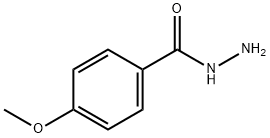
| Uses | 4-Methoxybenzhydrazide is used as pharmaceutical intermediates and it is also involved in a variety of organic synthesis. | | Uses | 4-Methoxybenzhydrazide may be used to synthesize:- N′-[(E)-5-bromo-2-hydroxy-3-methoxybenzylidene]-4-methoxybenzohydrazide monohydrate
- 2,5-bis(4-methoxyphenyl)-1,3,4-oxadiazole
- hydrazone ligands, which readily forms ruthenium(II) hydrazone complexes via reaction with [RuHCl(CO)(PPh3)3]
| | Synthesis Reference(s) | Journal of Medicinal Chemistry, 27, p. 1565, 1984 DOI: 10.1021/jm00378a007 | | Safety Profile | Poison by intravenous
route. Questionable carcinogen with
experimental neoplastigenic data. When heated to decomposition it emits toxic
fumes of Nox. |
| p-Anisohydrazide Preparation Products And Raw materials |
|


 日本语
日本语 한국어
한국어 Français
 Deutsch
 España
 Türkiye