Other grades of this product :
| 2-Octyl-2H-isothiazol-3-one Basic information |
| 2-Octyl-2H-isothiazol-3-one Chemical Properties |
| Melting point | <25 °C | | Boiling point | 120°C | | density | 1.04 | | vapor pressure | 4.9hPa at 25℃ | | refractive index | 1.5500 (estimate) | | Fp | 23℃ | | storage temp. | Sealed in dry,2-8°C | | form | neat | | pka | -2.04±0.20(Predicted) | | color | White or Colorless to Yellow | | Water Solubility | <0.1 g/100 mL at 19 ºC | | Merck | 14,6755 | | BRN | 1211137 | | Stability: | Stable. Incompatible with strong oxidizing agents. | | InChIKey | JPMIIZHYYWMHDT-UHFFFAOYSA-N | | LogP | 2.61 at 25℃ | | CAS DataBase Reference | 26530-20-1(CAS DataBase Reference) | | NIST Chemistry Reference | 3(2H)-isothiazolone, 2-octyl-(26530-20-1) | | EPA Substance Registry System | Octhilinone (26530-20-1) |
| 2-Octyl-2H-isothiazol-3-one Usage And Synthesis |
| Description | This isothiazolione, octylisothiazolinone, is contained
in relatively fewer products than other isothiazolinones. | | Chemical Properties | Yellow solid or clear dark amber liquid. | | Chemical Properties | Light Yellow Oil | | Uses | Fungicide. Antimicrobial agent | | Uses | Fungicide. Biocide in cooling-tower water, paints, cutting oils, cosmetics and shampoo; for leather preservation. | | Uses | 2-n-Octyl-4-isothiazolin-3-one is a mildeweide; bactericide; fungicide; biocide in cooling-tower water; in paints, cutting oils, cosmetics, and shampoos; leather
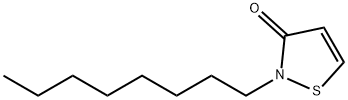
preservation; wound protectant for pruning cuts. | | Definition | ChEBI: A member of the class of 1,2-thiazole that is 1,2-thiazol-3-one substituted on the nitrogen (position 2) by an octyl group. A fungicide and antibacterial agent, it is used for treatment of canker and other fungal and bacterial diseases in fruit trees. It i
no longer approved for use within the European Union. | | General Description | Clear dark amber liquid. Used as a fungicide. | | Air & Water Reactions | Insoluble in water. | | Reactivity Profile | 2-Octyl-2H-isothiazol-3-one reacts as an isothiocyanate. Isothiocyanates are incompatible with many classes of compounds, reacting exothermically to release toxic gases. Reactions with amines, aldehydes, alcohols, alkali metals, ketones, mercaptans, strong oxidizers, hydrides, phenols, and peroxides can cause vigorous releases of heat. | | Fire Hazard | 2-Octyl-2H-isothiazol-3-one is probably combustible. | | Flammability and Explosibility | Nonflammable | | Contact allergens | This isothiazolinone, contained in relatively few products
compared to other isothiazolinones, is used in
cleaning and polishing agents, latex paints, stains,
adhesives, wood and leather preservatives, metalworking
fluids (cutting oils), and plastic manufacture. | | Safety Profile | Moderately toxic by
ingestion and skin contact. A skin and
severe eye irritant. A rmldewcide. When
heated to decomposition it emits very toxic
fumes of SOx and NOx. See also
KETONES. | | Potential Exposure | Isothiazolone/isothiocyanate/heteroaramatic
fungicide and microbiocide used on textiles, in metalworking
fluids, and some water thinned paints. Its use as
a fungicide on cotton was canceled in the United States and
the tolerances were revoked in 1998. | | Shipping | UN2922 Corrosive liquids, toxic, n.o.s., Hazard
class: 8; Labels: 8-Corrosive material, 6.1-Poisonous materials. | | Incompatibilities | Oxidizers. Contact with hydrogen peroxide
may form explosive material. Isothiocyanates are
incompatible with many classes of compounds, reacting
exothermically to release toxic gases. Reactions with
amines, aldehydes, alcohols, alkali metals, ketones, mercaptans,
strong oxidizers, hydrides, phenols, and peroxides can
cause vigorous releases of heat. Ketones behave a weak
acid. Forms water soluble alkali metal salts. Ketones are
reactive with many acids and bases liberating heat and
flammable gases. The amount of heat may be sufficient to
start a fire in the unreacted portion of the ketone. Ketones
react with reducing agents such as hydrides, alkali metals,
and nitrides to produce flammable hydrogen gas and heat.
Ketones are incompatible with isocyanates, aldehydes, cyanides,
peroxides, and anhydrides. They react violently with
aldehydes, nitric acid, and perchloric acid. | | Waste Disposal | Consult with environmental
regulatory agencies for guidance on acceptable disposal
practices. Generators of waste containing this contaminant
(≥100 kg/mo) must conform with EPA regulations governing
storage, transportation, treatment, and waste disposal.
Under 40 CFR 261.5 small quantity generators of this
waste may qualify for partial exclusion from hazardous
waste regulations. |
| 2-Octyl-2H-isothiazol-3-one Preparation Products And Raw materials |
|


 日本语
日本语 한국어
한국어 Français
 Deutsch
 España
 Türkiye