Other grades of this product :
| 2,5-Dimethyl-2,5-hexanediol Basic information |
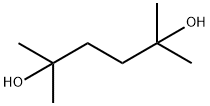
| Product Name: | 2,5-Dimethyl-2,5-hexanediol | | Synonyms: | 1,1,4,4-Tetramethyl-1,4-butanediol;2,5-dimethyl-5-hexanediol;5-Hexanediol,2,5-dimethyl-2;DiMethyl-2,5-hexan;2,5-Dimethyl-2,5-hex;2,5-DiMethyl-2,5-hexanediol, 99% 250GR;2,5-Dimethyl-2,5-hexanediol,99%;2,5-DiMethyl-2,5-hexanediol, 99.5% | | CAS: | 110-03-2 | | MF: | C8H18O2 | | MW: | 146.23 | | EINECS: | 203-731-5 | | Product Categories: | Organic Building Blocks;Oxygen Compounds;Polyols;Building Blocks;Chemical Synthesis;Organic Building Blocks;Oxygen Compounds;bc0001 | | Mol File: | 110-03-2.mol |
| 2,5-Dimethyl-2,5-hexanediol Chemical Properties |
| 2,5-Dimethyl-2,5-hexanediol Usage And Synthesis |
| Chemical Properties | white crystalline flakes | | Uses | 2,5-Dimethyl-2,5-hexanediol was used in the synthesis of six- and seven-membered heterocyclic boron compounds containing intramolecular N-B bond. | | Synthesis Reference(s) | Synthesis, p. 165, 1981 DOI: 10.1055/s-1981-29377 | | General Description | 2,5-Dimethyl-2,5-hexanediol on heteropoly acid catalyzed dehydration yields cyclic ethers via stereospecific intramolecular SN2 mechanism. It reacts with nitriles in concentrated sulfuric acid to yield Δ1-pyrrolines. | | Purification Methods | Purify the diol by fractional crystallisation. Then the diol is dissolved in hot acetone, treated with activated charcoal, and filtered while hot. The solution is cooled and the diol is filtered off and washed well with cold acetone. The crystallisation process ia repeated several times, and the crystals are dried under a vacuum in a freeze-drying apparatus [Goates et al. J Chem Soc, Faraday Trans 1 78 3045 1982]. [Beilstein 1 IV 2600.] |
| 2,5-Dimethyl-2,5-hexanediol Preparation Products And Raw materials |
| Raw materials | Nickel-->3-Methyl butynol-->3-HEXYNE-->2,5-Hexanediol-->2,5-DIMETHYL-2-HEXANOL-->2,5-Dimethyl-3-hexyne-2,5-diol-->2,5-DIMETHYLHEXANE | | Preparation Products | Bexarotene-->1,2,3,4-TETRAHYDRO-1,1,4,4-TETRAMETHYLNAPHTHALENE-->2,5-DICHLORO-2,5-DIMETHYLHEXANE-->1,1,4,4,6-Pentamethyl-1,2,3,4-tetrahydronaphthalene |
|


 日本语
日本语 한국어
한국어 Français
 Deutsch
 España
 Türkiye