Other grades of this product :
| Diphenylphosphoryl azide Basic information |
| Diphenylphosphoryl azide Chemical Properties |
| Boiling point | 157 °C/0.17 mmHg (lit.) | | density | 1.277 g/mL at 25 °C (lit.) | | refractive index | n20/D 1.551(lit.) | | Fp | >230 °F | | storage temp. | 2-8°C | | form | Liquid | | Specific Gravity | 1.277 | | color | slightly yellow | | Water Solubility | insoluble | | Hydrolytic Sensitivity | 7: reacts slowly with moisture/water | | BRN | 2058967 | | Stability: | Stable. Incompatible with acids, strong oxidizing agents. | | InChIKey | SORGEQQSQGNZFI-UHFFFAOYSA-N | | CAS DataBase Reference | 26386-88-9(CAS DataBase Reference) | | NIST Chemistry Reference | Diphenylphosphoryl azide(26386-88-9) |
| Hazard Codes | T | | Risk Statements | 23/24/25-36/37/38 | | Safety Statements | 26-36/37/39-45 | | RIDADR | UN 3278 6.1/PG 2 | | WGK Germany | 3 | | F | 3-10 | | Hazard Note | Toxic/Keep Cold | | TSCA | No | | HazardClass | 6.1 | | PackingGroup | III | | HS Code | 29299000 |
| Diphenylphosphoryl azide Usage And Synthesis |
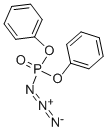
| Chemical Properties | Diphenylphosphoryl azide (DPPA) is a colorless or pale yellow liquid which boils at 134-136 °C/0.2 mmHg, and it will be stable at room temperature under shading. It is non-explosive just like the other phosphorazidate. When DPPA is stored at room temperature for a long time, it might be slowly and partially hydrolyzed with moisture in air to produce diphenyl phosphate and toxic explosive hydrazoic acid. In this case, it will be recommended to use after washing DPPA with aqueous sodium hydrogen carbonate followed by drying. | | Uses | Diphenylphosphoryl azide (DPPA or diphenyl phosphorazidate, (PhO)2P(O)N3) is a very toxic and potentially explosive organic compound. DPPA has been found to be effective for a variety of organic reactions as a versatile synthetic reagent. It is widely used in synthesis of other organic compounds especially as a reagent for the synthesis of peptides by virtue of its reactions with carboxylic acids leading to either the urethane or the amide. | | Application | Diphenylphosphoryl azide (DPPA) is a well-known azide reagent used in peptide couplings, Curtius rearrangements, and Mitsunobu inversions—is often encountered in pharmaceutical process development because it enables the most direct route to a desired product. Diphenylphosphonic azide acts as a reagent for the synthesis of peptides and phosphoramidates by reacting with amines. It is also used in the preparation of oligosaccharides linked with carbamate and urea bonds utilizing modified Curtis rearrangement. It is involved in pseudohalogen replacement of the azido group by treatment with nucleophilic reagents, such as water, butanol, ammonia, and various amines. Further, it is used as a hydroazidation catalyst for preparation of organoazides. | | Preparation | Diphenylphosphoryl azide (DPPA) is easily prepared in high yield by the reaction of the corresponding chloride with sodium azide in acetone. Combination of sodium azide and 18-crown-6 in the same reaction was reported, and the use of a quaternary ammonium salt as a phase-transfer catalyst in a biphasic phase of water and an organic solvent was also reported to be effective, as shown in Scheme 3.Diphenyl Phosphorazidate (DPPA) - More Than Three Decades LaterTakayuki ShioiriGraduate School of Environmental and Human Sciences, Meijo University | | Reactions | Diphenylphosphoryl azide, originally developed by Yamada in 1972, has shown significant synthetic versatility, being used in isocyanate synthesis, especially in the Curtius rearrangement, stereospecific conversion of alcohol into azide, as a coupling reagent in macrolactamization[4], in allylic amine synthesis, and in aziridination reactions. Diphenylphosphoryl azide, also called DPPA, diphenyl phosphorazidate or phosphoric acid diphenyl ester azide, is a colorless liquid with high boiling point (157 °C/0.17 mmHg), and can be easily prepared by the reaction between diphenylphosphoryl chloride and sodium azide in acetone in high yield. The Waldvogel group developed a reliable protocol for the large-scale (100 g) synthesis of DPPA, including purification by reduced-pressure distillation (Picture 1). A polymer-supported form of the reagent has also been developed using phenol resin by the Taylor group.
|
| Diphenylphosphoryl azide Preparation Products And Raw materials |
|


 日本语
日本语 한국어
한국어 Français
 Deutsch
 España
 Türkiye