Other grades of this product :
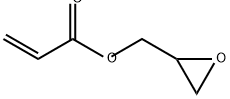
| GLYCIDYL ACRYLATE Basic information |
| GLYCIDYL ACRYLATE Chemical Properties |
| Melting point | -42 °C | | Boiling point | 60°C 16mm | | density | 1.1163 g/cm3 | | refractive index | 1.4508 (589.3 nm 20℃) | | Fp | 61°C(lit.) | | storage temp. | -20°C Freezer | | form | clear liquid | | color | Colorless to Light orange to Yellow | | Stability: | Stability Combustible. Incompatible with strong oxidizing agents. May be prone to polymerization. | | EPA Substance Registry System | Glycidyl acrylate (106-90-1) |
| GLYCIDYL ACRYLATE Usage And Synthesis |
| Chemical Properties | amber liquid | | Uses | Labelled Glycidyl | | Uses | Glycidyl Acrylate 85% can be used as an adhesive composition. | | General Description | Light amber liquid. | | Air & Water Reactions | Water soluble. | | Reactivity Profile | GLYCIDYL ACRYLATE may be sensitive to polymerizing conditions and/or catalysts. GLYCIDYL ACRYLATE will react with oxidizers. | | Hazard | Irritant to skin and eyes | | Health Hazard | TOXIC; may be fatal if inhaled, ingested or absorbed through skin. Inhalation or contact with some of these materials will irritate or burn skin and eyes. Fire will produce irritating, corrosive and/or toxic gases. Vapors may cause dizziness or suffocation. Runoff from fire control or dilution water may cause pollution. | | Fire Hazard | GLYCIDYL ACRYLATE is combustible. | | Safety Profile | A poison by ingestion,
inhalation, and skin contact. Mutation data
reported. A skin and severe eye irritant.
Flammable liquid when exposed to heat or
flame. Can react vigorously with oxidmers.
To fight fire, use foam, dry chemical, CO2.
When heated to decomposition it emits
acrid smoke and fumes. See also ESTERS. |
| GLYCIDYL ACRYLATE Preparation Products And Raw materials |
|


 日本语
日本语 한국어
한국어 Français
 Deutsch
 España
 Türkiye